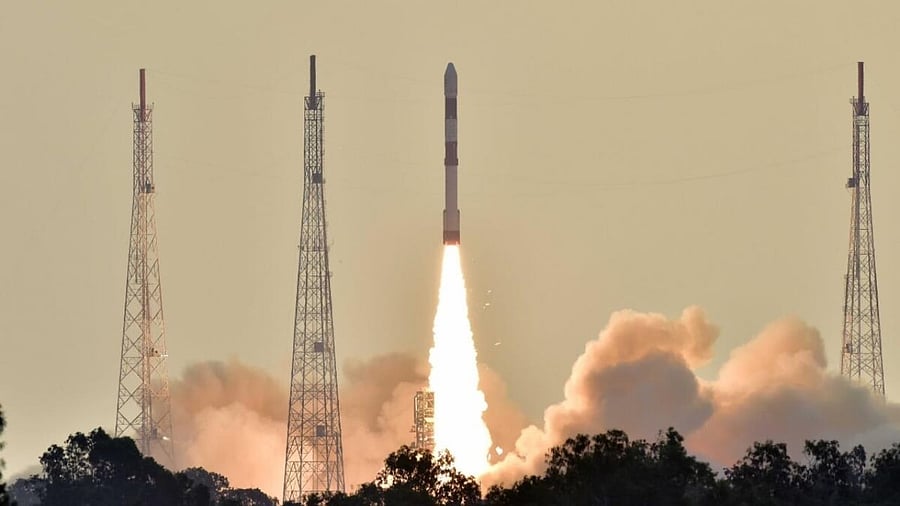
A representative image.
Credit: PTI Photo
Chennai: The first of three unmanned rocket test launches as part of Gaganyaan, the country’s first human spaceflight programmee, is scheduled to be carried out by the end of this year, Indian Space Research Organisation (ISRO) chairman Dr V Narayanan said on Thursday.
Speaking to reporters in Tirunelveli district, Narayanan said Gaganyaan mission will be launched in 2027 as scheduled with the space agency successfully conducting over 8,000 experiments, including simulations for air quality, temperature control, waste management, and emergency responses.
“The first unmanned mission will be launched late 2025, followed by two more in 2026 to validate the entire stack which includes the rocket, crew module, and re-entry systems. We are working tirelessly on the Gaganyaan mission which will send Indian astronauts to space using our own rocket,” Narayanan said.
The ISRO chief said the mission relies heavily on the Environmental Control and Life Support System (ECLSS) to ensures the safety and comfort of the astronauts during their time in orbit.
“Every test we have conducted so far has been successful. We have learned invaluable lessons to refine the technology. Gaganyaan is not about reaching space alone but it is about inspiring the next generation of scientists,” Narayanan added.
The statement by the ISRO chairman comes months after the ISRO accomplished the first integrated air drop test for the Gaganyaan programme at the Satish Dhawan Space Centre in Sriharikota.
According to ISRO, this test successfully demonstrated the objective of end-to-end performance validation of the critical parachute-based deceleration system of the crew module for the Gaganyaan mission in one of the typical mission scenarios.
"For the Gaganyaan programme, the integrated air drop test -- because when the entire module returns in the final phase almost nine parachutes have to work in a synchronised way for the proper splashdown -- so we lifted off a simulated module using a helicopter to a height of around three kilometres above the Earth. Using nine parachutes, it was successfully splashed down," the ISRO Chairman had said in October.