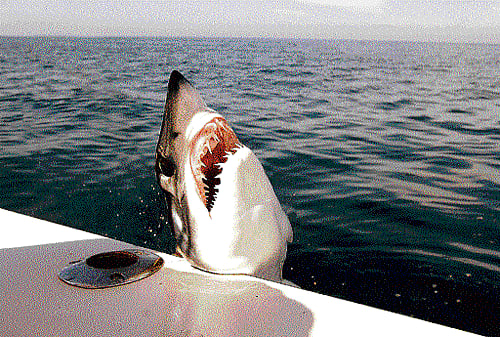
Environmentalists have had little success persuading fishermen not to kill or throw away live sharks caught in hooks, to die. Now, a contest where sharks are not killed but released after being photographed, is getting the anglers’ attention, says Jim Rutenberg.
Montauk. This seaside community is increasingly getting attention as a trendy summer playground for the wealthy, but for decades it has been known for something else entirely: killing sharks.
The shark-fishing craze started here in the 1970s with a colourful push from local angler Frank Mundus, who popularised what he called “Monster Fishing” and who was a model for the grizzled shark hunter, Quint, in “Jaws.”
Today, the docks are decorated with tails and dorsal fins of the sharks that swim these parts: threshers, makos, blues and the occasional great whites. The collection is replenished by the annual tournaments that offer pots of hundreds of thousands of dollars for the biggest sharks. The winning beast is hung by its tail, like a toothy testimony to man’s fear conquered.
Every now and then environmentalists would show up, carrying signs warning about the global decline of shark populations from overfishing and calling for an end to the slaughter. They were mostly ignored in a place where cars have bumper stickers that declare that the National Marine Fisheries Service, which regulates fishing hauls, has been “Destroying Fishermen and Their Communities Since 1976.”
But times change. And this summer, artist April Gornik and the environmental group Concerned Citizens of Montauk led a successful effort to persuade some of the most prominent shark fishermen to try something new, and they hope, lasting: a contest where not a single shark is killed.
Instead, all of the sharks caught in the contest, being held this weekend, will be photographed and released where they are caught.
Fishermen will be asked to use circle hooks, believed to inflict less damage on the fish. And they will be asked to help scientific study by attaching tracking tags to select sharks before they are let go. The winner, determined based on a point system, will receive a painting by Gornik and $6,000.
It is enough to make some of the old fishermen here wonder what is happening to the world. They lament that their friends are letting the environmentalists get to them and predict that a shark contest without a winning carcass on the dock will not be viewed as a shark contest at all by the hundreds who still come for them.
“People want to see sharks,” Jack Passie, the captain of the charter boat Windy, which ties off at the Star Island Yacht Club, declared the other day.
But for those who agree to participate, like musician Jimmy Buffett, it is a chance for Montauk to lead the way once again, this time to help preserve the shark population.
“Fishermen of Montauk are aware of one thing: The shark fishery is probably going to come to an end down the road,” said Carl Darenberg, the owner of the Montauk Boat Basin, which held one of the first shark-hunting contests in the country 43 years ago and will host the catch-and-release contest. “If you want to have fish around to catch in the future, you have to make adjustments.”
As a fourth-generation Montauk fisherman, Darenberg, 63, has extra credibility. His great-grandmother came here soon after emigrating from Sweden, having married the local lighthouse keeper. He has been around long enough to remember Mundus before he was legend. “He wanted to learn more about how sharks tick,” Darenberg said one recent afternoon at his bait shop. “And he sat there and caught them and caught them and caught them when everybody else was out catching swordfish and marlin.”
The technique was simple enough: Dump containers of chum into the water and wait for the sharks to be drawn by the wafting odour of blood. Mundus made a great show of it all the same, playing off the persistent shark phobia. Charging up to $1,800 a day, he would take his passengers - among them “Jaws” author Peter Benchley - on his “Monster Fishing” expeditions.
His weapon of choice was not a rod and reel but a harpoon attached to a series of floating barrels to wear the fish down. Some saw his techniques as silly, but the results were as plain as the 4,500-pound great white he brought to the docks in the summer of ’64. This niche pursuit suddenly took off in the 1970s because of two unrelated developments. The swordfish, marlin and tuna pursued by most sport fishermen became increasingly scarce, and director Steven Spielberg turned Benchley’s book into a hit movie.
“Jaws’ changed the world,” said Michael Potts, a second-generation Montauk fisherman and the captain of the Blue Fin IV. The town was besieged with aspiring shark hunters, and their appetite was equal to that of their prey. The carcasses piled up.
But other anglers had developed some doubts over the years, citing large sharks that were later found to be pregnant and a shift in attitudes about killing sharks - many of which are not very palatable - for sport.
Even Mundus grew concerned about the welfare of sharks. Before he died at 82 in 2008, he called for gentler treatment and more study of sharks, warning that many were being released to their deaths because hooks used to catch them caused serious injuries. He became an ardent advocate for circle hooks.
His concern caught the eye of Gornik, the artist, who had joined protesters against a shark tournament a few years ago and realised their effort just alienated the fishermen. “That mode of approach was so polarising that no one from the fishing community was going to talk about anything in between,” she said.
She teamed with Rav Freidel, an environmentalist and member of the Concerned Citizens of Montauk. A recreational fisherman himself, with strong ties to the fishing community, Freidel had himself been fed up with “seeing Dumpsters filled with dead sharks.”
Switching tactics, Gornik and Freidel began advocating for circle hooks, buying them by the thousands to distribute at the docks. It did not go well at first; the hooks they handed out were too small for East Coast shark fishing, reinforcing some captains’ wariness about their use.
But, after adjusting the giveaways to the correct size - they say they eventually handed out at least 30,000 - they raised their goal, and persuaded Darenberg to hold a circle-hook-only, catch-and-release-only tournament. Noting that other conservation efforts have helped bring back the striped bass and porgie populations, they say they hope catch-and-release will do the same for sharks.
“It’s about getting sustainable fisheries,” Freidel said. “Once the fishery is sustainable, hang the fish - I don’t care.”