
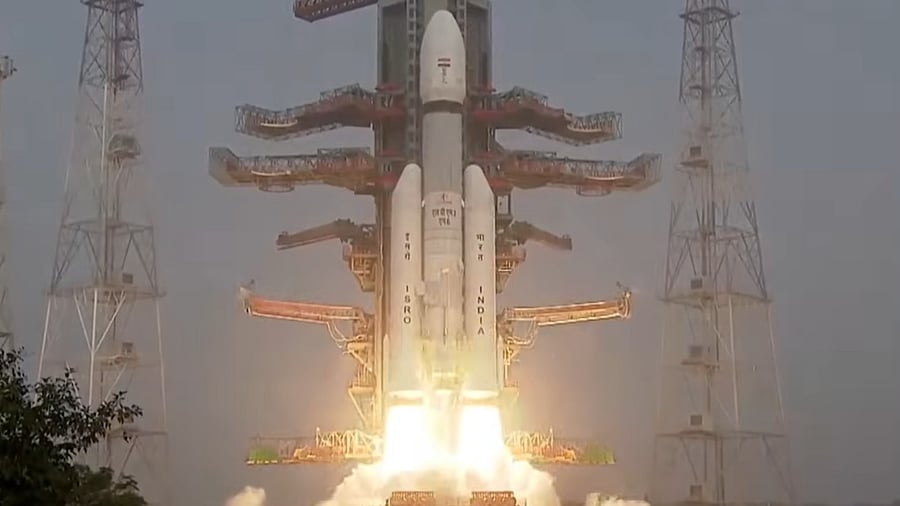
PSLV-C62 lifting off with the EOS-N1 at Sriharikota.
Credit: YouTube/@ISRO Official
New Delhi, Feb 2: India’s workhorse polar satellite launch vehicle (PSLV) may be ready for the next flight by June after multiple analyses on faults resulting in back-to-back failures of the home-grown rocket that has an excellent safety record, Union Science Minister Jitendra Singh said here on Monday.
“What happened this time (January, 2026) is different from what happened last time (May, 2025). We are carrying out an appraisal including a third party review. The next possible launch date may be in June,” Singh said.
Last month, Indian Space Research Organisation’s PSLV-c62 rocket carrying 16 satellites including a foreign earth observation satellite failed because of an anomaly in the third stage of the rocket.
In May 2025, PSLV-C61 carrying the RISAT-1B satellite also didn’t succeed because of an “observation in third stage,” the ISRO said. The failure analysis committee submitted its report to the Prime Minister’s Office, but the report has not been made public.
The minister said the causes of failure for the two failures were different, but none of future launches have been cancelled, suggesting the customers’ trust in ISRO.
He gave the analogy of a room turning dark because of a power failure. “Last time a bulb fused, this time there was a tripping outside.”
Despite the two failures within eight months, PSLV enjoys an excellent safety record of over 90% success.
“We have 18 launches scheduled this year, of which six are private. None have withdrawn the request to launch. Next year, there will be three major launches of foreign satellites from Japan, France and the USA. None have withdrawn,” he said.
Asked about the possibility of sabotage being the reason for two successive failures in eight months, Singh said, “As of now, we have not come across any such report.”
He said separate internal and external failure assessment committees have been set up to analyse what went wrong in each of the missions.
Sharing details on the budget announcements on astronomy, Abhay Karandikar, Secretary, Department of Science and Technology said the detailed project report of four astronomy proposals from Indian Institute of Astrophysics Bengaluru, worth Rs 3,500 crore, was ready and the Science Ministry would now seek the Union Cabinet’s approval to construct the telescopes in Ladakh.
The proposals include establishing a Rs 1,800 crore National Large Optical-Infrared Telescope at Hanle, Rs 800-1000 crore National Large Solar Telescope on the banks of Pangong Tso and upgrading the existing Himalayan Chandra Telescope, also at Hanle. The upgrade, sources said, would entail setting up another small telescope at the same site.