
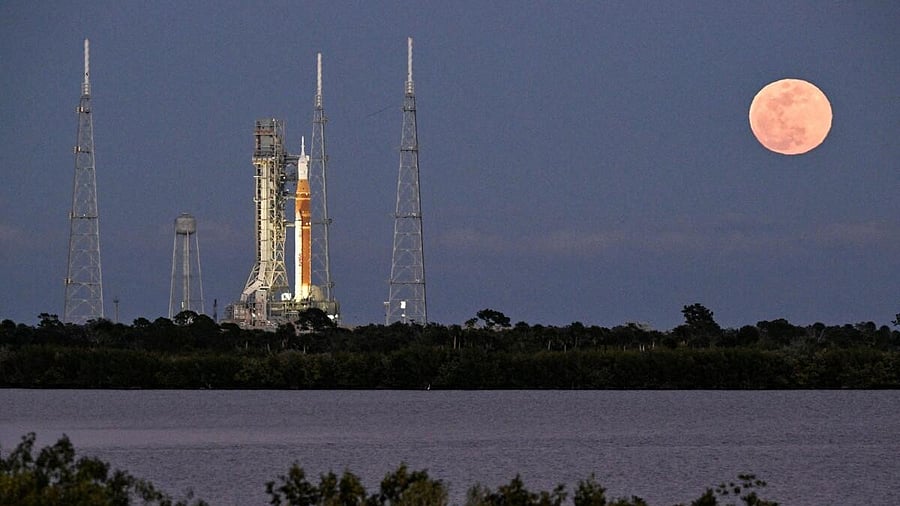
A full moon rises near the Space Launch System, with the Orion crew capsule, at launch complex 39B.
Credit: Reuters photo
Christened after the Greek goddess of the moon, the successor to the Apollo programme, Artemis, led by NASA, aims to put humans on the Earth's natural satellite.
In the first phase, Artemis II mission will take a four-member crew on a flyby of the moon. Just last week, NASA rolled out its gigantic Space Launch System (SLS) moon rocket and Orion Space Capsule to the launch pad.
This mission will sow the seeds for the upcoming Artemis missions which will eventually put human beings back on the moon.
This trip to the moon comes half a century after the Apollo missions which were successful in putting a man on the moon, paving for greater understanding of our galaxy and our universe.
As the first man on the lunar surface, Neil Armstrong said, "That's one small step for man, one giant leap for mankind." Little did anyone know, his words would prove to be so visionary as in the next century itself, the Artemis mission was launched, which aimed to scale old heights.
This Artemis II mission, which would be launched from the Kennedy Centre in United States would take the four-member crew on a 10-day trip around the moon.
Since the crew is just sowing the seeds for an eventual lunar landing, the crew onboard will be tasked with testing Orion Space Capsule's endurance.
According to NASA, the crew aboard the mission, Orion and the upper stage, called the interim cryogenic propulsion stage (ICPS), will orbit Earth twice to ensure Orion’s systems are working as expected while still close to home.
Orion will start in an elliptical orbit that will be refined to a “safe” high earth orbit of approximately 44,525 x 115 statute miles.
They will live and work in the Orion capsule, testing life support and communications systems and practising docking manoeuvres. After conducting the checks, the crew will head out to beyond the moon to check Orion's life‑support, propulsion, power and navigation systems.
During this three-hour detour, the astronauts will analyse and photograph geologic features, such as impact craters and ancient lava flows. This will be SLS' second mission into the space but it will be maiden flight with a crew onboard.
Who are the crew members
The crew includes NASA's commander Reid Wiseman, pilot Victor Glover, mission specialist Christina Koch and mission specialist, Jeremy Hansen.
After conducting a wet dress rehearsal, the American space agency will give the green light if everything is in working order. However, if during this check, NASA feels rocket is not ready for the launch, they might roll back the launch.
But if all systems are in working order, the earliest date for the launch would be Friday, February 6. There are multitude of things which need to be perfect for a launch, including the positioning of the Moon.
NASA chose to name the programme Artemis because she is twin sister of Apollo (the original Moon missions were named after).