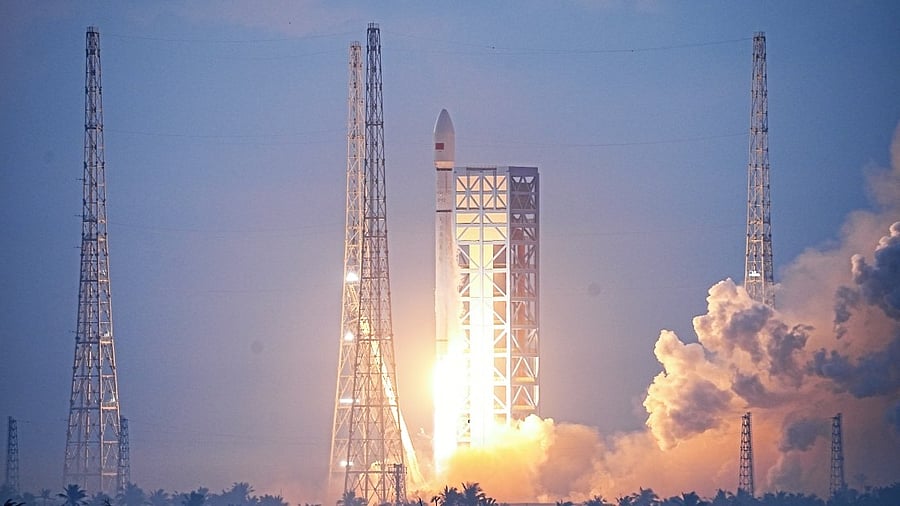
A Long March 12 carrier. (Image for representation)
Credit: CASC
Beijing: The first stage of China's reusable Long March 12A "was not successfully recovered" during the rocket's inaugural flight on Monday, according to the state-run Xinhua news agency, as Beijing looks to close the gap with US giant SpaceX.
The second stage of the rocket did successfully enter its planned orbit, Xinhua reported.
The Long March 12A's maiden flight marked China's second attempt at landing and recovering a rocket booster after launch.
China has in recent years launched dozens of rockets that deliver satellites into orbit but has yet to successfully complete a reusable rocket test, which requires the rocket's large lower section, known as the first stage or booster, to be landed and recovered after launch.
With Elon Musk's SpaceX having mastered this capability several years ago, Chinese private and state-owned rocket firms are rushing to test domestically developed reusable rockets. Reusability is crucial to lowering the costs of rocket launches, which would make it cheaper to send satellites into space. SpaceX's reusable rocket Falcon 9 has allowed its Starlink unit to achieve a near-monopoly on low-Earth orbit (LEO) satellites.
While Chinese firms have sent several hundred LEO satellites into orbit in recent years, Beijing will not be able to catch up to Starlink unless it develops its own version of the Falcon 9. The race to become SpaceX's primary Chinese challenger intensified earlier this month when private rocket firm Landspace became the first Chinese entity to attempt a full reusable rocket test with the launch of Zhuque-3, though it failed to stick the booster landing. The developer of the Long March 12A, China Aerospace Science and Technology Corporation, is a state-owned conglomerate with more than 100,000 employees and is the main rocket contractor for the country's space programme.
In contrast, Landspace operates as a startup with less than 2,000 staff.