
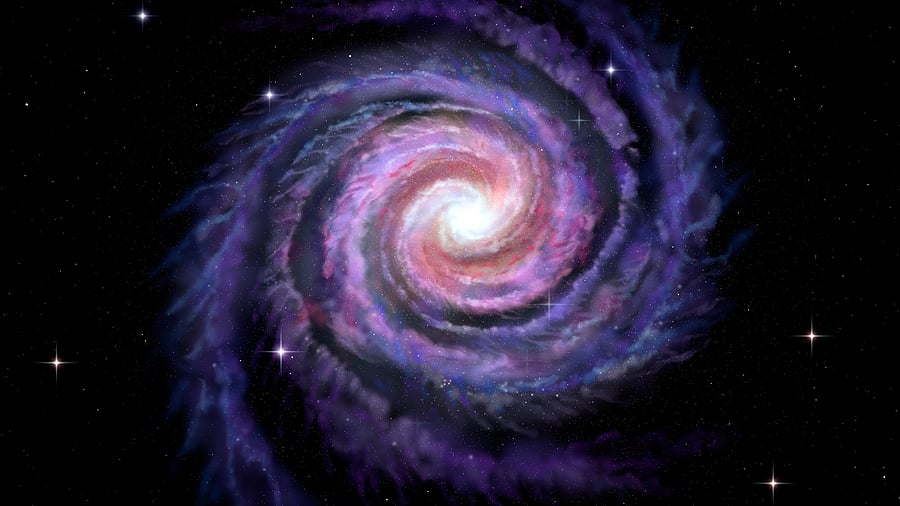
Representative image for galaxy
Credit: iStock Photo
New Delhi: Indian astronomers have discovered a spiral galaxy with an architecture strikingly similar to the Milky Way - a beautifully structured cosmic pinwheel – in the baby Universe that was only 1.5 billion years old.
The discovery of one of the most distant spiral galaxies ever observed, challenges the current theories of how quickly galaxies can emerge and acquire such complex cosmic structures.
Astronomers Rashi Jain and Yogesh Wadadekar at the National Centre for Radio Astrophysics, Pune used data from NASA’s James Webb Space Telescope to spot the galaxy that was named Alaknanda after the Himalayan river, one of the two main head streams of the Ganga.
The galaxy is so far away that its light – a billion times fainter than what naked human eyes can capture - has to travel for over 12 billion years to reach the JWST, an advanced space telescope sensitive enough to capture such faint signals.
“We’re seeing this galaxy as it appeared just 1.5 billion years after the Big Bang. Finding such a well-formed spiral galaxy at this early epoch is quite unexpected. It tells us that sophisticated structures were being built in our Universe, much earlier than we thought possible,” said Jain.
The Universe currently is 13.8 billion years old. Alaknanda was formed when the universe was just 10 per cent of its current age.
The team found that Alaknanda is an impressive cosmic powerhouse. It contains approximately 10 billion times the mass of our Sun in stars, and is actively forming new stars at a rate, which is about 20-30 times faster than the Milky Way’s current star formation rate.
What makes Alaknanda particularly striking is its textbook spiral structure. The galaxy displays two well-defined spiral arms wrapping around a bright central bulge, spanning approximately 30,000 light-years in diameter.
“This challenges all existing theories of galaxy formation. It took us 15 months to analyse the extraordinary data. While 70 per cent of the galaxies in the local universe are spiral galaxies, we have never seen one so far away,” Wadadekar told DH.
Explaining the rationale behind the name, Jain said, “Just as the Alaknanda is the sister river of Mandakini river, which is also the Hindi name for our own Milky Way galaxy, we thought it fitting to name this distant spiral galaxy after the Alaknanda river.”
Before JWST, astronomers believed that galaxies in the early Universe should be chaotic and clumpy, with stable spiral structures emerging only when the cosmos was several billion years old. The predominant theory suggested that early galaxies were “hot” and turbulent, requiring time to cool down and settle into well-formed rotation-dominated disks capable of maintaining spiral patterns.
Credit: DHNS
“Alaknanda tells a different story,” said Wadadekar. “This galaxy had to assemble 10 billion solar masses of stars and simultaneously form a large disk with spiral arms, in just a few hundred million years. That’s incredibly rapid by cosmic standards.”
The discovery adds to a growing body of evidence from JWST that the early Universe was more mature than previously thought.
The study has appeared recently in the European astronomy journal Astronomy & Astrophysics.