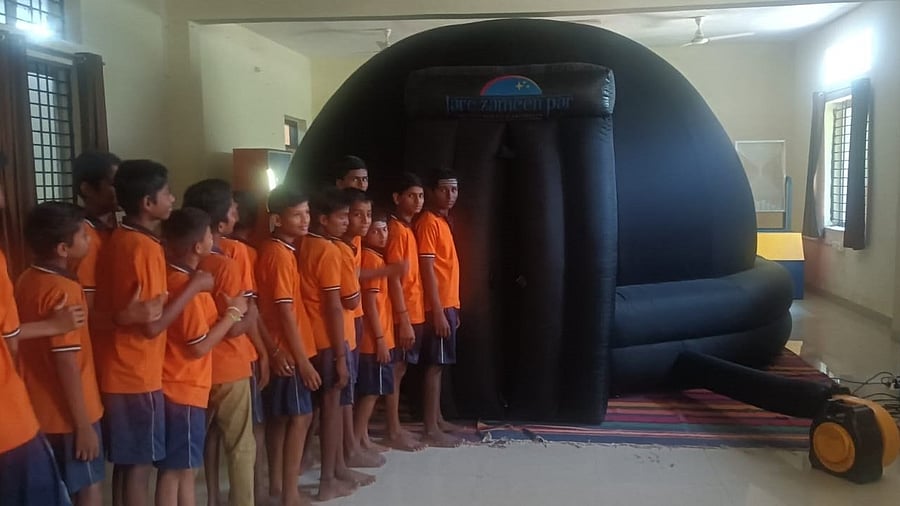
Credit: Special Arrangement
For most students, especially in rural areas, astronomy exists only in textbooks, charts and diagrams on paper. Telescopes and planetariums are out of reach, making the cosmos a mystery. Across Karnataka, the Mobile Digital Planetarium is changing that, taking starry theaters to their schools and giving children a front-row view of the universe.
Launched in 2017 by the Karnataka Science and Technology Promotion Society (KSTePS) under the State Science and Technology Department, the Mobile Digital Planetarium — Shaale Angaladalli Taralaya — programme was relaunched in November recently with upgraded technology.
The planetarium consists of a transportable dome theatre, equipped with advanced projection systems, offering students a glimpse of the cosmos.
As many as 11 customised vans have been built to carry these inflatable domes measuring 5 to 6 metres in diameter. These vans go to every school in the state, carrying high-resolution digistar projectors, sound systems, mats for seating and portable cooling units.
Once set up, the dome creates a darkened, theatre-like environment where students settle onto mats as the projection begins. The projection system spans a full hemisphere, recreating a night sky, zooming in on planetary surfaces, demonstrating eclipses and tracing comet paths, backed with educative vocal content in English and local languages. The visual content which includes topics like the birth of the universe, the milky way galaxy, cosmic life, dinosaur era and other topics of various branches of science is projected class-wise and are narrated in the form of a story. Each show lasts 25-30 minutes and can accommodate around 30 to 40 students at once. It ends with an interactive quiz and students giving correct answers are rewarded with gifts like pencils.
“For the first time, I could practically understand how electricity is produced and how a battery functions. The session was so interesting that we asked the organisers to continue it for some more time and they have promised to return with another session soon,” said Jnanavi, a Class 10 student from the Government High School in Mangala village in Chamarajnagar taluk.
Stronger buzz in rural areas
Since its inception, the programme has grown steadily and several teachers have observed a marked difference in student engagement. From 2017-18 to 2022-23 (except during the Covid years), the mobile planetarium covered 6,039 schools and conducted 42,752 shows for 15.6 lakh students. However, the operations were suspended in December 2023 following the end of five-years term of the maintenance company.
In the meantime, Karnataka Monitoring and Evaluation Authority (KMEA) assessed the programme’s impact and the evaluation report said the programme had been consistently positive, particularly in rural areas where exposure to such learning environments was limited. Thus, the project was relaunched recently with a promise of better experience.
Dheeramahendra H, headmaster of Arali Maradpalya Government Higher Primary School in Tumakuru district, said, “Students, and even teachers, often recall the planetarium experience. It has sparked scientific curiosity among the children to such an extent that we have started displaying educational videos on topics like star formation and Earth’s evolution using projectors during free periods.”
Several other teachers opined that the mobile planetarium has filled an important educational gap as explaining complex scientific concepts can be difficult in a traditional classroom.
Kumar D, a teacher at Mainahalli Government Model Higher Primary School in Koppal, added that children in rural areas rarely have access to planetariums. Bringing this experience to schools inspires them naturally. After the session, students ask more questions and begin thinking logically.
According to KMEA Director (Publication, Extension and Training) Vinay G P, the real success of the initiative lies in its ability to inspire. “Even if a single student develops interest in science after experiencing this practical, immersive show, it will be a significant achievement for the project,” he said.
Of the 11 vehicles currently on the road, seven have been deployed in the Kalyana Karnataka region. “Our aim is to reach every district and we have already requested additional planetarium units to expand the programme,” he added.
Manoz Jain, KMEA Chief Evaluation Officer, said that a good response to mobile planetariums in rural schools has encouraged the department to extend the project to all districts of the state. This, he says, will strengthen learning and ensure every child continues to experience the wonder of science.