When I was 16, I made two important decisions — I will not sing patriarchal devotional songs, even for the sake of the audience. And I will not believe in God. I simply did not have that in me, and it has remained that way. I believe in my music.
I am in my 50s now. I was once a woman. But now I am a man — a transman. I had my gender affirmation surgery in 2020. But I started living as a man, albeit in a woman’s body, in 2014.
While gender affirmation is a more acceptable conversation to have now that it was even 10 years ago, a unique challenge for me was that I’m a Hindustani vocalist.
At the start of my transition, I had no idea how it would affect my voice and my craft. The transmen I know are not singers. And I had no reference for what to expect.
I was born Sumathi Murthy. My mother, Kanaka Murthy, had a strong influence on me. She was a renowned sculptor, perhaps one of the very few female temple sculptors in the country. She was very masculine — she spoke and carried herself that way. I was always very much like her.
I began learning music when I was six. My first guru was Pandit Ramarao Naik, a direct disciple of Ustad Faiyaz Khan, exponent of the Agra Gharana. My guru can be credited with popularising the Agra Gharana in Karnataka. He would make me practise for 10 hours a day. I did that for 18 years. I was always aware of my feelings and attractions but I did not know how to express them. I only started asserting my gender and orientation when I joined activism at age 27.
I did not enjoy being a woman and all the things considered womanly. Unfortunately, in the Hindustani music sphere, women artistes are expected to dress and carry themselves a certain way. Coy, modest and falling at the feet of the ustads. I could not do it.
My biggest challenge was wearing a sari and singing. Once, when I was around 28, my sari came undone on stage after a performance. I joke about it now, but it was extremely embarrassing.
My family expected me to be married by 20-22 and have kids by 24. But thankfully I was obese, so though around 30 potential grooms came to see me, I was rejected by most. If anyone showed interest, I would let it slip that I had PCOD and I could not bear children. It sent them packing.
But in the music circles, I faced ridicule for my unmarried status. They would introduce me and say “Should we call you Kumari or Srimati?”. It was a big joke for these individuals who subscribed to traditional ideas of womanhood and musicianship, but I failed to see the humour. I did not understand how my marital status had a bearing on my music.
My unmarried status meant that invitations to perform at concerts were hard to come by. Coming out made my prospects grimmer. The biggest challenge was getting other musicians to play for me and with me on stage. Everyone was keen on staying away from me.
Sexuality journey
I was about 16 or 17 when I had my first heartbreak. I was in a relationship with a girl. I had been asking my guru for a while to start teaching me thumris, a genre of music that focuses on themes such as love, separation and devotion. He would always say it was not yet time. After my break-up, he somehow sensed that I was finally ready. He had no idea about my relationship status and I do not think he cared.
My mother’s guru, D Vadiraja, was a very different kind of man. He was the first non-toxic masculine presence in my life. He would take me along to watch films. With him I watched ‘Umrao Jaan’ and ‘Mughal-E-Azham’. These films gave me an early understanding of sexuality and gender, but of course, not in the words we use today.
My friend Famila, a transwoman, was the one who introduced me to the term ‘transman’. “Oh, you are a transman,” she told me one day. That helped me understand why I walked a certain way and carried myself a certain way, and why I felt so uncomfortable being a woman.
I was extremely close to Famila. Unfortunately, she died from suicide in 2004.
Surgery process
Though I had my surgery in September 2020, I started taking testosterone shots months in advance. My age was a concern, but my doctor did not dissuade me from doing it. His name is Dr Madhusudhan G and he leads a team of sensitive and skilled doctors who conduct these surgeries in Bengaluru.
I was not ready for the bottom surgery or phalloplasty (penis reconstruction) so I did not have that done. I never liked it. I also want to tell society that there are men without penises. There’s no need for a penis to decide who is a man. I don’t show macho masculinity. I just got my breasts, uterus and ovaries removed. The surgery went smoothly and I was put on lifetime testosterone. I was concerned about how it was going to affect my voice. I did not want to lose it at any cost.
My father decreed that I could not undergo the surgery before his death. But I knew I could not wait because I was already in my mid 40s. My mother, on the other hand, had no problem. The only question she asked was how it would affect my health. It was a valid question. I am a diabetic. So before the procedure, I had to shed some weight and get healthy.
Voice transition
Credit: DH PHOTO / PUSHKAR V
My voice is still changing. I do not know where it will go and where it will finally land. But it has been a painful and heartbreaking journey.
Sometimes, my voice is heavy and thick, sometimes it’s slightly thinner. But it has been interesting tracking the trajectory of my voice transition.
I started taking testosterone in 2019, before my surgery. But initially, it was in very small doses — 100 mg for the first three months. Later, the dosage was increased. So from January 2020, my pitch started getting lower.
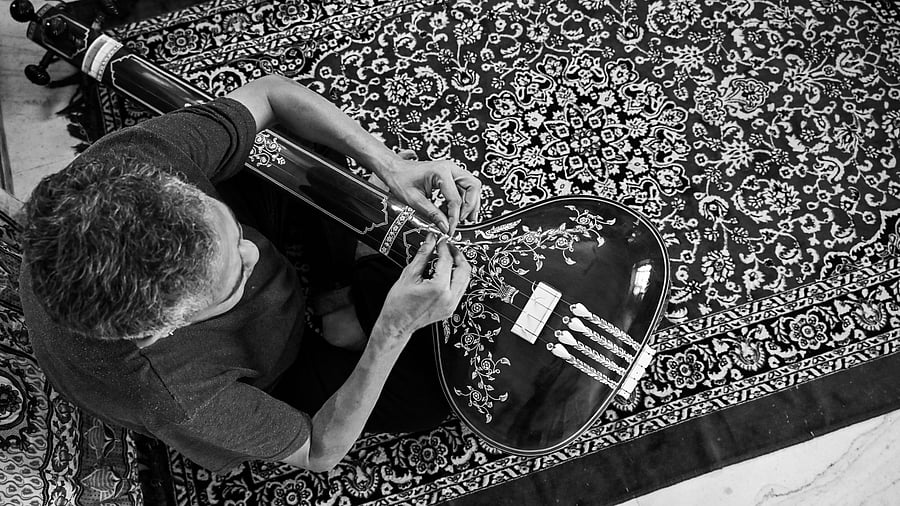
Before, notes A or A sharp were my comfort zones. When I first came down to note G, I was shell shocked. This was four notes lower than I was used to, but I was very comfortable with it. In fact, I realised I could sing lower in the lower octave. When I hit G in the lower octave, I was so happy. My voice sounded beautiful. Slowly it dropped to F and then to E. I am now able to hit D sharp. I am unable to sing in the higher pitches. My tanpura strings started getting looser and looser and eventually I had to restring it. But it was also confusing. Just when you are getting used to singing at a particular note, your voice drops further and the adjustment takes time.
In January 2021, I contracted a regular cough. I could not speak and consequently, could not sing either. I was on antibiotics and I was trying all sorts of home remedies. I would try to sing frequently but all attempts were futile. When I look back, I wonder if the loss of voice was my second puberty.
The first few months of 2021 were brutal. In April I lost a very dear friend who was a sex worker. Then, in May, I lost my mother.
It was my trans and other queer friends who were curious about my voice journey. But I think I was the first one to call it ‘voice transition’. Around this time, I took up the Reframe Fellowship in Delhi. Vani Subramanian, feminist activist and documentary filmmaker, and some of her friends introduced this fellowship for creative expression. I proposed to write a play on voice transition and the politics of music — a sort of personal narrative. It was a multi-lingual play (English, Kannada and Hindi) and even had a few musical pieces. It is called ‘Journey From A to E, And More…’. Unfortunately, I was simply unable to sing what I had written the first time it was staged. In the original script, I had written that I do not know what will happen to my voice and which direction it would take.
Between 2021 and 2023 — almost three years — I just could not sing. Even when I tried, my voice sounded so different. I did not sound like myself. I thought I had lost my talent forever. I was grasping at straws trying to hold on to it. Most of the help or advice I received did not make much of a difference. During this time, I asked for guidance from artistes like T M Krishna, Samarth Nagarkar, Shubha Mudgal,
M D Pallavi and the late Rajeev Taranath. Their inputs helped a lot.
Over the years, as I regained my voice and as it kept changing, I have had to keep tweaking the script to account for my voice changes.
I am currently in love with my voice. I have had to adjust the way I sing certain raags. I do not go for speed, but draw out every word. That is where the beauty lies. I have to thank my guru Aditi Upadhya, the daughter of Pandit Dinker Kaikini. She has a beautiful low voice similar to mine, and listening to her has inspired me.
Crisis management
In the early 2000s, I started working in crisis intervention with queer and trans people and sex workers. So I was a regular visitor at police stations. I would help connect individuals with lawyers and the police.
The community is always in need of support. I do not know how many more queer people would have killed themselves without it. I have heard of honour killings because of an individual’s queerness. It is usually associated with relationships, but no one talks about the lives snuffed out because of sexuality.
At the time, not many groups were engaged in crisis intervention, especially for female-assigned queer, trans and intersex people. It was very difficult. It has become easier now after the process became more structured following the 2014 NALSA judgment and the decriminalisation of homosexuality in 2018.
While doing crisis intervention, we would go to the police stations with a copy of the Constitution to seek justice.
Getting misgendered is something I deal with regularly. It’s an easy slip and sometimes I understand, especially when it is a genuine mistake. But some people do it intentionally.
When I was visiting police stations regularly for my work, the staff could not understand what I was. One officer was especially perplexed when I introduced myself as a transmasculine man — he thought I was a man who became a woman and then became a man again!
A year or so after I started living as a man, I was invited to perform at Vidhana Soudha for Tipu Jayanthi. I got down at the venue’s back entrance, my tanpura in hand. A police officer who I recognised from my police station visits stopped me and began yelling ‘Ey suley, illi yenu madtidiya?’ (You prostitute (slut), what are you doing here?). I was offended on many counts, but not for the reasons one might think. I told him I do not consider the word ‘suley’ an insult. It is work. But I pointed out that his assumptions were incorrect as I do not do sex work, but make music. Luckily, the organisers intervened and escorted me to the stage. Later, after learning I was a respected musician, the officer apologised to me.
Love and relationships
Credit: DH PHOTO / PUSHKAR V
I was always in love with women. But after my surgery, I started feeling attracted to men. My friend, Sunil, pointed out that I was a true homosexual! More importantly, I have started realising that I am drawn towards intellect. Gender is immaterial.
Whichever way my orientation swung, I have never believed in structured relationships. I believe in friendships, and sex is a part of those friendships.
I have known Sunil, another transman, for over 20 years, and we currently live together. But we are not exclusive.
Love is not limited. For me, it could be between three, four or even five people.
I believe this journey of attractions and desires is continuous and lasts one’s lifetime.
(As told to Rashmi Rajagopal.)