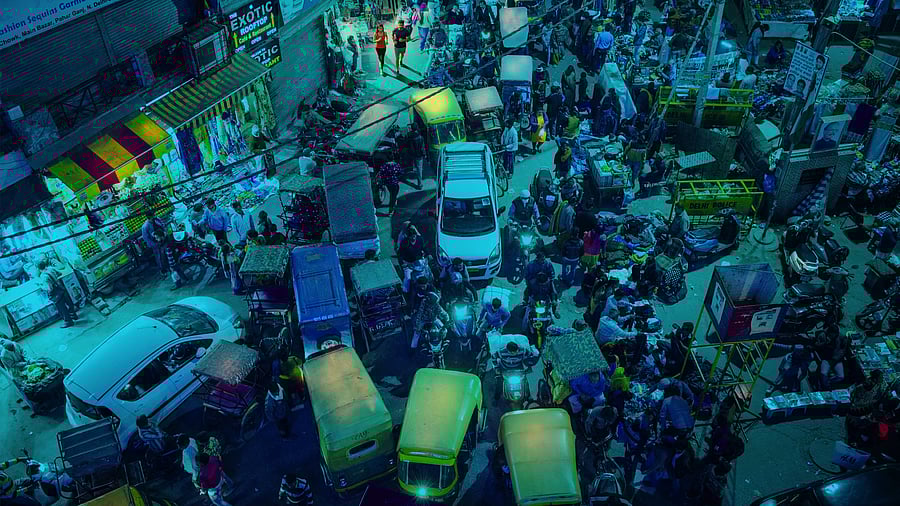
Evening traffic at Paharganj in Delhi.
Credit: DH Illustration-Deepak Harichandan
The stage is dust‑ridden. Pollution hangs like a grim curtain as pedestrians heave and sigh, searching for a footpath, that oh‑so‑mythical creature, often broken into scrappy remnants, like a flailing lizard’s tail. In India, footpaths are either missing or unsafe. Roads are death knells to cross. The right to walk is not explicitly recognised as a fundamental constitutional right, even as Article 21 guarantees the right to life and liberty.
Navigation apps routinely recommend walking routes without accounting for safety. In Bengaluru, for instance, mapping platforms frequently suggest walking as the fastest option, despite broken or missing footpaths, a risk borne entirely by the pedestrian. The absence of reliable public transport and safe last‑mile connectivity compounds the problem.
Humans walk. It is one of the most basic expressions of being alive — one foot after the other. When this most elemental act is taken away, progress itself falters. Cartoonist Paul Fernandes captures it succinctly: “Walking is what makes our cities what they are; without that, there is no city.”
A growing health crisis
India faces a growing crisis of non‑communicable diseases. Public‑health experts consistently emphasise that daily physical activity, including walking, plays a crucial preventive role. Yet in most Indian cities, the oft‑cited goal of 10,000 steps a day remains aspirational rather than achievable.
Urban planners internationally view pedestrian infrastructure as non‑negotiable. Cities such as London and New York, despite congestion, are walkable because footpaths, crossings, and public transport are treated as core infrastructure, not optional add‑ons. In India, walking remains marginal in mobility plans. Various assessments, including global walkability studies and Indian urban audits, consistently place Indian cities near the bottom, though precise global rankings vary by methodology. Mumbai, for instance, routinely performs poorly on walkability indicators, highlighting the gap between Smart City ambitions and lived reality.
Urban blind spot
Former Infosys CFO Mohandas Pai attributes this neglect to structural governance failures. “Our politicians derive power from rural areas. Parliamentary and legislative constituencies are based on population data that is nearly 30 years out of date, so urban areas are ignored,” he says.
Bengaluru illustrates the problem starkly. “We never had a full‑time mayor. Politicians and bureaucrats fear the post will become too powerful. Governance, roads, footpaths, pedestrian infrastructure, public transport — Bengaluru needs about 15,000 buses. We have roughly 7,000. We have around 100 km of metro, another 100 km under construction, but we need close to 500 km.”
There are exceptions. Mumbai’s Coastal Road Promenade includes a 7.5‑km sea‑facing stretch, with approximately 5.25 km opened in August 2025, featuring walking paths, cycle tracks, and recreational areas. Bengaluru’s TenderSURE (Specifications for Urban Roads Execution) programme redesigned streets in the Central Business District, prioritising pedestrians and utilities, and later informed Smart Cities street guidelines. Chandigarh’s sector-based design and cycle lanes, Kolkata’s integrated transport, Panaji’s colonial streets and riverfront promenades, Mysuru’s low-rise layouts, and Chennai’s footpath investments have shown results — yet most remain far from walkable. Most pedestrian‑friendly interventions have mixed but visible results. And these remain limited in scale relative to overall urban sprawl.
A daily warzone
Road safety data underline the urgency. According to government‑reported figures, India recorded approximately 1,72,890 road accident deaths in 2023. Pedestrians accounted for roughly one‑fifth of these fatalities, a proportion that has remained consistent over several years.
The scale is sobering. In absolute numbers, annual pedestrian deaths on Indian roads exceed fatalities reported in several active conflict zones globally, underscoring that Indian streets function as a daily warzone for walkers. The Supreme Court has repeatedly flagged pedestrian safety, including through audits of footpath availability and quality. However, these directives largely remain advisory. “Implementation only happens when rules are mandatory, and accountability is enforced,” says Srikanth Viswanathan, CEO of Jana Urban Space Foundation and Janaagraha.
Designed for cars, not people
Urban mobility experts agree that Indian roads are engineered for vehicles, not humans. Santhosh Loganaathan, who has worked on walkability projects across Tamil Nadu, notes: “India has among the highest pedestrian death rates globally. Attempts to redesign roads without prioritising pedestrians are a fundamental part of the problem. Footpaths are a default globally, not here.”
Indian Road Congress (IRC) guidelines mandate continuous, unobstructed footpaths —1.8 metres wide in residential areas and 2.5 metres in commercial zones — with pedestrian crossings every 200 metres. These standards are routinely ignored.
Dr Rutul Joshi of CEPT University is blunt: “Pedestrians are not the priority. In India, you walk at your own risk.”
Medical professionals see the consequences daily. Dr Thomas Kishen, a spine surgeon at Apollo Hospital, recalls treating a 70‑year‑old patient who fell into an uncovered drain on a poorly lit footpath, suffering a brain bleed and cervical spine injury. She avoided surgery but was bedridden for weeks.
Walk at your own risk
India has no national pedestrian act. While courts have linked safe walking conditions to Article 21, there is no statutory framework assigning accountability. “No department has ever been penalised for violating pedestrian norms,” says Loganaathan.
The Institution for Transportation and Development Policy (ITDP)’s Streets for People programme shows how inconsistent funding undermines progress. Chennai’s pedestrian budgets have fluctuated sharply — from Rs 90 crore to Rs 2 crore, then up again — demonstrating how gains erode without sustained commitment. “Indians walk because they have no choice, and many die doing so,” says Aswathy Dilip of ITDP.
“Our cities are over‑engineered and under‑designed,” says Dr Joshi. Roads are measured in passenger car units per hour, not human safety or comfort. Design expertise within municipal bodies remains scarce, and good design is often dismissed as elitist.
The last mile woe
Walkability cannot exist without public transport. “Public transport complements walkable corridors,” says Vivek Menon, co‑author of TenderSURE. The model prioritises pedestrians first, public transport next, and private cars last.
Parking policy is another lever. “Globally, parking is priced,” Dr Joshi notes. “Fix parking, and walking space improves.”
Safe footpaths require integrated utilities. Open stormwater drains covered with loose slabs dominate Indian streets, turning footpaths into hazards. Fully integrated utility corridors cost Rs 20–25 crore per km; without integration, costs drop to Rs 5–8 crore, but safety suffers. TenderSURE’s joint‑tendering model between municipal bodies and utility agencies addresses this. Bengaluru has implemented over 130 km of TenderSURE‑style streets, with additional corridors under construction or planning, according to Jana Urban Space Foundation.
Corruption remains endemic. “Bitumen laying is a money spinner,” says Loganaathan, pointing to election‑driven resurfacing and substandard materials.
A case study with caveats
Pimpri-Chinchwad is frequently cited as one of India’s more progressive urban mobility experiments, offering lessons for other cities, not only in ambition but also in the gaps between policy and practice.
The city’s approach is rooted in a Comprehensive Mobility Plan (CMP prepared in 2008 under national urban transport guidelines), which articulated a long-term shift toward sustainable mobility. Subsequent policy documents and non-motorised transport (NMT) strategies developed with partners such as ITDP emphasise a high share of trips by walking, cycling, and public transport over the coming decades, aligning with planning horizons extending to the mid-2030s.
On paper, Pimpri-Chinchwad has backed this intent with money. Independent budget analyses show that the city allocates one of the highest proportions of its urban transport budget in India to sustainable transport modes. In 2024–25, a substantial share of the Urban Transport Fund, variously estimated between roughly one-third and about half, depending on classification, was directed toward footpaths, cycle tracks, and related street infrastructure. This places Pimpri-Chinchwad ahead of many comparable Indian cities in terms of stated financial commitment. However, the emphasis remains uneven.
While spending on non-motorised infrastructure has increased, public transport, particularly bus services, continues to lag behind projected demand. At the same time, road-widening and vehicle-oriented projects still absorb significant capital expenditure, diluting the impact of sustainability-focused investments. Urban mobility experts consistently point to stricter parking management, expanded bus fleets for last-mile connectivity, and universal street accessibility as critical missing links.
Detailed surveys have found that a notable proportion of footpaths, across selected corridors, are present but effectively unusable, underscoring the gap between compliance with drawings and functionality on the ground. The takeaway from Pimpri-Chinchwad is therefore instructive: ambitious targets, progressive policies, and relatively strong budget allocations matter, but they deliver results only when implementation, maintenance, and enforcement are consistent and sustained.
What’s the way forward?
Deputy Chief Minister of Karnataka D K Shivakumar told DHoS: “To provide walkways to pedestrians is one of the biggest urban challenges today. This is a basic human right, and I have instructed all my officers to prioritise it. We are working tirelessly to ensure that all parks and lakes in the city have mandatory walking paths.”
Global examples show leadership matters. Paris’s shift toward a 15‑minute city under Mayor Anne Hidalgo demonstrates what autonomy and vision can achieve. Indian experts argue the 74th Constitutional Amendment must be strengthened to give cities real power. There are signs of movement. Uttar Pradesh’s Green Roads Infrastructure Scheme has allocated Rs 4,580 crore across 17 cities for 278 km of urban roads, scaling design‑led approaches similar to TenderSURE. The first such road has been completed in Gorakhpur.
Ultimately, India must invest heavily in public transport, but none of it works without walkable footpaths. “Disincentivise private transport only after building trust in public systems,” says Viswanathan. “Once people trust that they can live, work, and move safely without a car, walking becomes inevitable and safe.”
Until then, India remains a country where people walk because they must, not because they can.