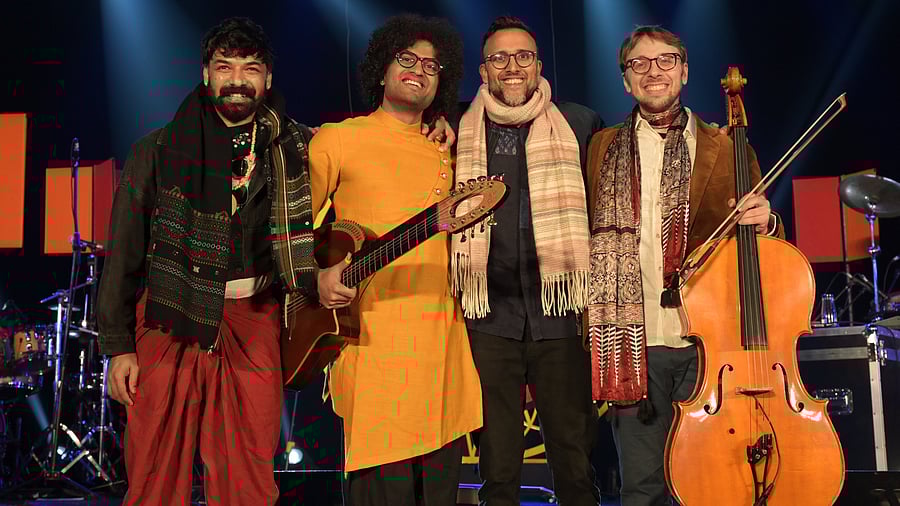
The Aditya Prakash Ensemble at a festival in Varanasi.
Credit: TEAMWORK ARTS
Their music is a celebration of diverse musical genres. At the Mahindra Kabira Festival, held in Varanasi last December, the Aditya Prakash Ensemble presented a set list anchored in the poetry of Kabir. Yet, the repertoire included Karnatik and Hindustani raga-based compositions, rhythmic detailing, and instrumental melodies — some familiar, some new.
The voice of lead singer and founder Aditya Prakash, who currently works between Los Angeles and Chennai, anchored the performance. Equally fundamental to the band’s sound were renditions by Chris Votek on the cello, Vishnu Ramprasad on the navtar, and Sumesh Narayanan on multi-percussion. A raga-tanam-pallavi-esque composition by Prakash in raga Keeravani, a memorable Naiharwa in which Votek’s cello played a key role, Ramprasad’s melodic storytelling on the navtar (which he has invented to access the musicality of the veena, sitar, sarod and guitar in one instrument), and rhythmic detailing by Narayanan through konnakol, mridangam, cymbals, cajon and other percussion instruments were hallmarks of the concert. The band’s unified voice spoke volumes of the rigour and flexibility of each musician’s practice.
The band, formed in 2011 when Prakash was in college, comprises a shifting set of musicians from across backgrounds and locations. Their three albums — ‘The Hidden’ (2012), ‘Mara’ (2016), and ‘Diaspora Kid’ (2020) — reflect the varied musical influences that shaped the founder’s formative years, growing up in Los Angeles while learning Karnatik music in India. ‘Diaspora Kid’ brings together rock, alternative, hip-hop, indie folk, and more than one form of Indian classical music.
The ensemble was never intended to be “a fusion band” but a place “to discover new musical material”, says Prakash. While studying ethnomusicology and navigating his training in Karnatik music, he was surrounded by musicians from different musical worlds. Initially connected by “the rigour of practice and a shared obsession with listening to great masters”, they started jamming together. Soon, their collaborations were presented “on stages, in jazz clubs, and at festivals and homes.”
Initially comprising fixed members, the ensemble later became “more fluid”. The prerequisite to collaboration is “a shared sensibility, deep listening, comfort with uncertainty, and respect for source traditions without feeling constrained by them,” he says. For him, “the goal of performance is not perfection” but “staying present and learning to lean into imperfections.”
He explains, “Stepping outside a familiar framework opens up a larger field of possibilities. You develop a deeper understanding of your own voice. If approached with respect and curiosity, diverse training brings strength and gives you more tools to express who you are musically.”
Prakash is looking forward to more performances with the band in India and abroad this year. “Smaller versions of the band” and more music anchored in Kabir’s poetry are on the cards.