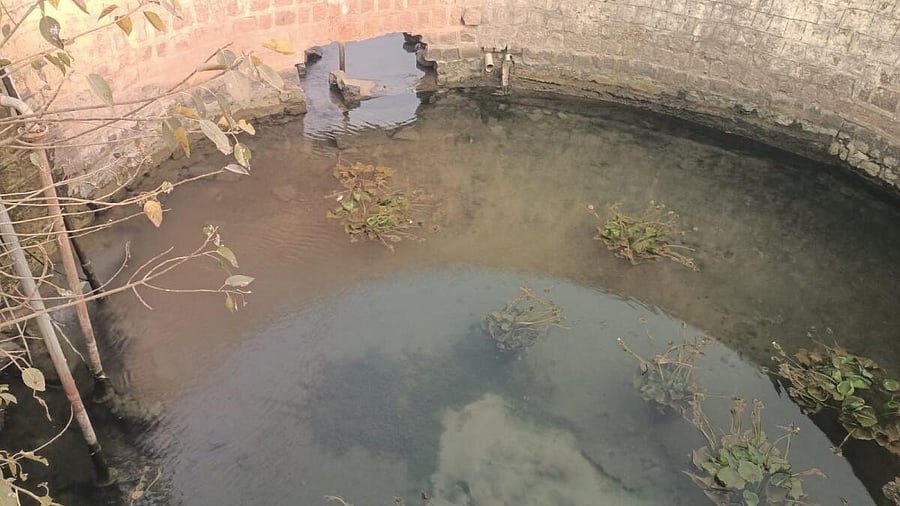
The natural water spring at Vajjala in Yadgir district
Credit: DH Photo
When we think of natural water springs, the mind usually travels to misty hills and forested ghats. Far less attention is paid to springs in the plains, which have played an equally crucial role in sustaining life for millions of years. The Hunasagi–Baichbal valley of Yadgir district is one such landscape. Here, seep springs and water pools have supported continuous human occupation since prehistoric times.
The major water body that has sustained life here is the Hunasagi stream fed by several shallow streams, including the Baichbal stream. The southwest monsoon, between June and September, replenishes the stream and smaller water bodies. But once the rains cease, the area would quickly dry up — were it not for two enduring features: perennial pools in the stream beds and seep springs.
These pools, often formed at bends and meanders, can be seen at Maralbhavi, Kupi, Fatehpur, and Kembhavi. Seep springs originate from places where sedimentary formations meet underlying Archaean granite-gneiss, at Mudnur, Vajjala, Maralbhavi, Hagartagi and other villages. Even today, these pools and springs not only provide clean drinking water but are actively used by local communities for agriculture during the dry season.
Some springs at Mudnur, Vajjala and Kalagi (in adjacent Kalaburagi district) are surrounded by temples built in the 12th century by the Kalyani Chalukyas. These sacred sites reflect the importance earlier generations placed on conservation. “Springs at Isampur and Vajjala feed the Hunasagi stream throughout the year, while those at Mudnur sustain local drainage channels. These springs provide a reliable source of fresh water once the monsoon ends, making them central to both past and present habitation,” says S K Aruni, a Shahpur-based history researcher.
Geological antiquity
Archaeologists note that the springs in the Hunasagi–Baichbal basin are not a recent phenomenon. “Extensive travertine deposits, over three metres thick, are found at Devapur, Kaladevanahalli and Mudnur. Formed by long-term spring activity, these deposits show that the springs existed even in prehistoric times,” says archaeologist K Paddayya, who has extensively studied early settlements in the region.
According to him, the consistent availability of water enabled continuous human presence over millions of years. “By the Lower Palaeolithic period (3.3 million to 0.3 million years ago), humans had developed stone-tool technology. The Hunasagi–Baichbal tertiary amphitheater-like basin, with its perennial water sources, limestone for tools, gentle terrain, abundant food and low surrounding hills, provided an ideal environment for long and uninterrupted occupation,” Paddayya explains.
He adds that early communities adapted their settlement patterns to the seasons: during the wet season, they spread across the valley, while in dry months they concentrated near springs and pools. Large animals that visited water sources were hunted during the dry season, while plant foods and small animals became a dietary staple when resources were plentiful.
Today, these springs continue to nurture local communities. “Water from a spring at Devapur is supplied to part of Hunasigi town, while another one serves villages like Vajjala. The Hunasagi stream waters nearby fields in an otherwise dry area,” says Nagappa Hadikyal, a former government officer involved in local water projects.
He adds that while water could be supplied from the left bank canal of the Upper Krishna Project, which is just 15 kilometre away, locals prefer spring water as it is sweeter and available year-round.
Mohanchandra Huddar, an Ayurvedic doctor and history enthusiast, citing Paddayya’s studies, says that the valleys once supported savannah woodland with dense gallery forests along streams. They had nearly 50 species of wild plant foods — leafy greens, fruits and berries, indicating a rich and varied plant base for prehistoric communities. Fossilised bones of cattle, horses, elephants and deer show that wildlife was also plentiful.
In the subsequent agropastoral period, humans developed simple water-storage systems, similar to check dams, to harness spring water for agriculture. But today, forest patches and medicinal plants that grew naturally around springs have shrunk substantially, he says.
“Until a few decades ago, crops here were cultivated through natural farming. Seasonal crops were irrigated by spring water, but with Krishna-based irrigation, farmers switched to water-intensive paddy and chemical inputs, polluting smaller streams. This large-scale shift towards paddy has also affected the crop diversity in the area, degrading soil health,” Huddar observes.
He adds that drainage water is also being released into the Hunasagi stream, impacting the entire habitat. “Though the spring water emanating from the aqueduct is clean, water in the stream and in the structures built around the spring to regulate and trap the water, are getting contaminated. These anthropogenic pressures threaten a valley that has sustained life for millions of years,” he says, urging government authorities to step in.
While the springs and pools continue to act as significant geological features, ecological refuges and anchors of one of the Deccan’s longest records of human occupation, their importance remains largely unrecognised. Few studies have explored these springs and the streams they feed, or examined ways to promote sustainable water and agriculture practices for the valley’s future.