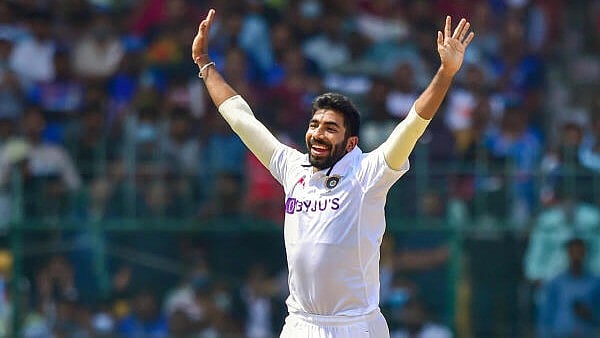
Indian bowler Jasprit Bumrah
Credit: PTI Photo
Sydney: "India is an absolute eye-opener," exclaims Stuart Clark.
The former Australia pace bowler isn't talking about the struggles he had while bowling on Indian pitches though.
For Clark, India is more than just a cricketing destination -- it’s an experience and a revelation. While his professional encounters with Indian pitches were less than memorable, Clark’s connection to India extends far beyond the sport, rooted deeply in his Anglo-Indian heritage and enriched by his personal explorations of the country.
Clark is candid in admitting his challenges as a fast bowler on Indian soil, especially in Test cricket.
“I massively struggled in India. I only played two Tests over there but I think I got one or two wickets,” he tells DH, reflecting on the difficulty of bowling on flatter, low-bouncing pitches. With minimal margin for error, he found adapting to Indian conditions a formidable task.
However, while his Test record in India might be modest, Clark fared better in the shorter formats. “I did okay at one-day cricket and things like that,” he adds.
Clark’s father was born in Madras (now Chennai) and studied at Christchurch Anglo-Indian High School, while his mother, with connections in Kolar, was born in Kerala. Their paths crossed in Chennai before they eventually settled in Sydney, where Clark grew up in a close-knit Anglo-Indian community.
“I grew up in an Anglo-Indian house… All mom and dad’s relatives are in Sydney as well, in the same sort of area,” he shares. His upbringing immersed him in Indian culture and cuisine, fostering a lifelong love for Indian food.
“I still do (love Indian food). I never had any dramas going to India. No stomach upsets,” he jokes.
Though it’s been a while since Clark visited India, his impressions of the country have evolved. He notes how cities like Mumbai, Chennai and Bengaluru have embraced modernisation while retaining their unique charm.
“They are very westernised now and they are great fun,” he observes.
But it’s not just the modernity that captivates him -- it’s the contrasts and surprises that make India an eye-opener. Clark recalls an early trip with his wife, where a drive through Mumbai showcased the unexpected: a man riding a camel alongside buses and luxury cars on Marine Drive.
“I said, 'that’s not something you’ll see in Sydney every day.’”
For Clark, India embodies a spirit of discovery. “I’m a big believer in reading, learning, and seeing different things,” he says, encouraging others to embrace the unfamiliar. “If you want an eye-opener in something different, go and do it nicely. Don’t do it the hard way. But yeah, great place, great fun.”
The conversation naturally shifts to Jasprit Bumrah, a name that has been on every cricket enthusiast’s lips during the ongoing Border-Gavaskar Trophy in Australia. His performances have been nothing short of phenomenal, leaving Australian players and fans alike in awe.
“Oh, look, he’s arguably the world’s best fast bowler now,” begins Clark. “And his record in this series has been unbelievable. He’s picked up wickets everywhere. Just world class. I don’t know what else I can actually say other than that. I know there’s been some discussions about whether he is the best Indian fast bowler of all time. He is well into those discussions. Whether he is or not, that’s a big issue.”
When pressed on what sets Bumrah apart, Clark doesn’t hold back his admiration.
“He’s a bit different,” Clark explains. “Like his action is obviously different. He’s a bit unique. Great wrist position, good pace and carry. Durable. Seems to be able to bowl lots and lots of overs. But just gets the ball in the right spot a lot of times. And makes the ball move both ways.”
For a bowler with an unconventional action and a relatively shorter stature, Bumrah’s ability to maintain precision is remarkable. Clark marvels at this trait.
“Well, it’s unique, isn’t it?” he says. “He has got amazing control. And he’s got amazing control in all three versions of the game. He’s a world-class T20 bowler. We will see what he does in the next few years. But he’s got great consistency. And yeah, look, it is unique. But if you look closely, at the point of release, his wrist is perfect. And he gets the ball to go where he wants it to go. And he’s got that hyperextension and all the rest of it. But I marvel. All of us sit there and marvel at how good he actually is. And how much he makes the ball move around.”
Addressing doubts about Bumrah’s bowling action, Clark is firm in his defence.
“No, I’ve got no issue with his action,” he states categorically. “People say that… I’ve read the stories. He doesn’t straighten his elbow, he hyperextends it… He’s got a lot of whip. And that’s where the hardness comes. That’s why he’s difficult to play. He’s got so much whip through his wrist and through that action.”
While Bumrah earns glowing praise, Clark is less convinced about the rest of India’s pace attack. “I think, they’re probably a bowler or two down, like Bumrah,” he notes. “If you think about it, without Bumrah, what would they have done? So, you know, he’s basically carried the attack. Even (on the fourth day of the Boxing Day Test) when Australia was struggling, Marnus (Labuschagne) was trying to shield Pat Cummins from Bumrah. He was happy for him to face everyone else except for Bumrah.”
Reflecting on India’s pace resources, Clark adds, “He’s two-thirds of the attack. (Mohammed) Shami he’s been injured but he is a bit older now too. But India, they’ve got a lot of fast bowlers coming through as we’ve seen, but are they conditioned to do what he (Bumrah) does and play days and days of Test cricket? Probably not as yet. So, you need to find more Bumrahs. You’re lucky to have one Bumrah, you need to find more.”