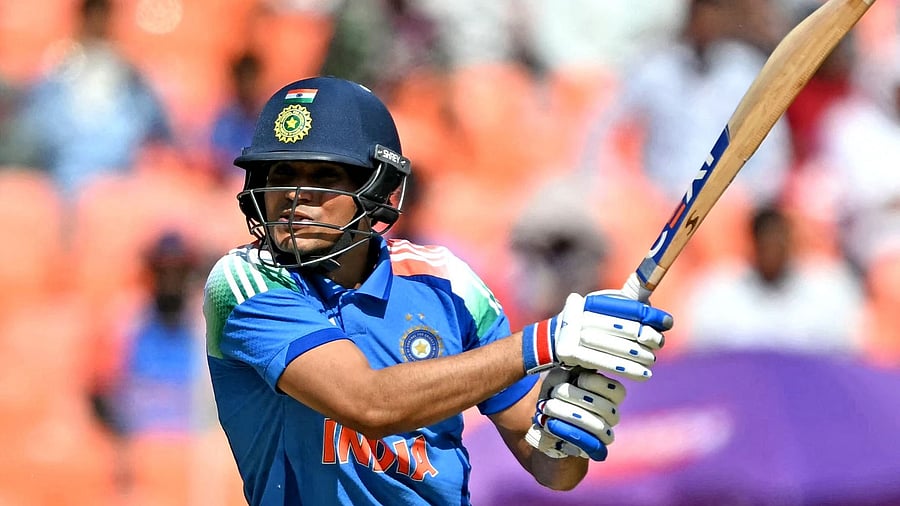
The inability of Shubman Gill (left) and Shreyas Iyer to dominate spinners during the just-concluded New Zealand ODI series has yet again brought to fore the Indian batters' struggles against the turning ball.
Credit: PTI Photo
New Zealand often used to be India's bugbears in ICC events as the 7-10 win-loss record across three global events (50-over and 20-over World Cups and the lone World Test Championship final) shows. Alarmingly, this scourge has extended to bilateral series at home too. Two of India's long-held proud records have been obliterated by the Kiwis in the last 14 months. In November 2024, they inflicted a 3-0 whitewash for their first-ever Test series win in India. The Black Caps followed it with another first -- an ODI series win on Indian soil when they completed a 2-1 win in Indore on Sunday.
The Indian batters’ struggles against spin, particularly in Tests, have been discussed ad nauseam in recent years following their repeated losses to visiting teams on turning tracks. What used to be a setback in an odd Test in a series has now grown into a major weakness, which saw them plummet to two series losses at home in about a year, against New Zealand and South Africa between November 2024 and November 2025.
In the just concluded ODI series against New Zealand, this shortcoming was once again exposed by Kiwi spinners. This time, however, it was not just the batters. Indian spinners, too, just as during the South Africa Test series, came into sharp focus as they struggled to have any impact on Kiwi batters. While India have been exceptional in T20Is, they seem to struggle as the format gets longer.
The warning signs have been there for a while, but little has been done to address the issue at any level.
The twin problems stem from domestic cricket, where you do not have a whole lot of quality spinners, the majority of whom now develop their skills to suit the T20 format in the hope of joining the IPL bandwagon. Because there are no quality spinners, you do not see many batters who can tackle high-class spin bowling. It is a classic chicken-and-egg case because we do not know which problem led to the other, but there is a big issue at hand and of that there is little doubt.
Blame it on pitches or lack of confidence, we have seen a trend with the majority of domestic captains whose utilisation of spinners has been debatable. They are often used as a control mechanism rather than attacking options, and the fields are set in such a way that a spinner has to bowl defensive lines at the cost of high trajectory, revs on the ball and variation. These are bad habits that do not survive the test of time.
“I know a left-arm spinner who does not bowl without midwicket and long-on fielders for a right-hand batter in red-ball cricket. So understand the problem,” says former India batter Vijay Bharadwaj.
The two spinners Kuldeep Yadav and Ravindra Jadeja whom India employed in the ODIs against New Zealand could not contain the Kiwi batters, led by their nemesis Daryl Mitchell. While Kuldeep struggled for rhythm, Jadeja’s limited arsenal was not enough to keep a well-prepared Mitchell and company quiet in the given conditions. They swept, reverse swept and stepped out, and the accomplished duo had no answer.
“Did you see how many hundreds were scored in the Vijay Hazare Trophy this time?” asks Bharadwaj when asked about the lack of a quality supply line. “How do you expect spinners to do well in these conditions and how do you expect them to develop? They focus more on drying up runs rather than taking wickets. If that is one side of the problem, batters get false confidence about their game. While I am not undermining any of their efforts, there has to be some balance in playing conditions where both sets of cricketers develop into quality players,” he offers.
Bharadwaj, who grew up in an era when Indian batters could play spin blindfolded, was obviously referring to Indian batters’ inability to dominate New Zealand spinners.
“Where is the sweep, where is the footwork?” he wonders.
Again, barring a few exceptions, historically the sweep shot has never been a trusted weapon for Indian batters. While we have seen the Tendulkars or the Dravids, among many others, employ the sweep, it was never their primary mode of defence or run-making option. Blessed as they were with nimble footwork, the batters of the not-too-distant past did not necessarily have to rely on sweep or reverse sweep to dominate spinners. That halo has been broken now, and didn't require a Shane Warne or a Muttiah Muralitharan, both of whom struggled in India; the Santners and the Harmers have accomplished that task.
So how do you expect someone like Virat Kohli or KL Rahul to develop the sweep and reverse sweep at this stage of their careers, especially given the success they have enjoyed batting the way they do?
“This is the argument I keep having always," Bharadwaj says. "The game is evolving, so you too have to. You saw Kohli against spinners in the third ODI. He played them smartly, but could not dominate with his method. Of course, he has the ability to make up for that as he goes on, but we cannot be rigid about learning new skills. Again, there is a difference between technical change and technical adjustment. It does not require you to change your whole setup at the crease. It is just about making a small adjustment in technique and a big change in mindset,” he explains.
“If the traditional method is not working, go for an unconventional approach. Sweep, reverse sweep or whatever it takes to upset a spinner’s lines and lengths. Do not allow him to bowl the way he wants to. This is the exact opposite of what we did against New Zealand. They were not great spinners, but they were smart enough to choke the batters for runs. But this comes only with hours of practice. You cannot just go into a match and decide to sweep. Mitchell worked on these skills for one month before coming to India, and see how he is batting, look how well he controlled the middle overs.”
Middle overs in an ODI, typically from 16 to 40, are crucial, and whoever controls this phase always stands a better chance of winning the match. While the first Powerplay sets the tempo for an innings, the following consolidation period up to over number 40 often sets up the game. With only four fielders allowed outside the 30-yard circle, spinners have to be precise as they bowl a significant chunk of these overs. The numbers show that this is where India lost the plot, once while batting first in the second ODI and then while chasing in the final ODI.
In the second game, where India managed a mere 112 for 4, New Zealand plundered 163 for 1. In the third, India improved to 148 for 2 but were still well inferior to New Zealand’s 167 for no loss. The only match India won, the first ODI, they scored 147 for 3 as opposed to New Zealand’s 136 for 5.
Cricket has always been a batter’s game, and even more so in India. Sometimes, however, batting failures mask the bowlers’ lack of success, but India can keep overlooking this mess only at their own peril.