
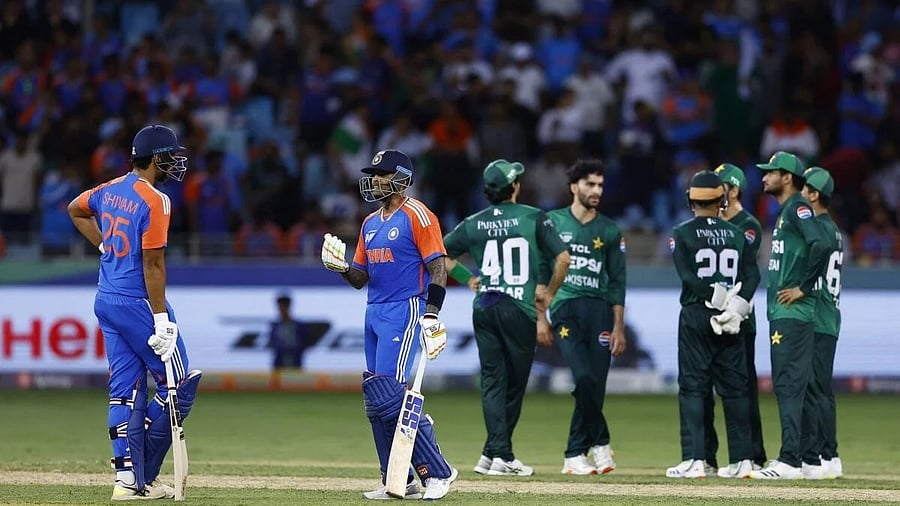
A representative image showing India and Pakistan cricket team.
Credit: Reuters Photo
By Sharda Ugra
To understand the entanglement of sport with politics worldwide, we need not return to the US boycott of the 1980 Moscow Olympics in protest to the Soviet invasion of Afghanistan. Or the rebound Soviet boycott of LA1984. In this century, politics arrives not through boycotts but through administrative neutrality, selective sanctions, and carefully worded exemptions. The Milan-Cortina Winter Olympics, which begin on February 6, are a textbook example.
Athletes from 93 countries will compete across 16 sports, yet two countries – Russia and Belarus - are missing from the list of participating nations. Their athletes will compete as ‘Individual Neutral Athlete (AIN), a category with its own anthem and flag. The Russian and Belarussian flags and anthems will neither be seen nor heard at the Winter Games. The reason? The International Olympic Committee (IOC) cites Russia’s invasion of Ukraine in February 2022 was a violation of the Olympic Truce, the period between the 2022 Winter Olympics and Paralympics. (Belarus’ support of Russia has earned them the same strictures). Every Olympic Truce lasts approximately two months, begins seven days before the start of an Olympic Games and comes to an end a week after the end of the Paralympics Games.
Major team sports like football, ice hockey, rugby, cycling, volleyball, basketball have also banned Russian and Belarussian teams/ clubs competing, as have individual sports like tennis, athletics, swimming, gymnastics among others. They allow Russian and Belarussians to compete but without displaying national flags, either on their person or against their names. Ukrainian athletes, tennis players most prominently, have refused to shake hands with their Russian or Belorussian opponents.
It must be noted here that athletes from Israel have taken part in the Paris Olympics and will also be competing in Milan-Cortina. During Israel’s continued bombing of Gaza. Palestine also happens to be an IOC member with its own independent national Olympic committee. Regardless of Israel’s formal acceptance across sporting bodies, there have been protests against the country’s club and national teams in basketball and football over the last 12 months, in Amsterdam, Bologna, Thessaloniki and Udine. Maccabi Tel Aviv fans were barred from attending a Europa League match in Birmingham vs Aston Villa. There were protests at basketball events in Amsterdam featuring Israeli clubs. Civil society organisations like the nine-country Game Over Israel calling for Russia-style sanctions on Israel due to the Gaza genocide.
This long, unbroken history over decades shows us that world sport has progressed into the 21st century with politics by its side – maybe not as a travelling companion but certainly as a fellow passenger. International conflict and national compulsions have given rise to friction, but mostly at an institutional level between sporting governor bodies and national governments. Athletes remain trapped between the consequences of conflicts and regulations.
However, the current four-way churn in South Asian cricket is a unique kind of political entanglement whose over-heated stew includes regional relations, domestic politics, social media pressures and sport. It involves three boards: the BCCI as one of two hosts, the second, the Bangladesh Cricket Board (BCB) a participating nation that has withdrawn from the competition. The third, Pakistan Cricket Board, has taken on an active role as BCB ally and finally, the sport’s global ruling body, the International Cricket Council (ICC).
If cricket was a professional and seriously-run sporting body of a big money sport, the problem could have been solved simply. A player is asked to withdraw from a domestic event (starting six weeks later) in one of the two host nations, due to fears around individual safety. This leads his home board to express concerns about the safety of their team as a travelling group. They ask for their matches to be relocated to the second host nation.
Only two logical solutions present themselves. Either the security situation be re-assessed and the single Bangladeshi national be informed that the worry about his safety was inaccurate and there is no such threat as of today. Which implies that his national team is now safe to travel in the same country over the next few weeks.
Or ICC officials, their neutrality and professionalism on high beam, then work overnight to re-jig schedules and itineraries with minimum disruption to the second host nation. The ICC did neither. What followed was not the politicisation of sport, but the abdication of governance.
To remark in horror that X, Y or Z board/ individual “politicised” the cricket World Cup is naivety. Culture, society, politics forms a part of south Asian cricket more than anywhere else in the world because to the region’s four major cricketing nations that have reinvented its boundaries and landscapes, it matters more.
Of the three boards currently squabbling, politics is directly tied into the constitutional framework of the PCB and to a degree, of the BCB. The Prime Minister of Pakistan is the patron of the PCB. Mohsin Naqvi, appointed on the PCB’s governing board by an acting PM in Jan 2024 elected Chairman a month later, is the country’s Interior Minister. Bangladesh’s National Sports Council, a government body, appoints five councillors and directors on the BCB. The BCB president is elected by those directors and the government can control cricket board high-ranking appointments.
Add these facts, alongside the decisions taken by the BCCI regarding PCB and BCB over the last six months, view those decisions through its prism of messaging to domestic constituencies in all three countries, amped by their social media followings. The issue of participation/ non-participation on the surface is a cricketing matter. The frequency on which decision-making around it is now happening, though, is political.
No matter Indian cyberspace’s support of the decisions about Mustafizur and handshakes, this open hostility was received and felt directly by not just Pakistani and Bangladeshi social media communities but most sharply by their political establishments. Neither the men at the top of BCB and PCB could afford to ignore the slights given their own domestic audiences. Their response was not going to be timid.
It is why BCB, refusing to be dictated to, pulled out of the T20 World Cup. PCB/ Naqvi stepped in as an unexpected ally in order to re-ignite the Asia Cup discord. It is why the Pakistan government said they would not play the T20 World Cup match against India. This is not retreat but escalation. Pakistan’s response is gambling-speak. So you won’t shake hands? Okay, we’ll raise you to a full forfeit.
In comparison to PCB and BCB’s direct connection to the government of the day, the BCCI’s constitution and its tax-free ‘private body’ status has not led to pristine professionalism. On the ground, starting with the 2023 ICC World Cup, through its big-event ops and narrative-control, the BCCI’s priorities lie in constantly signalling loyalty to political power, rather than taking decisions in the service of the sport. The influence of unipolar political power on Indian cricket has never been so pronounced. When the Mustafizur story broke, Indian journalist and foreign policy expert Suhasini Haider noted on X, “with neighbour after neighbour, the government allows social media campaigns to overpower its diplomacy.”
The stew is smelling bad because too many ingredients have been tossed in without care: ICC’s weak governance, politically-attuned signalling from the BCCI, reactive posturing from BCB and PCB, and the accelerant of social media outrage into a mix on a high flame. And everybody knows who started the fire.
(The writer is a Bengaluru-based author & senior sports columnist)