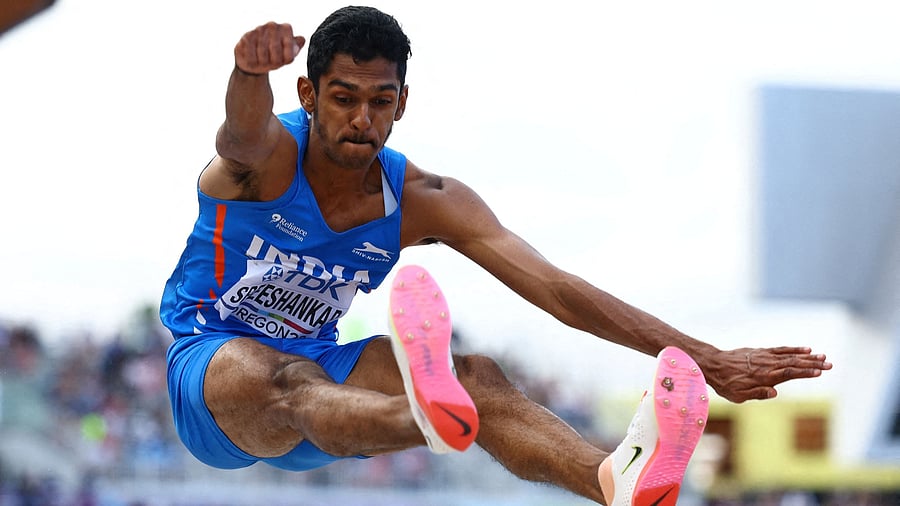
Long jump athelte Murali Sreeshankar in action.
Credit: Reuters File Photo
Bengaluru: A couple of years ago, World Athletics thought it had found a clever fix for one of long jump’s most frustrating problems: the endless stream of foul jumps.
The idea was simple on paper -- replace the unforgiving take-off board with a 40-centimetre “take-off zone” and measure the jump from wherever the athlete actually leaves the ground. This wasn’t a random brainstorm either as WA first floated the idea in early 2024 and pushed it into proper testing a year later, hoping it would modernise the event without changing its spirit.
Early numbers from those trials suggest they might be onto something. The foul rate, usually hovering around a hefty one-third of all attempts, dropped to nearly a third of that during the test events of the last indoor season.
Fans didn’t mind it either as spectator feedback leaned marginally in favour of the new format. For a while, it genuinely looked like the long jump was headed for a quiet revolution. But numbers were one thing and athletes are another.
That’s where the idea began to unravel. India’s Murali Sreeshankar, one of the top long jumpers from the country and a key participant in WA’s athletes meeting, recalled how the discussions went while speaking to DH.
“They (WA) called all the long jumpers around the globe for a virtual meeting almost two years ago, I was part of it as well, and everyone was against it,” said the reigning CWG and Asian Games silver medallist. “The reason why the jumpers were not convinced because long jump is a technical event and with the broader board coming in, you take away the beauty of the event. Long jump is a skill-based event and you have to show precision with your run.
“The main purpose of bringing the change was to reduce the number of fouls and have bigger jumps. The number of fouls did reduce at trial events but there weren't many big jumps happening.”
Globally, Sreeshankar wasn’t alone. Olympic champion Miltiadis Tentoglou didn’t mince words as he publicly blasted the proposal and even went as far as saying he’d quit long jump if the rule ever became permanent. When athletes of that stature dig their heels in, any reform is already on shaky ground.
Anju Bobby George, long jump legend and AFI senior official, offered a slightly different angle. For her, the resistance wasn’t just about numbers or mechanics, but emotion.
“Accuracy is the key for long jump. I missed many big jumps because of the number of fouls I committed in my career," said India's first-ever World Championships medallist. "That's the beauty of the event, the unpredictability, because when we fly far, the first thing in a jumper's mind is 'did I overstep the line?' The curiosity is among the fans too.
“See every event in track and field, World Athletics is trying to bring positive changes. However, what I feel didn't work is people's ability to accept change. Jumpers who are able to jump far with the old rules, are unlikely to complain but those who make fouls, they will prefer the change; it depends on people's perspective.”
Eventually, WA read the room and backed off as the take-off zone is now shelved indefinitely. In the end, even well-intentioned ideas struggle when they tamper with what athletes consider the essence of their craft.