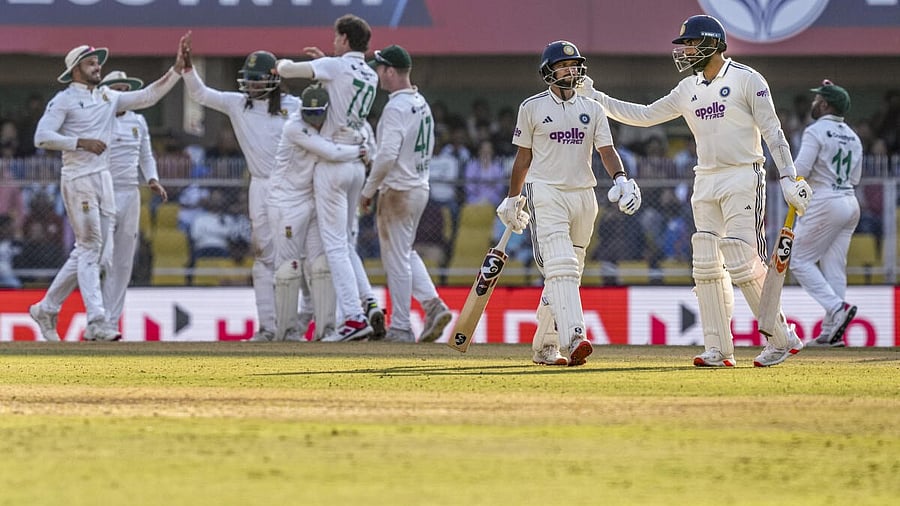
Team India cut a sorry tale -- both at Kolkata and Guwahati.
Credit: PTI Photo
India's abject capitulation to South Africa in the two-match series at home is likely to open a Pandora's box.
Gone are the days when India would dictate terms to the opposition on spin-friendly wickets at home as the table has turned on them.
Losing one series at home in a decade used to be the norm during good old days.
A throwback at India's performance from the 80s is an indicator of that.
From 80s to 90s they lost a series each at home to the then mighty-West Indies under Clive Llloyd, to the under-rated David Gower's England side and then to Imran Khan's Pakistan who 'spun' them away in a bunsen burner in Bengaluru.
From 90s to 2000s the only series loss was against Hansie Cronje's South Africa.
Post 2000, Adam Gilchrist's Australia tasted success -- once in 2004 -- and then it was Englishmen's turn again, this time Alastair Cook's captaincy in 2012.
It looked as though India had regained the aura of invincibility at home until the Kiwis whitewashed them at home in 2024, they had not lost a single series.
But two consecutive losses to SENA countries at home have put question marks over India's dominance on rank turners.
One series defeat at home can be called an 'aberration'. But what do you make of another in the following year?
Preparing a spinning pitch does not guarantee India success any more as Kiwis proved last year and the Proteas this year.
As the Temba Bavuma-led South Africa thrashed India by a whopping 408 runs in the second Test at Barsapara Stadium in Guwahati, critics have already started to bay for the blood of coach Gautam Gambhir and Co.
It is not the series loss, but rather the manner of abject capitulation that is more alarming.
The Indian batters, who were masters in the art of playing spin, have off late been at the receiving end and now it looks as though they have started feeling to get a taste of their own medicine.
Simon Harmer was the wrecker-in-chief at both Kolkata and Guwahati as India with spin, which has been the sub-continental giant's traditional strength, now more or less becoming their 'Achille's heel'.
With a growing surfeit of T20 Leagues and the dwindling interest in 50-over game, Test cricket has been struggling to stay afloat and India batter's difficulty in negotiating spin just epitomises that. They definitely seem to be wanting in technique, when it comes to playing spin.
India's recent travails can be attributed to the fact that players are being fast-tracked into the national team just based on Indian Premier League performances, while the nimble-footed and supple-wristed batters who can dominate spin, continue to plunder runs in Ranji Trophy and other domestic fixtures.
The batters have forgotten the art of building innings brick-by-brick and playing long innings — something players like Rahul Dravid and Cheteshwar Pujara did with elan — and is integral to succeed in white flannels.
Test cricket is still a format which needs specialisation and where quick-fixed does not work.
India tinkered too much with the team composition in both the matches. In Kolkata they did the folly of playing four spinners — with one of them pencilled in to bat at the crucial No.3 slot.
The one-drop position in the batting order is so crucial and it is high time India found a regular fit there as they have been experimenting too much.
Playing two wicket-keeper/batters, just based on recent form was another move that backfired.
While the role of a coach in cricket is not like what is it in other games like football, Gambhir cannot absolve the responsibility of the humiliating loss (the 408-run loss at Guwahati was the biggest in terms of margin).
Ever since Gambhir took over the coaching reins from Dravid, India's fortunes at home have plummeted, though their overseas record remains quite decent.
There is a school of thought which believes Gambhir has created lot of uncertainty in the team and the way he handled players like Sarfaraz Khan and Karun Nair leaves a lot to be desired.
Gambhir does nor carry the aura that past Indian coaches like Dravid, Ravi Shastri and Anil Kumble had and it is high time he did some serious soul-searching.
All is not lost in Indian cricket. The team's record in white-ball format is awesome. The ICC T20 World Cup is a few months away where the Men in Blue will be defending their crown and the 50-over World Cup is slated to be held in 2027.
Victories in global events in white-ball formats may force an average cricket fan to forget what happened at the hands of Kiwis and Proteas with the red-cherry.
But if India have to improve their Test match credentials, then some drastic changes need to be done. Kneejerk reactions will not work. The World Test Championship cycle is on and already having missed the previous edition's finals, the onus is on Team India to fix chinks in the armour quickly. Going back to the drawing board and getting international cricketers play more four-day domestic first-class fixtures will not be a bad idea to begin with.