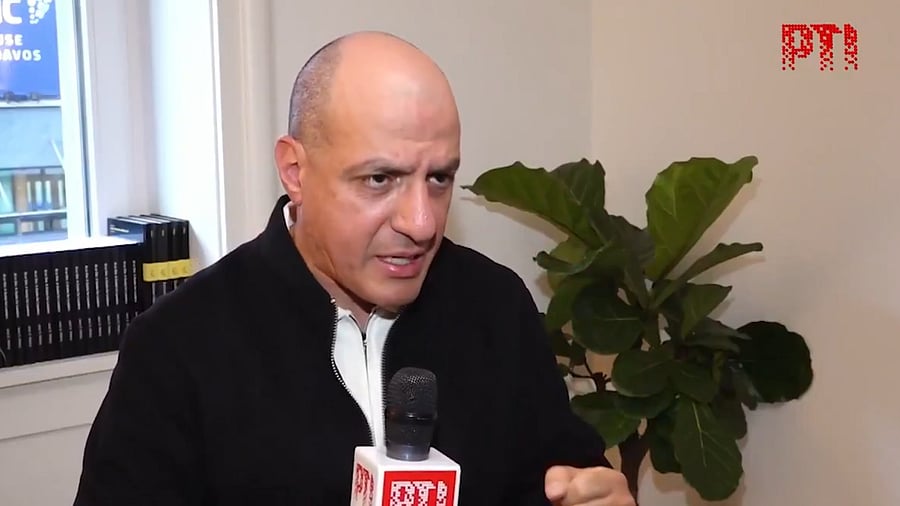
Jack Hidary
Credit: X/@PTI_News
Davos: It's time to embrace AI or die, be it individuals, corporates or governments, and India appears to be on the right track with artificial intelligence offering huge potential for Indian companies to scale up to global levels, says CEO of SandboxAQ that was born at Google's Alphabet Inc as a moonshot unit and is now an independent and influential entity.
Jack Hidary launched a sandbox or research group on AI and quantum technologies at Alphabet in 2016, which was spun off into an independent company in 2022. Its investors include former Google CEO Eric Schmidt, now chairman of SandboxAQ; Salesforce CEO Marc Benioff; T Rowe Price and a lot more.
Sandbox typically refers to a secure and live testing environment and draws its name from a child's sandbox, where children can build, experiment with or even destroy sand formations without causing any damage to the real world.
A B2B company, SandboxAQ, now focuses on enterprise solutions converging AI and quantum technologies to help corporates and governments on drug discoveries, materials science, navigation, cybersecurity, etc.
Speaking to PTI during the World Economic Forum Annual Meeting here, Hidary explained in detail his thesis of 'AI or Die', which is also the name of his upcoming book that seeks to wake people up to the urgency of AI adoption beyond just content creation tools.
The core message, he said, is that the companies that embrace AI will grow and those that don't will die.
Calling the present time a major inflection point across all industries, Hidary said it is not just a "nice to have" but existential for business survival.
Giving examples across industries, he said AI enables faster drug discovery for cancer, Alzheimer's, and other diseases, as against traditional timelines of 15 years or so.
In the energy sector, those using AI-powered catalysts to convert oil and gas into new energy products will thrive, be said.
"If we look at education sector, and India is very important here, having the largest population in the world of 1.4 billion people, if they don't embrace AI it will not be able to thrive globally," he said.
On WEF identifying cyber insecurity as the biggest risk facing India in the immediate future, Hidary said cyber security is fundamental to national security at the federal as well as state levels, as Indian states are larger than many countries.
"There can be critical infrastructure targets like banking, telecom and public utilities," he said.
At the same time, there are Indian tech giants like Infosys, Wipro, TCS and many others that hold massive amounts of customer data, and they have a global footprint that requires immediate cybersecurity implementation, Hidary said, adding that the same is true for governments too.
He said AI offers both benefits and new vulnerabilities and pitched for better AI solutions to deal with AI problems, saying SandboxAQ solutions are being used by banks, companies, and governments worldwide, including the US.
In India, he said the country's 80 per cent economy is in the physical world, such as railroads, energy, telecom and infrastructure, and SandboxAQ's AI solutions directly impact this majority sector.
He said his idea is to promote the intellectual properties of Indian companies.
Giving examples, he said there are Indian pharma companies like Dr Reddy's that make new medicines, but there are many that just manufacture drugs whose IP are elsewhere.
There is a potential for a paradigm shift to create intellectual property within India itself, and SandboxAQ software enables AI-driven molecular design, providing an opportunity to transform India from IP consumer to IP creator, he said.
Hidary listed the life sciences sector as a key target for transformation.
He said there are some fantastic AI tools to create documents, images, videos, etc, in the digital world.
"But at SandboxAQ, we focus on AI for the real world, based on physics, mathematics, chemistry, new medicines, new materials, new catalysts, and that is important for the economy as well.
"When you look at 80 per cent of the economy in India, it's fundamentally in the real world, not the digital world. And that's the area that SandboxAQ impacts," he said.
"And we want to help bring that transformation by working with both the industry and the governments," he said.