
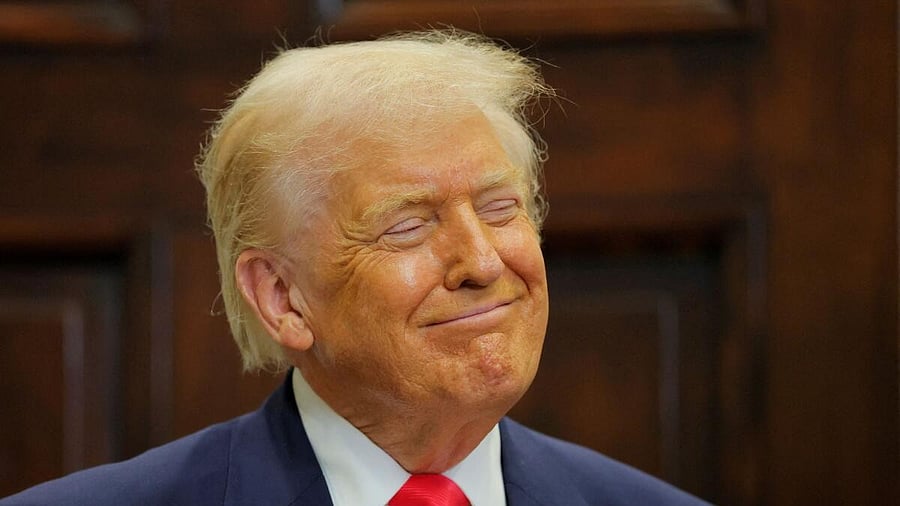
US.President Donald Trump
Credit: Reuters photo
The Trump administration has begun tightening the rules for H1-B visa applicants as well as H-4 dependents by making the vetting process much stricter.
The US internal state department has issued a memo which outlines the new rules for rejection. This has caused immense anxiety among the highly skilled workers as well those who work in tech companies.
This tightening of rules comes after US hiked the application fees for H-1B visas—which allow US employers to hire foreign workers in specialty fields — to $100,000 in September of this year.
Vetting social media profiles
The US State Department said beginning December 15, a review of the online presence for all H-1B applicants and their dependents will be conducted.
Up till now, students and exchange visitors were already subject to such scrutiny, however, it has now been extended to include those applying for H-1B and H-4 visas.
“To facilitate this vetting, all applicants for H-1B and their dependents (H-4), F, M, and J nonimmigrant visas are instructed to adjust the privacy settings on all of their social media profiles to 'public',” the State Department said.
Underscoring that a US visa is a privilege and not a right, the department said it uses all available information in screening and vetting to identify visa applicants who are inadmissible or pose a threat to America's national security or public safety.
"Every visa adjudication is a national security decision," it said.
The department said the US “must be vigilant” to ensure applicants do not intend to harm Americans and that all visa applicants credibly establish eligibility and intent to comply with the terms of their admission.
"Censorship" of free speech
There will now be heightened focus on instances of censorship and free speech According to the memo, "visa applicants were subject to this policy, but sought a heightened review for the H-1B applicants given they frequently worked in the technology sector "including in social media or financial services companies involved in the suppression of protected expression."
The Trump administration has made free speech, particularly what it sees as the stifling of conservative voices online, a focus of its foreign policy.
Separately, Washington has also paused with immediate effect Green Card, US citizenship and other immigration applications for people hailing from 19 “countries of concern”, following the shooting of National Guard soldiers by an Afghan national.
A policy memorandum issued Tuesday directs the US Citizenship and Immigration Services (USCIS) to “place on hold”, effective immediately, all asylum applications, regardless of the immigrant’s country of nationality, pending a comprehensive review.
The pause also applies to all immigration applications from nationals of 19 countries previously covered by the administration's travel ban.
These countries are Afghanistan, Burma, Burundi, Chad, Congo, Cuba, Equatorial Guinea, Eritrea, Haiti, Iran, Laos, Libya, Sierra Leone, Somalia, Sudan, Togo, Turkmenistan, Venezuela, and Yemen.
(with PTI and Reuters inputs)