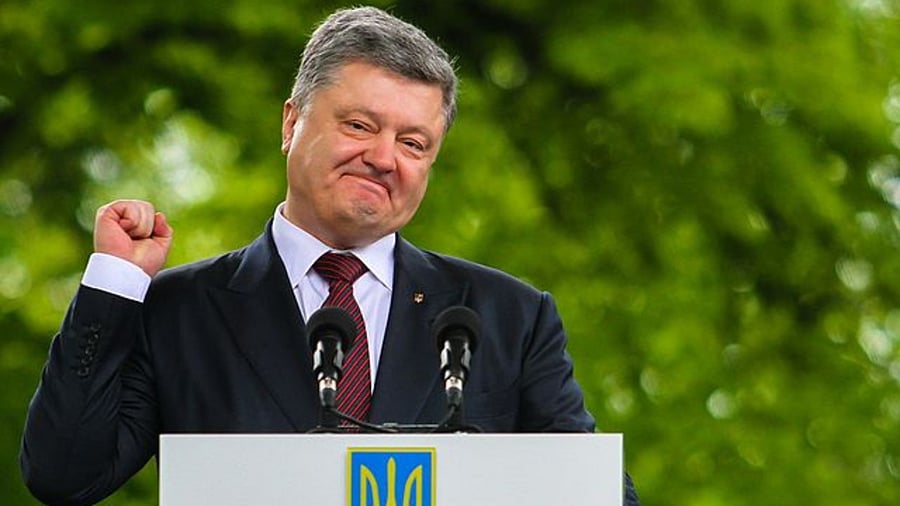
Former Ukrainian President Petro Poroshenko.
Credit: Wikimedia Commons
On the first day of Russia’s all-out invasion, Ukrainian President Volodymyr Zelenskyy and his main political opponent at home shook hands, setting aside their ferocious rivalry to focus on the enemy. The country’s typically raucous politics went largely dormant for the three years that followed.
Now, as peace talks led by the Trump administration have stirred prospects for a ceasefire and eventual elections, the political jockeying has returned.
Ukrainian politicians are maneuvering at home and reaching out behind the scenes to the Trump administration, which has made no secret of its disdain for Zelenskyy, despite his lionization on the world stage for standing up to Russia.
Petro Poroshenko, a former Ukrainian president and the leader of a rival party, says that the best way to smooth the peace talks is to bring opposition figures into the government.
Poroshenko had earlier floated the idea of overhauling Ukraine’s politics to form a national unity government, which could benefit his party. He revived the proposal after Zelenskyy’s contentious Oval Office meeting with President Donald Trump in February and a call by a Republican senator for him to step down.
Zelenskyy has shown no interest in forming a coalition of ministers that would include opposition figures. Instead, his government has ratcheted up pressure on opponents by law enforcement and security agencies.
Kyiv Mayor Vitali Klitschko has said Zelenskyy abused martial law powers to overrule the City Council. In January, Ukraine’s National Security Council froze Poroshenko’s bank accounts while leveling no specific accusations.
“We don’t have any other option other than a coalition of national unity, a government of national unity,” Poroshenko said in an interview Wednesday. “We should have unity in the parliament and demonstrate unity in the country. And the results of this decision should be a stop to the war.”
Zelenskyy’s five-year term, which was set to expire last year, was extended under martial law. Elections are legally banned under martial law and impractical as long as Ukraine remains at war.
Nearly a month ago, Ukraine offered a monthlong, unconditional ceasefire that Russia has not accepted. A Trump administration envoy, Steve Witkoff, traveled to Russia on Friday, possibly in an effort to rekindle negotiations.
Poroshenko said the talks could get a boost if Zelenskyy allowed political opponents to enter the government, given that Trump has called Zelenskyy a “dictator without elections.” That echoed criticism by Russian President Vladimir Putin, who has said he will not sign a peace settlement with Zelenskyy.
Poroshenko said he disagreed with Trump’s assessment of Zelenskyy as a dictator.
But with the prospect of a ceasefire and elections, Poroshenko has taken to more openly criticizing the president. The sanctions that the National Security Council placed on Poroshenko froze his bank accounts and could exclude him from future elections.
Poroshenko called the sanctions against him “disastrous, unconstitutional and extrajudicial.” If he were arrested, he said, he would then say that Ukraine is on a path to dictatorship.
The intense rivalry between the two Ukrainian leaders goes back years. Poroshenko led Ukraine from 2014-19. After Zelenskyy soundly defeated him, the new government then questioned Poroshenko as a witness in a flurry of criminal cases that Poroshenko called politically motivated.
Even as tanks massed at the border before Russia invaded in 2022, the infighting continued in Ukraine: Prosecutors sought an arrest warrant for Poroshenko, although it was declined by a judge.
Poroshenko has a base of support in Ukrainian nationalist politics, particularly in western and central Ukraine, while Zelenskyy in the 2019 race won broad support across the country, including from Russian speakers in central and eastern Ukraine.
The two men met on the morning of Feb. 24, 2022, when Russia began its onslaught, to set aside their rivalry. Zelenskyy asked what he could do for Poroshenko. The former president said that he asked for 5,000 Kalashnikovs to arm his supporters against the Russians, and that Zelenskyy had provided the guns.
Poroshenko, 59, has little chance of winning a presidential election, polls show. He has consistently been in third place or lower, behind Zelenskyy and a former army commander, Gen. Valery Zaluzhny.
Political analysts say that Poroshenko may be angling for an electoral alliance with Zaluzhny, who is serving as ambassador to Britain and is wildly popular in Ukraine. He has remained mostly silent about politics.
In the interview, Poroshenko said he had met with Zaluzhny in London, but he declined to disclose details of their talks. An aide to Poroshenko said he had accepted an autographed copy of the general’s biography, “Iron General.”
As Zelenskyy has negotiated with the Trump administration, Poroshenko has offered advice through intermediaries, he said.
“Trump can ask unexpected questions, I can say even impolite,” Poroshenko said.
At one meeting during the first Trump administration, Poroshenko said, Trump asked if he could get an honest answer to a question. Poroshenko said yes. Trump then leaned closer and asked, “Tell me: Is Crimea Russian?”
Poroshenko said he answered that Crimea, the peninsula that Russia seized in 2014, was Ukrainian, and asked what prompted the question. Trump then said that a Russian friend had told him that the peninsula should be Russian, Poroshenko said.
Poroshenko pursued a transactional foreign policy with the United States that partly paid off. That included purchases of coal from Pennsylvania that preserved some jobs in a swing state, even though Ukraine has abundant coal of its own.
Before the end of Trump’s first term, the administration offered a formal statement, known as the Crimea Declaration, that asserted as a matter of U.S. policy that Crimea was Ukrainian.
“He’s not easy,” Poroshenko said of Trump. “But now is the time of diplomacy.”