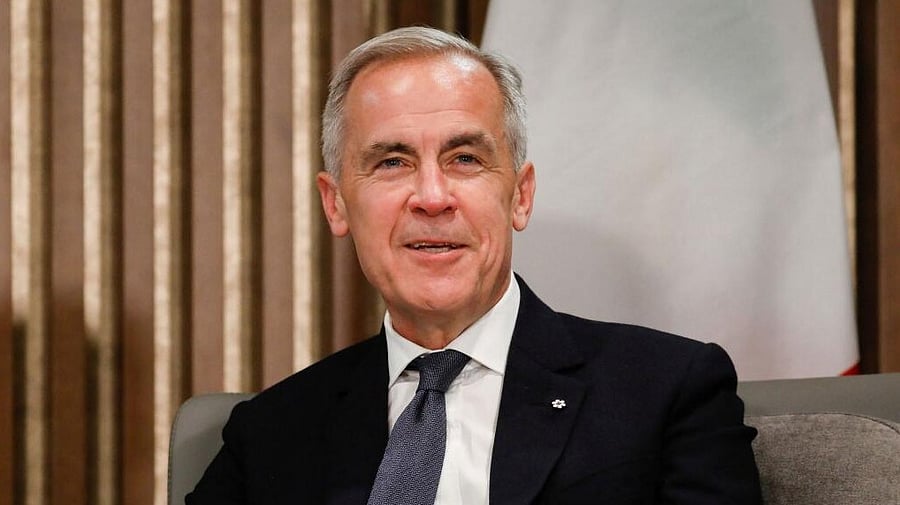
Canada Prime Minister Mark Carney
Credit: Reuters Photo
Ottawa, Ontario: Prime Minister Mark Carney of Canada will arrive in Beijing on Wednesday for a critical three-day state visit during which he will meet with President Xi Jinping and seek to repair an important relationship that may be more vital now that the United States is no longer a reliable Canadian ally.
Carney, under pressure by a recalcitrant President Donald Trump who has all but nixed trade talks and has threatened Canada's sovereignty, is spending a significant chunk of his time overseas seeking new customers for Canadian goods. China is at the top of his list.
Diplomatic relations between the two nations ruptured in 2018, when China arbitrarily detained two Canadian citizens after Canada arrested a Chinese business executive wanted in the United States. The Canadians were held under often harsh conditions, while the Chinese executive was allowed by a Canadian court to live in two large houses in Vancouver, sparking outrage in Canada.
The fallout has included high retaliatory tariffs on key exports: Chinese electric vehicles along with Canadian canola oil and other agricultural goods.
Officials from the two countries are negotiating lowering the tariffs, but an agreement had not been reached by the time Carney left Ottawa on Tuesday and may not be reached during the visit, two officials briefed on the talks said. They spoke on condition of anonymity because they were not authorized to publicly discuss the talks.
The broader relationship has been clouded by deep suspicion of China in Canada. Canadian security services say China routinely meddles in Canadian political affairs and surveils and represses Chinese Canadians on Canadian soil. Hong Kong exiles in Canada and others have been singled out, the security services have said, and China has sought to influence Canadian elections, including by targeting candidates.
In recent months, there have been signs of a thaw in the relationship, and Carney and Xi met on the sidelines of a summit in South Korea in October. Carney, experts and officials said, will seek a reboot of his country's affairs with China set against both nations' volatile and complicated relationship with the United States.
"There is intrinsic value in the event of the visit happening," said L Philippe Rheault, a former Canadian diplomat in China who leads the China Institute at the University of Alberta.
"These days it's hard to talk about Canada-China relations without a reference to what's happening in Washington," he added. "Whatever you think about Trump, he's serving as a historical accelerant and a catalyst for countries to reassert their economic and security arrangements."
Carney is traveling with several top Cabinet ministers, including officials responsible for industry, agriculture and energy, an indication of the areas in which the Canadian delegation will be seeking deals with China.
The Canadian leader is expected to meet with Premier Li Qiang of China on Thursday and Xi on Friday, before heading to his next stop, Qatar, on Saturday.
Tariffs and counter tariffs
China is Canada's second-largest export market after the United States, but it's a very distant second. Approximately 70 per cent of Canada's exports head to the United States, while less than 5 per cent go to China.
Carney has pledged to diversify Canada's customers to counter a seismic pivot away from the United States because of Trump's policy of imposing tariffs on some key Canadian goods, questioning the necessity and future of their free-trade agreement (which also includes Mexico) and occasionally laying claim to Canada itself.
Canada has been a follower of the United States when it comes to China, and its repositioning with Washington leaves it in need of a new China policy. The visit, the first for a Canadian prime minister since 2017, could indicate what that relationship might look like.
In 2024, Carney's predecessor, Justin Trudeau, followed the United States and imposed a 100 per cent tariff on Chinese electric vehicles.
China imposed tariffs on Canadian agricultural products last year, including a 100% levy on most Canadian canola oil products and other goods, hobbling an important industry for Canada's western province of Saskatchewan.
Canadian and Chinese officials have been in talks over lowering both those levies, the two Canadian officials with knowledge of the talks said.
They said that talks, for now, centered on slashing the tariff rate to 50 per cent or lower, but not eliminating tariffs altogether.
The officials said that reaching an agreement on a mutual, synchronized lowering of tariffs on electric vehicles and canola oil was seen as important, but not politically easy, by the Canadian government.
Chinese electric vehicles, which are a pivotal piece of the country's export economy, are very cheap. Allowing them into the Canadian market with a low tariff rate would hamper domestic demand for other vehicles, including those made in Canada.
That would further hurt the Canadian automobile sector, which is already reeling from Trump's effort to use tariffs to push car manufacturing to the United States.
Carney is also expected to test China's appetite for Canadian oil and natural gas, and the potential for cooperation on renewable energy.
Values vs Pragmatism
Carney and his advisers have said that he is seeking a pragmatic thawing of Canada's relationship with China after a lengthy period of acrimony.
That began in 2018, when Canada, executing a United States extradition order, arrested, in Vancouver, Meng Wanzhou, a top executive at the Chinese tech giant Huawei and a daughter of its founder.
That same year, China arrested two Canadians, Michael Kovrig, a former diplomat and China expert for the International Crisis Group, a nonprofit; and Michael Spavor, a businessperson, on what were widely regarded as trumped-up charges of espionage.
The two men spent more than 1,000 days in prison in Beijing as part of China's "hostage diplomacy," and the affair came to be known as the "Two Michaels" crisis. They were released in 2021, after the United States released Meng.
In an interview, Kovrig urged Carney to be cautious as he embarked on this new phase in Canada-China relations.
"What Mark Carney's government is trying to do is strike a very careful balance between seeking economic opportunities while safeguarding national interest," he said. He noted that Canada's previous hard-line policy toward China was not just a matter of adopting US policy, but also because of warnings from Canada's security services.
"The policy challenge is how to do this within a framework that protects Canadian values and interest and national sovereignty," he added.
Lynette Ong, a top China scholar at the University of Toronto, said that in reengaging with China, Carney should avoid creating new dependencies and put some sensitive industries such as the news media and critical minerals beyond the grasp of Chinese interests.
"With the Chinese, as with any bullies, you need to tell them where your boundaries are," Ong said. "That's how you get respect."
She added that it was imperative to avoid swapping Canada's reliance on exports to the United States with overreliance on China. "China is a diversification strategy away from the United States, but it should be the beginning of the strategy, not the end," she added.
Human rights groups are also petitioning Carney to uphold Canada's traditional role on the global stage as an advocate for human rights and democracy.
"Prime Minister Carney should recognize that the Chinese government's deepening repression threatens not just the rights of people in China but, increasingly, Canada's core interests and values," Maya Wang, deputy Asia director at Human Rights Watch, said in a statement last week.
She urged Carney to "ensure that engagements with the Chinese government on trade and security are consistent with Canada's values, which includes the promotion of human rights."
But Ong said issues of human rights and foreign meddling, while well founded, should be kept separate from economic relationships.
"All the concerns on foreign interference and transnational repression are all valid but should be disentangled from trade talks," she said. "Whether or not we forge a closer economic partnership with China is independent of their decision to interfere in politics here."