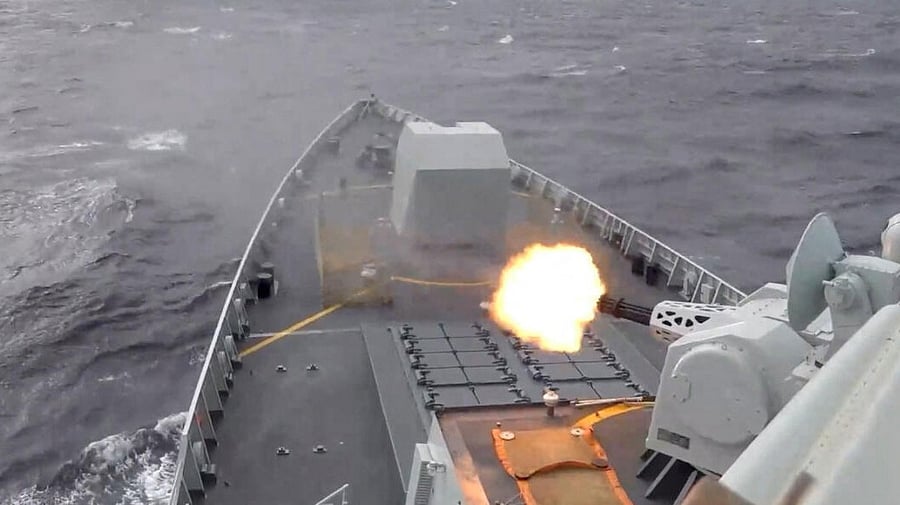
A ship fires a weapon during drills east of Taiwan, in this screenshot from a video released by the Eastern Theatre Command of China's People's Liberation Army (PLA).
Credit: Reuters Photo
Taipei, Taiwan: China launched military exercises around Taiwan on Monday, mobilizing naval, air, ground and missile forces for what the People’s Liberation Army described as a “stern warning” to opponents of Beijing’s claims to the island.
As part of the drills, Chinese authorities said that seven zones of ocean and airspace around Taiwan would be sealed off for live-fire exercises to be held Tuesday.
The operation, called “Justice Mission 2025,” marked the first major military exercises around Taiwan since April by the People’s Liberation Army, or PLA. They appeared designed to display Beijing’s growing capabilities to encircle Taiwan.
They also came after the administration of President Donald Trump revealed a proposed package of arms sales to Taiwan this month that would be worth more than 11 billion dollars and include powerful high-mobility artillery rocket systems known as HIMARS.
Senior Col. Shi Yi, a spokesperson for the Eastern Theater Command, the part of the Chinese military that is conducting the exercises, said it would simulate blockading ports and establishing Chinese dominance to the east of Taiwan — the direction from which any potential wartime support from the United States and its allies would likely come.
The exclusion zones for live fire form five swaths, some positioned near Taiwan’s most important ports and military bases, Maj. Gen. Meng Xiangqing, a professor at China’s National Defense University, said on a Chinese news program.
“Our vessels and aircraft have been forming a new posture of pressing the island by getting closer and closer,” Meng said. “The rope is being pulled tighter and tighter”
China’s main state-run television broadcaster, CCTV, said the exercises included destroyers, fighter bombers and drones conducting “maritime and airborne search-and-destroy operations, simulated strikes on land and live-fire naval drills.”
Taiwan’s Ministry of National Defense said that by Monday afternoon it had detected 14 Chinese navy vessels and another 14 Chinese coast guard vessels off Taiwan, as well as an amphibious assault ship group in the Western Pacific. Taiwan also detected dozens of Chinese military aircraft in its vicinity. The activities will culminate when the exclusion zones go into force.
For “vessels attempting to transit north–south through the Taiwan Strait, the restricted zones could in practice block passage,” said K Tristan Tang, an associate fellow at the Secure Taiwan Associate Corp., a nonprofit group in Taipei. In theory, “Taiwan could lose its sea route connections with Kinmen and Matsu,” he said, referring to two Taiwanese island groups closer to the Chinese coast.
Two Taiwanese passenger airlines canceled flights to and from Kinmen and Matsu until the live fire drills end Tuesday evening
China has long staged similar threatening exercises near Taiwan — some bigger and longer than others — especially since Nancy Pelosi, as speaker of the House of Representatives, visited the island in 2022, a step that Beijing said was an affront to its claim of sovereignty over Taiwan.
Even so, a Pentagon report released last week said China’s leaders were still not confident of being able to seize Taiwan by force. The exercises are a pallid imitation of the scale, complexity and risks that an actual blockade would entail.
Shi said the latest exercises were “a legitimate and necessary action to safeguard China’s sovereignty and national unity.” But Beijing gave no specific reason for holding the exercises now, and experts said several factors may have prompted China’s leader, Xi Jinping, to renew threats of an armed attack on Taiwan.
“The timing of PLA drills are increasingly disconnected from single political events,” said Amanda Hsiao, the director of China coverage at the Eurasia Group, a company that advises clients on global risks. “This drill may be as much intended for domestic audiences as much as Taiwan and US ones.”
China’s Communist Party leaders have long maintained that Taiwan, an island-democracy of 23 million people, is Beijing’s territory. Xi has been building up his nation’s military to apply pressure on Taiwan, and perhaps one day try to take it by force.
But the PLA leadership has also been in turmoil. Dozens of commanders and generals have been removed in recent years, some formally dismissed and investigated for corruption and other suspected misconduct, others disappearing from public view without explanation.
The upheavals have magnified doubts among experts about the Chinese military’s readiness to seize Taiwan by force. Last week, Xi appointed a new commander — Yang Zhibin, a former air force pilot — to lead the Eastern Theater Command, which is in charge of the area around Taiwan.
While Yang appears to have been acting commander of the Eastern Theater for months, the exercises were announced right after he was officially put in charge, said Lin Ying-yu, an associate professor at Tamkang University in Taiwan who studies the Chinese military.
“I personally think this could also be considered a new test for him,” Lin said.
Trump and Xi have been trying to stabilize relations before a planned summit in Beijing in April. Although China’s initial reaction to the arms sales to Taiwan was relatively muted, the exercises may be intended to convey China’s anger, said David Sacks, a fellow at the Council on Foreign Relations who studies ties between the United States, China and Taiwan.
“This response is expected, given the scale of the arms sale package,” Sacks said. Xi appeared “confident he can push without provoking a counter response from President Trump.”