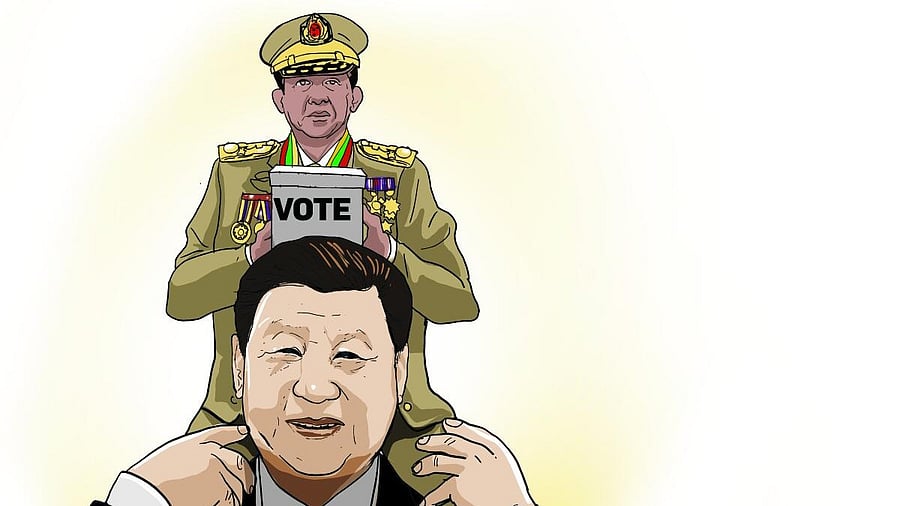
Credit: DH Illustration
Myanmar’s military regime will conduct elections in three phases, beginning on December 28, nearly five years after it staged a coup on February 1, 2021, annulling the new Parliament elected in November 2020, and forcibly wresting power from the Aung San Suu Kyi-led National League for Democracy. Although largely out of international or regional attention, the elections are aimed at legitimising the junta’s rule, which has been prolonged by several extensions of emergency constitutional provisions, going well beyond the provisions of the 2008 Constitution, drafted by the military itself. The military regime seeks to delegitimise the popular resistance and restore itself in the comity of nations with a democratic and civilian façade.
The elections will also take place against the backdrop of an evolution of the conflict in Myanmar from a non-violent, nationwide, citizen-led, Gandhian Civil Disobedience Movement against highly centralised military rule to a widespread armed resistance straddling both the Bamar heartland and surrounding hill areas populated by diverse ethnic “races” of Myanmar. Its human costs in terms of casualties, torture and deaths in custody, political prisoners, internally displaced persons, and international refugees have been huge.
The resistance against the military regime reached its peak between October 2023 and December 2024, when it wrested control of two major Regional Military Commands in Lashio to the northeast and Ann in Rakhine State through a coordinated offensive of the Three Brotherhood Alliance (3BHA) of ethnic armies, which also took over most of border trade posts and some 94 out of 330 of the townships of Myanmar, with at least 160 being actively contested. The 3BHA took control of most of Arakan and Chin states, and mounted pressure on strategic towns in the north, including, for a while, Mandalay. It, however, was not able to press its offensive beyond that.
By mid-2025, with the junta planning the elections, the opposition offensive was blunted by China’s pressure on ethnic resistance organisations (EROs) under its influence in the northeast of Myanmar. The disproportionate use of air power and artillery against civilian targets (including monasteries and hospitals), as well as the failure of the opposition in capitalising on its gains and forging a united, coordinated, or cohesive leadership or a broad political and diplomatic front, and some disarray in its military command, also helped the military resist further advances of the forces adversarial to it. The earthquake in Myanmar provided the junta with humanitarian assistance from the international community and much-needed breathing space. Regional concerns about the possible balkanization of the country, transnational crime, and stability in Myanmar, as well as ASEAN’s paralysis and the distraction posed by the fratricidal conflict between Thailand and Cambodia, also played a role in avoiding serious proactive diplomacy over Myanmar.
But, more than anything else, it was China’s unusual decision to shed its policy of discreet support for both the regime and the armed opposition from behind and weigh in openly in support of the junta, the lack of interest of the US under President Donald Trump, and Russia’s offensive against a wobbling Western alliance in Ukraine that provided the geopolitical space for the military government to pursue its ruthlessly aggressive policy against the armed opposition and proceed with elections.
By October 2025, the Chinese forced two of the opposition armies, the Kokang MNDAA and the Palaung TNLA, to sign ceasefires with the junta, and the army had wrested back key towns in the northeast like Lashio, Nawngkhio, and Mogok, relieving pressure on Mandalay. But these gains could be overstated, reversed, and pyrrhic. To the west of Myanmar, along the country’s border with Myanmar, the junta has not been able to make much headway against the Chin forces, the Arakan Army, and the Kachin Independence Army (KIA).
Overall, the military balance between the conventionally armed Myanmar Army and less sophisticated EROs and People’s Defence Force is still 50:50.
None of these military gains, however, has been accompanied by any political initiatives or won the regime greater legitimacy, and no one really expects the elections to provide the regime with a democratic veneer or resolve Myanmar’s decades-old internal conflicts around ethnicity, democracy, and federalism. More importantly, no objective observer inside or outside the country, not least its regional supporters, mainly China, has any illusions that the elections will be free, fair, national in scope, or representative in any way. Elections have been ruled out in 56 opposition-held townships and will be only partially held in 93 out of 330, on grounds of lack of security. Draconian provisions for registration of political parties and the conduct of elections have outlawed and constrained the NLD and other major opposition political parties, who have boycotted the elections anyway on grounds of foul play. Voting is likely to be thin.
By almost all independent accounts, the elections will be a farce implemented by force, gerrymandering, interference, or plain fabrication. Although the opposition has threatened to disrupt the polls, there is probably very little it can do to prevent them altogether. The only claim to legitimacy of the elections will be that they will be held regardless of the number of people voting. This will pave the way for the “King’s Party”, the USDP, to win elections. Its outcome will also be favourable to China.
So, what then do the junta and its regional supporters hope to achieve with such an election? How will it shape Myanmar’s future, and what posture should India adopt towards it in its aftermath?
Author Gautam Mukhopadhaya.
For the junta, more than domestic legitimacy, which is unattainable, it hopes that by merely conducting the elections, it could win enough international legitimacy with the help of Russia, China, and possibly India and a section of ASEAN to form a government with an acceptable face, escape international isolation, attract sufficient investment and commerce to procure more arms and stabilize the economy, and regain its seat in the UN that is currently with the NUG. It can draw some encouragement from the recent decision of Donald Trump’s administration to deport refugees from Myanmar from the US on the grounds that the situation in the Southeast Asian country is normal enough for elections to be held.
For China, Myanmar’s dependence on it provides an opportunity to influence internal politics in favour of its strategic and economic interests that include access to the Bay of Bengal, Belt and Road Initiative projects, energy pipelines, connectivity, trade and transit routes through Myanmar, and commercial investments in natural resources and real estate. The Chinese have enough equity within the armed forces, the USDP, and the opposition NLD to shape outcomes.
But a totally self-centric and pro-junta policy comes with political and reputational risks for China. There is no guarantee that even with some degree of international legitimacy and even rumoured changes in Myanmar’s leadership, the armed opposition will be crushed, and the junta will prevail in the long run. Even if the junta can tame insurgencies in the China-dependent northeast with Chinese help, it is unlikely to establish its writ nationwide, especially in Rakhine and the dry zone of central Myanmar in Sagaing and Magway, the heart of the Bamar insurgency that is the nationalist bulwark against Chinese domination and hegemony.
What then of the opposition? Here too, the situation is far from hopeful. The NUG has failed politically to establish either a unified command structure or a system of governance, even in “liberated” areas that are under individual ethnic political and armed organisations. Its diplomatic gains, too, have been extremely modest. More telling has been the failure of the armed opposition to take advantage of the gains of the 3BHA in 2023–24 and to provide leadership and coordination to the next or “national” level and convert “million mutinies” in the heartland into one concerted offensive for a more democratic or federal (or both) Myanmar.
Nor has sufficient work gone into evolving a detailed draft political structure that accommodates the needs of greater autonomy, federalism, and democracy beyond the Charter for a Federal, Democratic Union drafted in 2023 in the first flush of opposition victories and enthusiasm. Unless the opposition seriously raises its military, political, and diplomatic game, or the military can offer an alternative, more imaginative or effective military or political approach, or the international community takes Myanmar more seriously, Myanmar will remain as contested after the elections as before. Alas, none of the above options is in sight.
This is one area where, more than any other country, India — as a multi-linguistic, multi-religious, pluralist democracy, a union with federal characteristics, and a regional heavyweight — could have played a constructive role as the political antithesis of China in Myanmar. In the last quarter of 2024, India appeared to realise this when it hosted both military representatives and opposition parties in looking for solutions. But the international community, including India, has erred on Myanmar: firstly, by not recognising that the forces of democracy and federalism and centralised military rule are too polarised and fundamentally irreconcilable in today’s Myanmar; and, secondly, by leaving Myanmar to ASEAN and its outdated five-point consensus. China has chosen that it is more useful for it to be on the side of the junta over the Myanmar people and feels it has the equities to ensure it. India does not and should not make that choice.
A more productive political and diplomatic approach would be for the international community, ASEAN, and India to nudge and guide Myanmar’s political forces in the direction of a federal, democratic union in line with their aspirations. Such an approach would align India with the Myanmar people rather than the military’s agenda to stay in power. Sadly, India today seems to have lost that commitment to freedom, democracy, and federalism that it used to have and appears to be more comfortable with authoritarian forces in the name of “realism” under a mistaken notion that they can guarantee its security and national interests better. It also seems to draw greater comfort from the Bamar-Buddhist nationalism in Myanmar as the counterpart of its own Hindu nationalism.
Equally puzzling is New Delhi’s strategic silence over Beijing’s growing presence in Myanmar, and, in particular, the Kyaukphyu deep-sea port in the Bay of Bengal, where China has oil and gas pipelines and an exclusive economic zone justifying its securitisation in future. The elections will not be able to change Myanmar’s future, but they will likely entrench China’s dominance in Myanmar and its presence in the Bay of Bengal, and limit India’s room for manoeuvre further. India would do well not to appear as a pale imitation of China and to play to its democratic and pluralist, rather than majoritarian, credentials.
(The writer is a retired diplomat who served as India's ambassador to Myanmar between June 2013 and May 2016)