
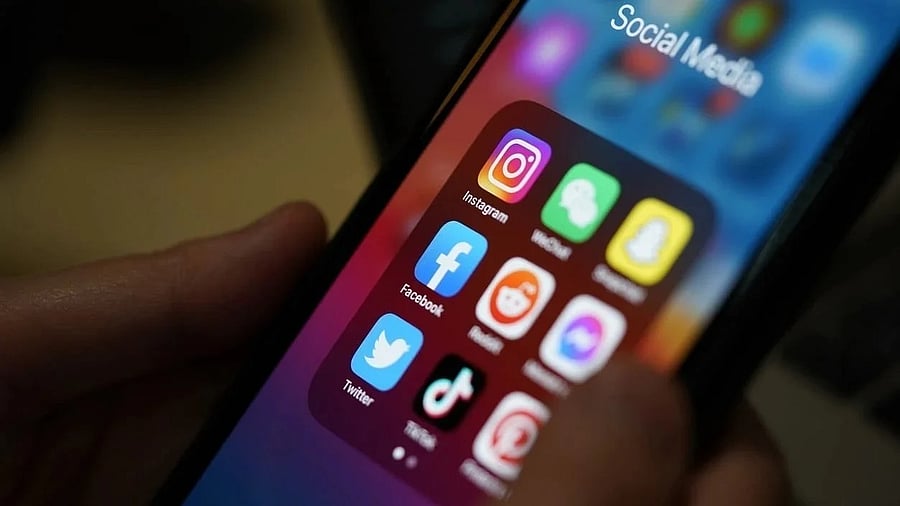
Representational image for social media.
Credit: iStock Photo
Australia's new law banning children aged 16 years and below from social media came into effect on Wednesday.
The law aims to protect children from addictive algorithms, online predators and digital bullying.
Following the ban, Australian Prime Minister Anthony Albanese himself took to social media saying both children and parents benefit from the restriction. He added that he is proud that Australia is the first country in the world to take such a measure.
On Sunday, Albanese that the move was already a success as it had started a conversation around social media among families.
Following the new law, 10 of the biggest social media platforms, including Instagram, Facebook, Threads, Snapchat, YouTube, TikTok, Kick, Reddit, Twitch and X, will not be accessible to children.
Failing to comply will attract a fine of up to $33 million on the companies.
Meanwhile, the apps that were not banned at least for now are WhatsApp, YouTube Kids, Discord, GitHub, Google Classroom, LEGO Play, Messenger, Pinterest, Roblox, and Steam and Steam Chat.
This is because there were three criteria based on which select platforms faced bans. These include: whether the platform's sole or "significant purpose" is to enable online social interaction between two or more users, whether it allows users to interact with some or all other users and whether it allows users to post material
How will the ban work?
Children under the age of 16 years can no longer open a new account, while existing profiles will be deactivated.
Further, no punishment will be imposed on children and parents not complying with the ban. Instead, social media companies face fines of up to $32million for serious or repeated breaches.
The government has ordered companies to take "reasonable steps" to keep children away from their platforms, and must use multiple age assurance technologies such as government ID verification, face or voice recognition, or the "age inference", which analyses online behaviour and interactions to estimate a person's age.
However, platforms cannot allow users to self-certify or parents to approve the age of their children.
Response and concerns
Several critics have questioned the feasibility of the law. Albanese himself has acknowledged that it is not a perfect law.
"We've said very clearly that this won't be perfect… but it's the right thing to do for society to express its views, its judgment, about what is appropriate," Albanese told the ABC.
Further, many have raised concerns over the collection and storage of data needed to verify users' ages. The country has, in the past, experienced massive data breaches where sensitive personal information was stolen and published or sold.
The social media companies were not happy with the law ever since it was first announced in November 2024. Companies have said it will be difficult to implement and easy to bypass the laws, adding that it would be time consuming for users and would be risky to their privacy.
Further, companies argued that the law could expose children to darker corners of the internet and deprive youngsters of contact.