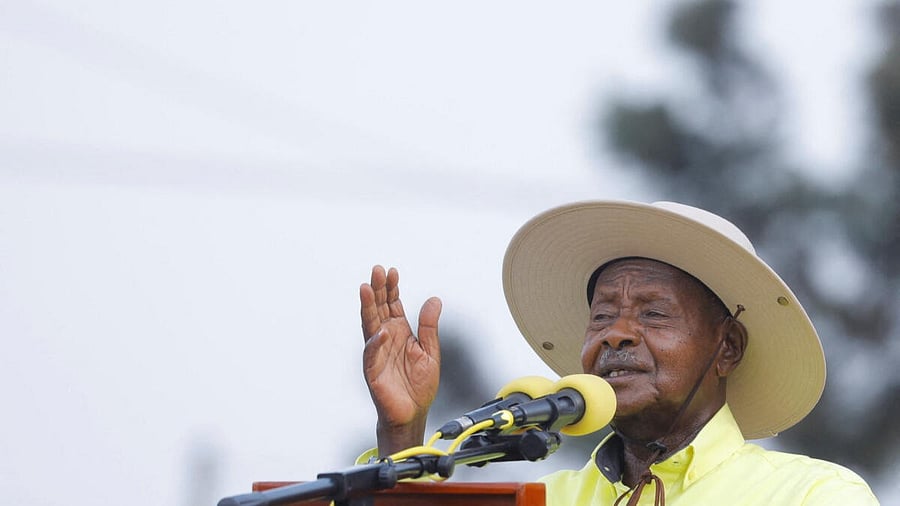
Uganda's President and the leader of ruling National Resistance Movement (NRM) party, Yoweri Museveni.
Credit: Reuters photo
Ugandan President Yoweri Museveni will seek to extend his four-decade rule on Thursday in an election that has renewed questions about the 81-year-old leader's eventual succession.
While political analysts say Museveni's stranglehold on Ugandan institutions makes victory for him and his National Resistance Movement (NRM) party a near certainty in presidential and parliamentary elections, how the vote unfolds could have important implications for the country's path forward.
Who are the candidates?
Museveni, who came to power at the head of a rebellion in 1986, is aiming for a seventh term in office.
His main challenger is 43-year-old Bobi Wine, who finished runner-up in the 2021 election with 35% of the vote and is popular with young voters.
Other notable candidates are former military chief Mugisha Muntu, an anti-corruption campaigner, and Nandala Mafabi, a lawmaker who was previously the opposition leader in parliament.
What are the key issues?
Museveni has campaigned on a slogan of "protecting the gains", touting a record of relative peace and stability.
He has said he wants to make Uganda a middle-income country by boosting manufacturing, adding value to agricultural exports such as coffee and cotton and capitalising on the start of oil production expected later this year.
Wine has focused on restoring political freedoms, accusing Museveni of "40 years of dictatorship". The government has denied allegations of widespread human rights abuses.
Wine has also vowed to stamp out corruption, bolster youth employment and review production-sharing agreements with international oil firms if they do not favour Ugandan interests.
Will there be unrest?
Successive elections in Uganda have been marred by violence and crackdowns on government opponents.
Security forces killed more than 50 people before the last election in 2021 while responding to protests triggered by Wine's arrest.
Hundreds of opposition supporters have been detained in the run-up to this year's vote, and at least one was killed at a campaign event.
Violent youth-led protests in neighbouring Kenya and Tanzania over the past two years have underscored the risks to the government of young people's frustration with political systems they see as corrupt and unresponsive to their needs.
Last week, Ugandan authorities said they were banning live broadcasts of riots, "unlawful processions" and other violent incidents.
What is at stake for foreign actors?
Museveni's Uganda has been a strategic ally of Western countries, sending troops to fight Somalia's al Shabaab and other militant groups in the region. It also hosts the largest number of refugees in Africa.
The United States criticised the 2021 elections as neither free nor fair and imposed visa bans on some Ugandan officials, but Washington is unlikely to weigh in on this year's poll after U.S. diplomats were instructed in July not to comment on the integrity of foreign elections.
Museveni's government has curried favour with U.S. President Donald Trump's administration by entering an agreement in August to take in deportees from the U.S. who are nationals of third countries.
Uganda has expanded its economic ties with China and non-Western powers such as Russia and the United Arab Emirates in recent years. China National Offshore Oil Corporation is one of the two lead partners in Uganda’s Lake Albert oil fields, which are due to start commercial crude production later this year.
What else will Uganda observers be watching?
There may be little suspense about the election outcome, but political observers will be watching the vote for what it says about a future presidential succession.
Museveni is widely thought to be lining up his son, military chief Muhoozi Kainerugaba, to succeed him.
Kainerugaba has fuelled the speculation by openly discussing his presidential ambitions, although Museveni has denied grooming his son to succeed him.
Political analysts say Kainerugaba's status as heir apparent is a source of controversy within the NRM and that other party heavyweights are also positioning themselves for Museveni's eventual departure from the scene.
One important metric will be Museveni's margin of victory. In 2021, he registered his lowest score in a presidential election with 58% of the vote. Any further slippage could weaken his political standing before a possible succession battle, analysts say.