
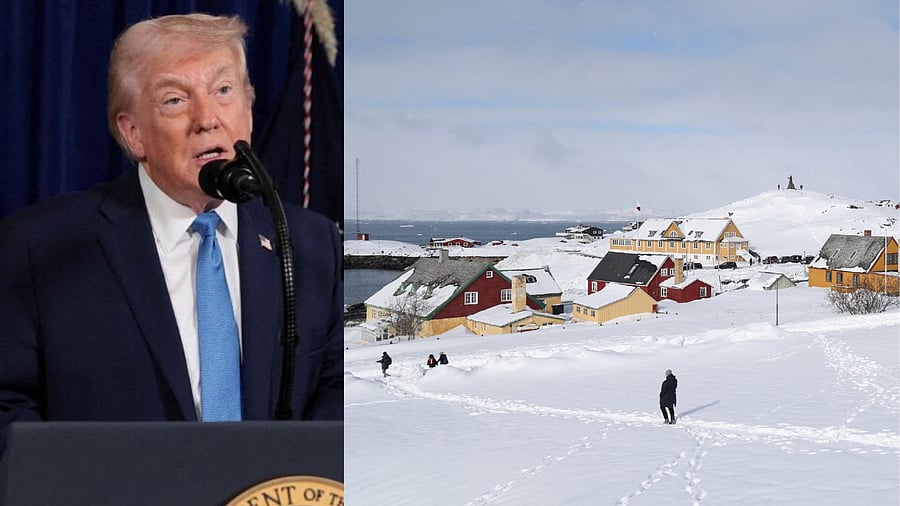
US President Donald Trump and (R) a file photo of Greenland capital Nuuk.
Credit: Reuters File Photos
The United States' military intervention in Venezuela has reignited fears for Greenland, which US President Donald Trump has repeatedly said he wants to annex, given its strategic location in the Arctic.
Greenland, which is a part of NATO through Denmark's membership, is strategically significant for the US military and for its ballistic missile early-warning system since the shortest route from Europe to North America runs via the island.
On January 4, Trump doubled down on his claim that Greenland, an island of just 57,000 people, should become part of the United States, despite calls by the Denmark’s Prime Minister to stop “threatening” the territory.
While aboard Air Force One en route to Washington, Trump reiterated the goal. “We need Greenland from the standpoint of national security, and Denmark is not going to be able to do it. We'll worry about Greenland in about two months... let's talk about Greenland in 20 days," Trump said in response to a reporter's question.
In an earlier interview, Trump had said, "We do need Greenland, absolutely. We need it for defence."
What is the current US presence?
The US maintains a presence at the Pituffik Space Base in northwest Greenland. A 1951 agreement between the U.S. and Denmark gave the U.S. the right to move around freely and construct military bases in Greenland as long as Denmark and Greenland are notified. Washington has expressed interest in expanding its existing military presence on the Arctic island, including placing radars there to watch waters between the island, Iceland and Britain used by Russian navy vessels and nuclear submarines.
Shipping data shows most Chinese shipping in Arctic waters is in the Pacific Arctic and Northern Sea Route near Russia. Most Russian shipping in the Arctic is around Russia's own coast, though analysts say Russian submarines do often travel the waters between Greenland, Iceland and the UK. More broadly the Arctic is becoming increasingly militarised with NATO states, China and Russia all expanding activity there.
Mineral, oil and natural gas wealth
The island, whose capital Nuuk is closer to New York than the Danish capital Copenhagen, boasts mineral, oil and natural gas wealth, but development has been slow and mining has seen very limited U.S. investment.
According to a 2023 survey by the Geological Survey of Denmark and Greenland, 25 of 34 minerals deemed "critical raw materials" by the European Commission were found in the island. They include graphite, lithium, as well as rare earth elements used in electric vehicles (EV).
Greenland has, however, banned the extraction of oil and natural gas for environmental reasons, resulting in its economy being reliant on fishing, which accounts for over 95 per cent of exports. It is also dependent on annual subsidies from Denmark, which cover roughly half of the island's public budget.
Greenland's status
The island, a former colony of Denmark, became a formal territory of the Nordic kingdom in 1953 and is subject to the Danish constitution. This means any change to the island's legal status would need a constitutional amendment.
In 2009, the island was granted broad self-governing autonomy, including the right to declare independence from Denmark through a referendum.
Relations between Greenland and Denmark have been strained after revelations of historical mistreatment of Greenlanders under colonial rule. However, Trump's interest in the island has prompted Denmark to do more to improve ties with Greenland. Polls show a majority of Greenland's 57,000 inhabitants back independence, but many Greenlanders warn against acting rashly – fearing Greenland could become worse off and expose itself to the U.S. if it too quickly seeks independence from Denmark.
Trump's interest not new
Trump's interest in Greenland is not a new development. He first expressed his interest in buying the island from Denmark in 2019 but was rebuffed.
Trump's recent statement has met with international condemnation, with Greenland Prime Minister Jens-Frederik Nielsen warning, "That's enough now."
"No more pressure. No more insinuations. No more fantasies of annexation. We are open to dialogue. We are open to discussions. But this must happen through the proper channels and with respect for international law," Nielsen said in a Facebook post.
Denmark has responded with ire to Trump’s Greenland agenda.
“I have to say this very clearly to the United States: it is absolutely absurd to say that the United States should take control of Greenland,” Danish Prime Minister Mette Frederiksen said in a statement on January 4. She called on Washington to stop “threatening its historical ally”.
(With agency inputs)