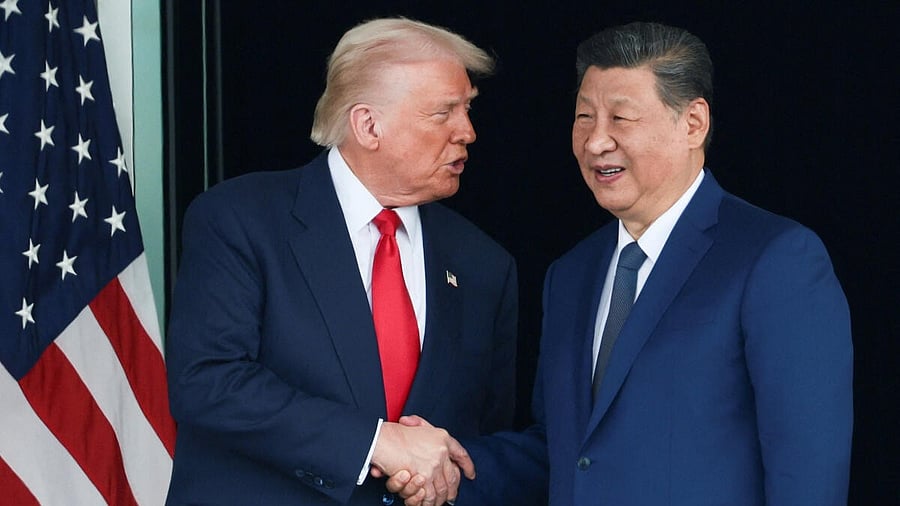
US President Donald Trump meets with Chinese President Xi Jinping
Credit: Reuters Photo
In its rivalry with the United States, China has racked up a series of wins in recent weeks.
The Trump administration has softened its criticism of China’s Communist Party in a strategy document. It has reopened a channel for high-end chip sales that Washington once treated as untouchable. And President Donald Trump has held his tongue as a key US ally in Asia faces Chinese intimidation for backing Taiwan.
For Beijing, the shifts in Washington’s approach suggest that Trump has less of an appetite for confronting China over ideology, technology and diplomacy. Some commentators in China have hailed these developments as irrefutable signs of American decline and Chinese ascendancy.
Trump’s decision Monday to allow some advanced chips to be sold to China, the prominent Chinese technology executive Zhou Hongyi said on social media, showed how China’s unstoppable technological rise had “pushed the United States against a wall.”
The Global Times, a Communist Party newspaper, pointed to the White House’s new national security strategy, which focuses more on the Western Hemisphere than China, as “evidence of the US acknowledging its relative decline in power.” Washington has realised “it cannot afford the costs of prolonged confrontation” with China, the nationalist blog Jiuwanli similarly concluded.
And Trump has remained publicly silent as China has mounted a pressure campaign against Japan, a US ally, over that country’s support for Taiwan. Beijing has summoned Japanese diplomats, canceled flights, curbed tourism and stepped up military flights near Japanese airspace, including with Russia, to highlight its displeasure.
This is Trump’s more transactional diplomacy in action, according to Chinese analysts. In this less hawkish, more pragmatic approach, China is seen not as a threat to US supremacy that must be contained, but as a major nation to be negotiated with.
That shift was laid out plainly in Trump’s national security strategy, released last week. It recast the US-China rivalry as chiefly an economic contest and not a struggle over security or political systems. The strategy’s stated priority: establishing a “mutually advantageous economic relationship with Beijing.”
And unlike previous presidents, Trump showed no interest in the long-standing American project of promoting democracy in China. For the first time in more than 30 years, the national security strategy did not criticise China’s authoritarian rule or press Beijing to uphold human rights — sentiments echoed by presidents from George H.W. Bush to Joe Biden and even to Trump himself in 2017, during his first term.
The strategy showed that “China’s push to make the international system friendlier to autocracy is no longer on our list of priorities,” said Caroline Costello, assistant director at the Atlantic Council’s Global China Hub, who analysed previous national security strategies released since 1986, when Congress began requiring US presidents to submit their foreign policy visions.
Xin Qiang, a US-China expert at Fudan University in Shanghai, said that the strategy showed that the Trump administration had finally realised that “trying to change China by playing the ideological card is neither possible nor feasible.”
“At least since Trump took office in his second term, he hasn’t shown a strong ideological drive in his China policy. It’s what we call ‘profit-driven,’” he said, adding that this was good for China.
Trump’s transactional bent may help explain why his administration reversed export controls on critical artificial intelligence technology that can help China economically and militarily. It granted Nvidia, the American chipmaker, permission to begin selling its second-most-powerful semiconductor to China. The US government would receive 25 per cent of all the revenues from the sales, Trump said in a social media post, a trade that critics said prioritises short-term economic gain over long-term American security interests.
The latest moves by the Trump administration, in some ways, extend the conciliatory posture Trump struck at his summit with China’s leader, Xi Jinping, in October. That meeting resulted in the United States walking back tariffs after China flexed its leverage by withholding exports of rare earths, critical minerals needed for almost all modern manufacturing, and soybean purchases.
The two leaders spoke again last month, after which Trump said he had accepted an invitation from Xi to visit Beijing in April.
David Sacks, a fellow in Asia studies at the Council on Foreign Relations, said Trump was clearly thinking about that Beijing meeting when the White House released its national security strategy. “I think he likely wants to have maximum negotiating space in that meeting, and perhaps more pointed language on China he might view as constraining that space,” he said.
For Beijing, the shift from containment to competition amounts to a strategic victory. It validates China’s argument that countries should not interfere in the matters of other states or impinge on their development, and that there is no such thing as universal human rights that all countries should protect.
It also gives Xi more room to be aggressive in the region. China has repeatedly criticised Japan’s prime minister, Sanae Takaichi, for saying that a hypothetical Chinese attack on Taiwan could incite a military response from Tokyo. China escalated its campaign on Japan on Tuesday, by sending Chinese fighter jets and bombers alongside two nuclear-capable Russian bombers near Japanese islands.
When Japan’s defense minister complained that the show of force by China on Tuesday had been a threat to his country’s national security, a spokesperson for China’s Defense Ministry shrugged off the criticism, describing the exercises as a “demonstration of the determination and capability” of his country and Russia to deal with regional security challenges. (On Wednesday, Japan and the United States conducted a joint military exercise over the Sea of Japan to demonstrate the strength of their countries’ alliance, Japan said.)
Chinese analysts say Trump’s more pragmatic approach to China should herald a more stable and predictable chapter in the relationship. In response to Trump’s national security strategy, China’s Ministry of Foreign Affairs said this week that Beijing also wanted “mutually beneficial economic relations” and hoped the United States would continue working with China to “shrink the list of issues” between the two countries.
But others point out that any let up in US pressure on China is only temporary. Meng Weizhan, a social sciences researcher at Fudan University, wrote in an article for the Qianhai Institute for International Affairs in Shenzhen that the Trump administration was still targeting China, just less overtly.
“It’s possible that over the next three years, Trump’s policy toward China will not be excessively aggressive or hard-line,” Meng wrote. “After he leaves office, you might even think his presidency ‘wasn’t all that bad’ for China.”
But, according to Meng, Trump might even be taking inspiration from the dictum made famous by Chinese leader Deng Xiaoping: “Hide your strength and bide your time.” By focusing on regrouping and rebuilding the United States’ economic and technological edge, it will be able to better compete with China in the future.
“The underlying essence of the United States’ strategy toward China has not changed: to maintain its own dominant position, and to prevent and contain China’s rise,” he wrote.