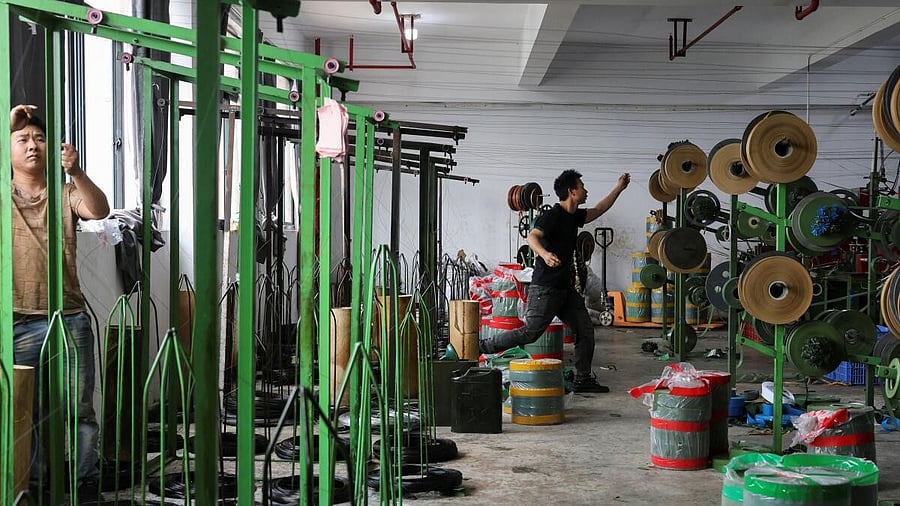
Effects of US tariffs on China
Credit: Reuters photo
Guangzhou: As President Donald Trump ratcheted up new tariffs on goods from China to 125 per cent this week, the mood in the dusty streets and small factories of southeastern China was a mixture of anger, worry and resolve.
Thousands of export-oriented small factories in or near Guangzhou, the commercial hub of southeastern China, have played a central role in the country's rapid economic development over the past half-century.
Quick to supply almost any manufactured product at a low cost, they employ millions of migrant workers from all over China.
Now many of these small factories, cornerstones of the Chinese economy, are confronting difficult times. Clothing factory managers fret about a spate of orders from American customers being canceled at the last minute, saddling them with losses. Managers of factories making machinery wonder whether their low costs will help them survive. And workers hope they will still have jobs in the coming weeks and months.
A few garment factories that mainly supplied the United States market have already closed temporarily as their owners wait for more clarity on tariffs. Managers of many more factories are now hurrying to find buyers in other countries or chase down customers in China.
But China already faced a huge glut of factory capacity even before Trump began closing the American market this year to many imports from China. Customers elsewhere have demanded ever deeper discounts.
Ruinously low prices for manufacturers have become particularly prevalent in the domestic market in China. Many Chinese consumers are now extremely frugal after losing their life savings in the country's housing market crash.
"The trade war has a huge impact, because if you can't export, there will be fewer orders for clothing, and there will be nothing to do," said Ling Meilan, co-owner of a shirt factory on the second floor of a concrete building in a vast warren of low industrial buildings. Workers hunched over sewing machines on long tables under fluorescent lights.
Ling focuses on the domestic market in China. But some neighboring factories that sell primarily to the United States have already temporarily suspended operations.
A factory manager down the street who gave only her family name, Yao, said that she mainly supplied Amazon and had already seen a slowing of orders. "If the U.S. tariffs are too high, we can't do it, and I will definitely switch to other markets," she said.