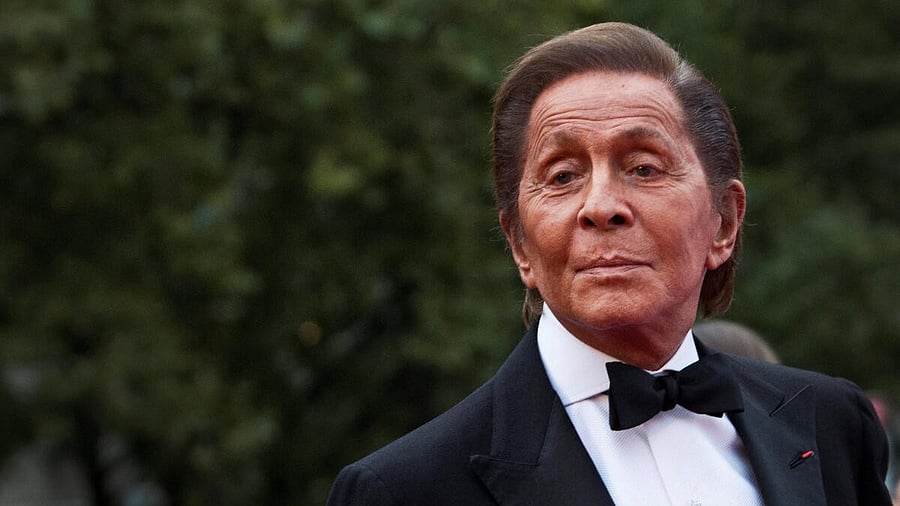
Fashion designer Valentino Garavani
Credit: Reuters photo
Valentino Garavani, the last of the great 20th-century couturiers and a designer who defined the image of royalty in a republican age for all manner of princesses — crowned, deposed, Hollywood and society — died Monday at his home in Rome. He was 93.
His death was announced in a statement by the Fondazione Valentino Garavani e Giancarlo Giammetti.
Dubbed “the last emperor” in a documentary film of the same name released in 2008 and “the Sheik of chic” by John Fairchild, the former editor of Women’s Wear Daily, Garavani founded his namesake company in 1959. For the next half century he not only dressed a world of grandees but became their equal, with his own palaces, movable court and signature shade of red.
“In Italy, there is the Pope — and there is Valentino,” said Walter Veltroni, then the mayor of Rome, in a 2005 profile of the designer in The New Yorker.
Perpetually tanned a deep shade of mahogany, his hair blow-dried to immobile perfection, almost always referred to by his first name (or by the honorific “Mr. Valentino”) and trailed by a retinue of people and pugs, Garavani created and sold an image of high glamour that helped define Italian style for generations.
His business came into the world just before the era of “La Dolce Vita,” and he was relentless in his allegiance to that ideal. “I always look for beauty, beauty,” he told the broadcaster Charlie Rose in an interview in 2009. He was not the designer-as-tortured-artist, but rather the designer as disciplined-bon-vivant. He didn’t care about setting trends or channeling the zeitgeist or being on the cutting edge.
“It is very, very simple,” he told The New York Times in 2007. “I try to make my girls look sensational.”
He made the cream lace dress Jacqueline Kennedy wore for her marriage to Aristotle Onassis in 1968, the sable-collared suit Farah Diba wore to flee Iran when her husband, the shah, was deposed in 1979, and the dress Bernadette Chirac wore when her husband Jacques was sworn in as president of France in 1995.
Also: the draped column with feathered hem Elizabeth Taylor wore to the Roman premiere of “Spartacus” in 1960, the black-and-white gown Julia Roberts wore when she won the best actress Oscar in 2001 and the one-shouldered yellow silk taffeta confection Cate Blanchett wore when she won Best Supporting Actress in 2005.
In the process he — and his business partner and closest associate, Giancarlo Giammetti — also earned Italian fashion a seat in the inner circle of Parisian couture ateliers, paving the way for Italian brands that came after such as Armani and Versace, built a fortune in licenses and became the first designer name brand quoted on the Milan stock exchange. And he achieved that rare thing in fashion: a smooth transition away from the runway.