
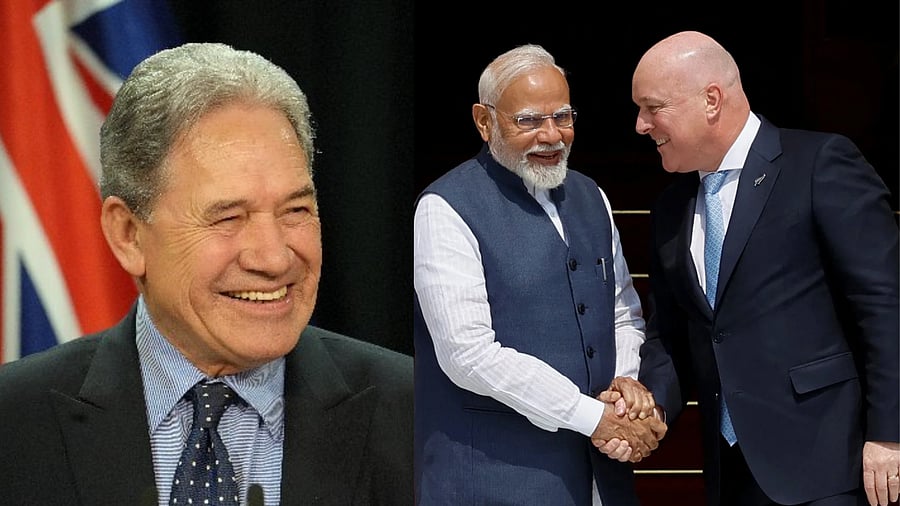
New Zealand Foreign Minister Winston Peters and (R) a file photo of Prime Minister Narendra Modi with his New Zealand counterpart Christopher Luxon.
Credit: X/@winstonpeters and Reuters Photo
New Zealand Foreign Minister Winston Peters has termed the India-New Zealand Free Trade Agreement (FTA), announced on Monday, “neither free nor fair” and warned that it is a 'bad deal for New Zealand' as it gives away too much while getting too little in return.
"New Zealand First is regrettably opposed to the India Free Trade Agreement. We consider the India-New Zealand Free Trade Agreement to be neither free nor fair. Regrettably, this is a bad deal for New Zealand. It gives too much away, especially on immigration, and does not get enough in return for New Zealanders, including on dairy," Peters said in a post on X.
Peters said his party New Zealand First, a nationalist political party, had urged its coalition partner not to “rush into concluding a low-quality deal with India” as getting "Parliamentary majority for that deal was uncertain" and instead use the full parliamentary term to negotiate a better outcome.
“Unfortunately, these pleas went unheeded,” Peters said and accused the National Party, led by Prime Minister Christopher Luxon, of choosing to do “a quick, low-quality deal over doing the hard work necessary to get a fair deal that delivers for both New Zealanders and Indians.”
Peters said his party had expressed its disapproval for the deal when Cabinet approval was sought for it last week. "New Zealand First exercised the agree to disagree provision of its coalition arrangements – while making clear that it would vote against enabling legislation if and when it is introduced to Parliament."
What does the deal offer
India and New Zealand on Monday announced the FTA that will eliminate duty on a majority of goods trade (except dairy and farm products), ease mobility rules for students and professionals and facilitate investments.
The deal was clinched in around nine months after launching the negotiations, making it the fastest FTA pocketed by India.
Under the FTA, New Zealand has agreed to provide duty-free access to all Indian exports. On the other hand, India has offered to eliminate tariffs on 70% of goods, covering 95% of the trade value. However, India has excluded its dairy sector and select farm products from the agreement.
The two countries announced the conclusion of the deal after Prime Minister Narendra Modi held a telephonic conversation Luxon.
“The two leaders jointly announced the successful conclusion of the historic, ambitious and mutually beneficial India–New Zealand Free Trade Agreement,” the Prime Minister’s Office said in a statement.
The FTA negotiation was launched during Luxon’s visit to New Delhi in March this year.
$20 billion investments
Apart from offering 100% duty free access to Indian goods, New Zealand has agreed to facilitate $20 billion investments in India over the next 15 years. New Zealand has also agreed to ease mobility rules for Indian students and professionals.
'Not a good deal for New Zealand farmers'
Expressing concerns over provisions of the agreement, Peters said, "While New Zealand is completely opening its market to Indian products under this deal, India is not reducing the significant tariff barriers currently facing our major dairy products. This is not a good deal for New Zealand farmers and is impossible to defend to our rural communities."
In the X post, he said, "National has also made serious concessions to India in areas that have nothing to do with two-way trade - but rather relate to encouraging the movement of people from India to New Zealand and New Zealand investment in India. On a per capita basis, National has offered far greater access for India to our labour market than did Australia or the United Kingdom to secure their FTAs. This is deeply unwise given New Zealand’s current labour market conditions, with too many New Zealanders in unemployment or doing it tough economically."
Stating that New Zealand First’s position on the India deal takes nothing away from its efforts to advance the India-New Zealand relationship, Peters said, "We are deeply committed to the advancement of the India-New Zealand relationship, which is in our country’s strategic interests."
He said that his party's stance had been communicated to External Affairs Minister S Jaishankar.