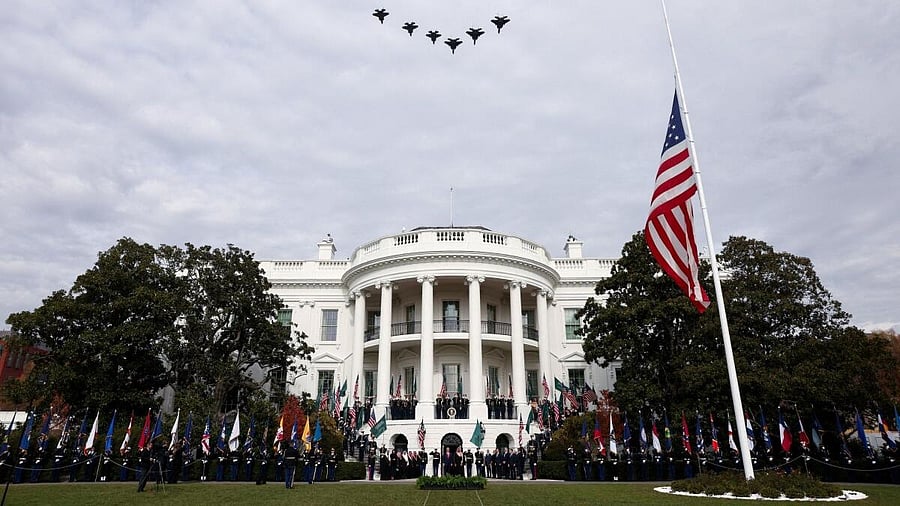
The White House in Washington, DC, US.
Credit: Reuters Photo
In late November, the Trump White House unveiled a new National Security Strategy that signals a sharp break from decades of US policy. Analysts on both sides of the Atlantic say the document redraws Washington’s strategic map, most notably by no longer treating the defence of Europe — a pillar of US grand strategy since World War II — as a central obligation. More pointedly, it chastises leading European countries for what it sees as their willingness to allow unbridled immigration, which, in the authors’ view, could lead to civilisational collapse.
At the same time, while the document extols a commitment to free speech, it rebukes European states for their perceived failure to uphold those principles. Reading between the lines, it is clear that it refers to the efforts of several European countries, most notably Germany, to impose what they regard as legitimate curbs on hate speech.
In a related vein, the strategy fails to mention, let alone highlight, the threat that a revanchist Russia poses to much of Europe. It does, however, emphasise the administration’s interest in ensuring that Europe bears a greater share of the burden for its collective defence. While it underscores the importance of protecting national sovereignty, it says nothing about guaranteeing the sovereignty of vulnerable states, most notably Ukraine.
The document also devotes considerable attention to President Trump’s domestic priorities, including his stated plans to restore America’s industrial capacity, protect American workers from what he considers unfair foreign competition, and end what he views as unfair trade practices. His administration has long articulated these goals, and their reiteration therefore comes as no great surprise.
In discussing other regions, particularly the Middle East and Africa, the strategy unabashedly prioritises the promotion of America’s material interests over other objectives. In the Middle East, it highlights President Trump’s decision to launch Operation Midnight Hammer, which it claims significantly degraded Iran’s nuclear weapons programme. It also notes America’s reduced dependence on energy from the region and suggests that the Middle East could instead become a major source and destination for investment, ranging from nuclear energy to artificial intelligence. With regard to Africa, the strategy criticises America’s past emphasis on spreading “liberal ideology” and calls instead for an “investment and growth paradigm” aimed at harnessing the continent’s abundant mineral resources.
The document further makes clear the administration’s desire to maintain American dominance in Latin America, largely to secure access to critical minerals and markets. It also hints darkly at the inroads made by unnamed actors in the region and stresses the perceived need for the United States to keep them at bay.
Turning to Asia, the strategy reaffirms America’s stated commitment to prevent any unilateral change to Taiwan’s status. As in the case of Europe, however, it calls on South Korea and Japan to do more to ensure peace and stability in East Asia. While it highlights intense economic competition with the People’s Republic of China (PRC), the document stops short of explicitly describing Beijing as a peer competitor. That said, it does reaffirm America’s commitment to the Quadrilateral Security Initiative, or the Quad.
With regard to India, the strategy stresses the need to deepen commercial and strategic ties. Consistent with its broader emphasis on burden-sharing, it urges New Delhi to contribute more to ensuring Indo-Pacific security. How Indian policymakers will respond remains an open question, particularly in light of the highly punitive tariffs the administration has imposed on the country. The document also repeats President Trump’s frequent assertion that he played a decisive role in ending the post-Pahalgam India–Pakistan crisis.
Several overarching themes emerge from the strategy. Most notably, it makes no pretence of a commitment to multilateralism. Equally striking is the absence of any discussion of the existential threat posed by climate change, or of ways to mitigate its likely consequences.
Another defining feature is its unapologetic emphasis on advancing America’s material interests worldwide. At the same time, it offers no affirmation of a commitment to foreign assistance, whether bilateral or multilateral. If anything, such efforts are dismissed as misguided.
Beyond these elements, a clear leitmotif runs through the document: the administration’s approach to the world is explicitly transactional. The United States will work with friends and allies only when doing so is deemed beneficial to Washington, DC. Any vestige of altruism that may have characterised earlier national security strategies has been entirely cast aside.
Finally, a tone of grievance permeates the text. It reflects a belief that, for years if not decades, other countries have sought to exploit the United States. This strategy appears designed to ensure that such perceived exploitation comes to an end. For the world’s wealthiest and most powerful country to adopt such a petulant stance is a sobering commentary on the current state of its leadership.
(The writer is a Senior Fellow at the Hoover Institution, Stanford University, and directs the Huntington Programme on Strengthening US–India Relations)