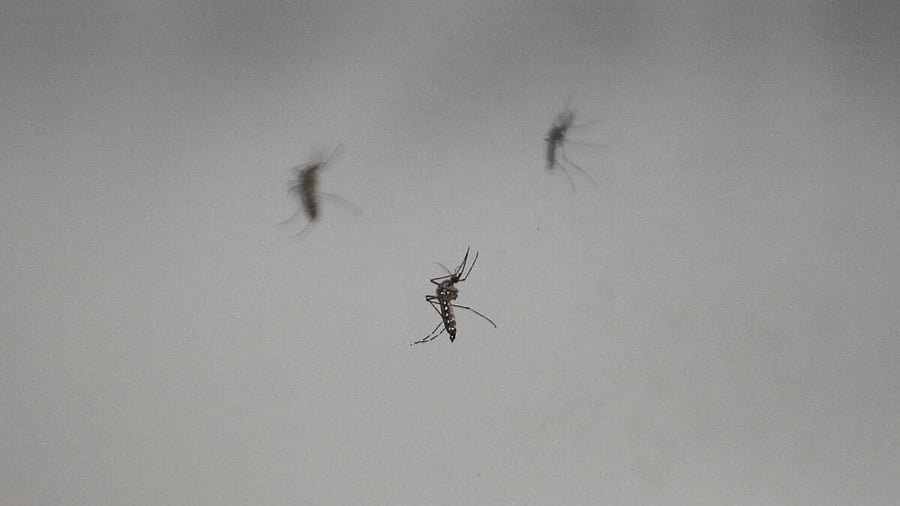
Image of mosquitoes for representational purposes.
Credit: Reuters Photo
New Delhi: A study in Brazil's Atlantic Forest has found that ongoing biodiversity loss may be causing mosquitoes -- that once fed on a variety of hosts -- to develop a preference for human blood.
The forest, stretching along the Atlantic coast of Brazil and extending into Paraguay and Argentina, is a globally recognised biodiversity hotspot, home to thousands of plant and animal species.
However, because of human expansion, only about 30 per cent of the forest's original area remains intact, researchers from Brazil's Federal University of Rio de Janeiro and Oswaldo Cruz Institute said.
With human presence driving away animals from their habitats, mosquitoes that once fed on a wide variety of hosts might be finding new, human targets to quench their thirst for blood, they said.
The study, published in the journal Frontiers in Ecology and Evolution, identified food sources of over 1,700 mosquitoes captured from the Atlantic Forest region of two natural reserves -- the Sítio Recanto Preservar and Guapiacu River Ecological Reserve -- in the state of Rio de Janeiro.
Of the captured mosquitoes, which belonged to 52 species, 145 females were engorged with blood and were analysed in a lab for food sources.
Blood meals consumed by 24 of the 145 female mosquitoes could be identified and were sourced from 18 humans, one amphibian, six birds, one canid, and one mouse, the researchers said.
"A total of 1,714 mosquitoes were captured, of which only 145 females (6.98 per cent) were engorged. The results revealed a clear tendency for the captured mosquito species to feed predominantly on humans," the authors wrote.
"This is crucial because, in a environment like the Atlantic Forest with a great diversity of potential vertebrate hosts, a preference for humans significantly enhances the risk of pathogen transmission," co-author Sergio Machado, a researcher of microbiology and immunology at the Federal University of Rio de Janeiro, said.
The researchers explained that with the dwindling of the Atlantic Forest due to deforestation and humans pushing into previously forested areas, plants and animals are disappearing.
As a result, mosquitoes change their habits and habitats and get closer to humans, they said.
"With fewer natural options available, mosquitoes are forced to seek new, alternative blood sources. They end up feeding more on humans out of convenience, as we are the most prevalent host in these areas," Machado said.
The findings can help develop more effective policies and strategies aimed at controlling disease-carrying mosquitoes and prevent outbreaks, the researchers said.
They added that studying mosquitoes' feeding behaviour is fundamental for understanding the ecological and epidemiological dynamics of the diseases the insects transmit.