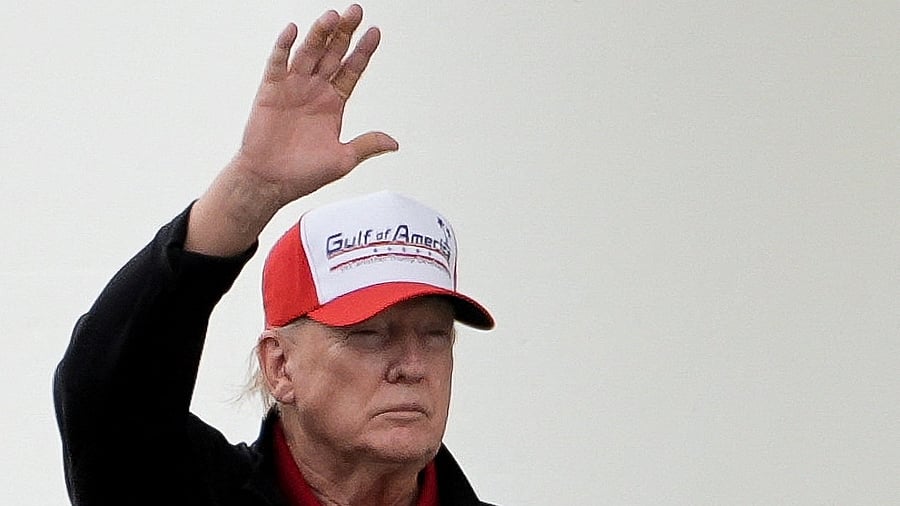
U.S. President Donald Trump
Credit: Reuters photo
A draft of a Trump administration executive order proposes a drastic restructuring of the State Department, including eliminating almost all of its Africa operations and shutting down embassies and consulates across the continent.
The draft also calls for cutting offices at State Department headquarters that address climate change and refugee issues, as well as democracy and human rights concerns.
The purpose of the executive order, which could be signed soon by President Donald Trump, is to impose "a disciplined reorganization" of the State Department and "streamline mission delivery" while cutting "waste, fraud and abuse," according to a copy of the 16-page draft order obtained by The New York Times. The department is supposed to make the changes by Oct. 1.
Some of the proposed changes outlined in the draft document would require congressional notification and no doubt be challenged by lawmakers, including mass closures of diplomatic missions and headquarters bureaus, as well as an overhaul of the diplomatic corps. Substantial parts of it, if officials tried to enact them, would likely face lawsuits.
Elements of the executive order could change before final White House review or before Trump signs it, if he decides to do so. Neither the State Department nor the White House National Security Council had immediate comment on the draft order early Sunday.
Secretary of State Marco Rubio wrote a short comment on social media after this article was published calling it "fake news."
The document began circulating among current and former U.S. diplomats and other officials Saturday. It was not immediately clear who had compiled the document or what stage of internal debates over a restructuring of the State Department it reflected. It is one of several recent documents proposing changes to the State Department, and internal administration conversations take place daily on possible actions.
Major structural changes to the State Department would be accompanied by efforts to lay off both career diplomats, known as foreign service officers, and civil service employees, who usually work in the department's headquarters in Washington, said current and former U.S. officials familiar with the plans. The department would begin putting large numbers of workers on paid leave and sending out notices of termination, they said.
The draft executive order calls for ending the foreign service exam for aspiring diplomats, and it lays out new criteria for hiring, including "alignment with the president's foreign policy vision."
The draft says the department must greatly expand its use of artificial intelligence to help draft documents, and to undertake "policy development and review" and "operational planning."
The proposed reorganization would get rid of regional bureaus that help make and enact policy in large parts of the world.
Instead, the draft says, those functions would fall under four "corps": Eurasia Corps, consisting of Europe, Russia and Central Asia; Mid-East Corps, consisting of Arab nations, Iran, Pakistan and Afghanistan; Latin America Corps, consisting of Central America, South America and the Caribbean; and Indo-Pacific Corps, consisting of East Asia, Southeast Asia, India, Bangladesh, Sri Lanka, Nepal, Bhutan and the Maldives.
One of the most drastic proposed changes would be eliminating the bureau of African affairs, which oversees policy in sub-Saharan Africa. It would be replaced by a much smaller special envoy office for African affairs that would report to the White House National Security Council. The office would focus on a handful of issues, including "coordinated counterterrorism operations" and "strategic extraction and trade of critical natural resources."
The draft also said all "nonessential" embassies and consulates in sub-Saharan Africa would be closed by Oct. 1. Diplomats would be sent to Africa on "targeted, mission-driven deployments," the document said.
Canada operations would be put into a new North American affairs office under Rubio's authority, and it would be run by a "significantly reduced team," the draft said. The department would also severely shrink the U.S. Embassy in Ottawa, Ontario.
The department would eliminate a bureau overseeing democracy and human rights issues; one that handles refugees and migration; and another that works with international organizations. The undersecretary position overseeing the first two bureaus would be cut. So would the office of the undersecretary of public diplomacy and public affairs.
The department would also get rid of the position of the special envoy for climate.
The department would establish a new senior position, the undersecretary for transnational threat elimination, to oversee counternarcotics policy and other issues, the draft memo said.
The Bureau for Humanitarian Assistance would absorb the remnants of the U.S. Agency for International Development, which has been gutted over the past two months by Rubio and other members of the Trump administration.
As for personnel, the memo said, the department needs to move from its "current outdated and disorganized generalist global rotation model to a smarter, strategic, regionally specialized career service framework to maximize expertise."
That means people trying to get into the Foreign Service would choose during the application process which regional corps they want to work in.
The department would offer buyouts to foreign service and civil service officers until Sept. 30, the draft said.
The draft order also calls for narrowing Fulbright scholarships so that they are given only to students doing master's-level studies in national security matters.
And it says the department will end its contract with Howard University, a historically Black institution, to recruit candidates for the Rangel and Pickering fellowships, which are to be terminated. The goal of those fellowships has been to help students from underrepresented groups get a chance at entering the Foreign Service soon after graduation.
The draft executive order is one of several internal documents that have circulated in the administration in recent days laying out proposed changes to the State Department. Another memo outlines a proposed cut of nearly 50% to the agency's budget in the next fiscal year. Yet another internal memo proposes cutting 10 embassies and 17 consulates.
This article originally appeared in The New York Times.