
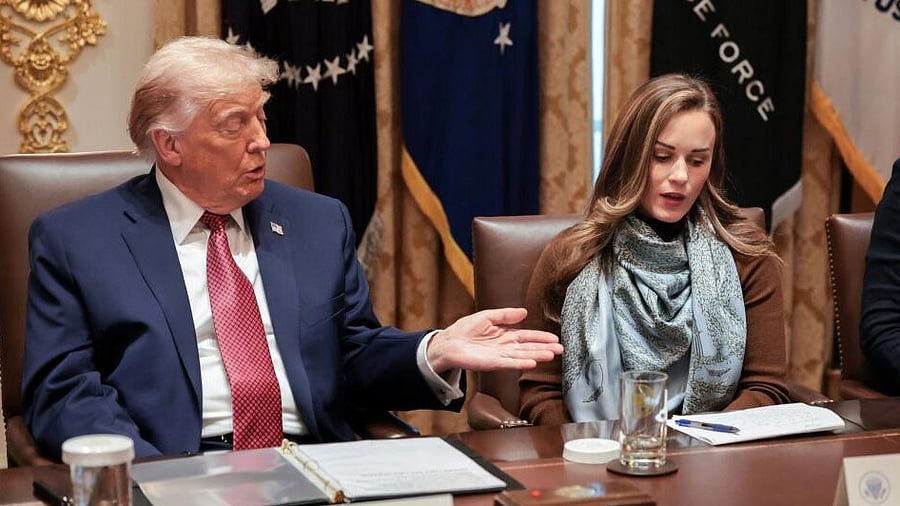
US President Donald Trump speaks next to Meryl Kennedy of the rice farming company 4 Sisters during a roundtable discussion at the White House in Washington, DC, US.
United States President Donald Trump has said that India should not be "dumping" rice into the US market and he will "take care" of it, while stressing that tariffs will solve the "problem" easily.
He said this at a roundtable in the White House on Monday with representatives of the farming and agriculture sector as well as key members of his Cabinet.
Meryl Kennedy, who runs her family's agribusiness in Louisiana, told Trump that rice producers in the southern part of the country are "really struggling" and that other nations are "dumping" rice into the US.
When asked by Trump which countries are dumping rice into America, Kennedy, sitting next to the President, replied, "India, and Thailand; even China into Puerto Rico. Puerto Rico used to be one of the largest markets for US rice. We haven't shipped rice into Puerto Rico in years."
Kennedy said that this has been happening for years and did not start during the Trump administration. "But unfortunately, we're seeing it in a much bigger way now," she said.
She said that tariffs imposed by the Trump administration are working, “but we need to double down”, to which Trump said, "You want more, I understand".
Treasury Secretary Scott Bessent and Agriculture Secretary Brooke Rollins were among those present at the roundtable during which Turmp announced USD 12 billion in federal aid for farmers.
Turning to Bessent, Trump said, “India, tell me about India. Why is India allowed to do that? They have to pay tariffs. Do they have an exemption on rice?”
"No sir, we're still working on their trade deal," Bessent replied.
Trump then said, "But they shouldn’t be dumping. I mean, I heard that. I heard that from others. They can’t do that."
Kennedy then told Trump there's a World Trade Organization case against India.
Trump asked Kennedy to give him the names of the countries dumping rice into the US and instructed Bessent to note down the names. "India. Who else?" Trump said.
"India, Thailand, China into Puerto Rico, not into the continental US, but into Puerto Rico. Those are the main culprits," Kennedy said, adding that American farmers can feed the US as well as nations around the world, but "we need fair trade, not free trade".
Trump said this would be “so easy to settle”.
"It's solved so quickly with tariffs to these countries that are illegally shipping. It's solved. Your problem is solved in one day. That's why we have to win the Supreme Court case," he said, adding that this problem will be solved in “one day”.
India largest producer of rice
India, with a 28 per cent share of the global market, is the largest producer of rice — 150 million tonnes. It is also the top exporter, with a 30.3 per cent share of global exports in 2024–2025, data by the Indian Rice Exporters Federation (IREF) showed.
According to data available on the website of the India Brand Equity Foundation (IBEF), India exported about 2.34 lakh tonnes of rice to the US in the 2024 fiscal, less than 5 per cent of its total global basmati rice exports of 52.4 lakh tonnes. West Asia remains the dominant destination for Indian rice, according to the data.
'Sona Masoori' is preferred in markets such as the US and Australia, among other varieties.
50 per cent tariff on India
Trump has imposed a 50 per cent tariff on India, the highest in the world, including 25 per cent for Delhi's purchases of Russian oil.
Prem Garg, president of Indian Rice Exporters Federation National, had termed the 25 per cent reciprocal tariff as a temporary "hurdle" for rice shipments and had stated that India still retains a pricing advantage over competitors like Vietnam and Pakistan.
"This tariff is a temporary hurdle, not a long-term roadblock. With strategic planning, diversification, and flexibility, Indian rice exporters can protect and even expand their presence in the US market," Garg had said earlier this year.
At the roundtable on Monday, Trump said that America lost half of its car industry and chip industry because these products were being manufactured in other countries, and previous administrations did not impose tariffs on these imports into the US.
"It's the same thing with rice. It'll be good, will get it solved very quickly. We just need the countries. Just give us the names of the countries. Tariffs, again. It solves the problem in two minutes," the President said.
(With PTI inputs)