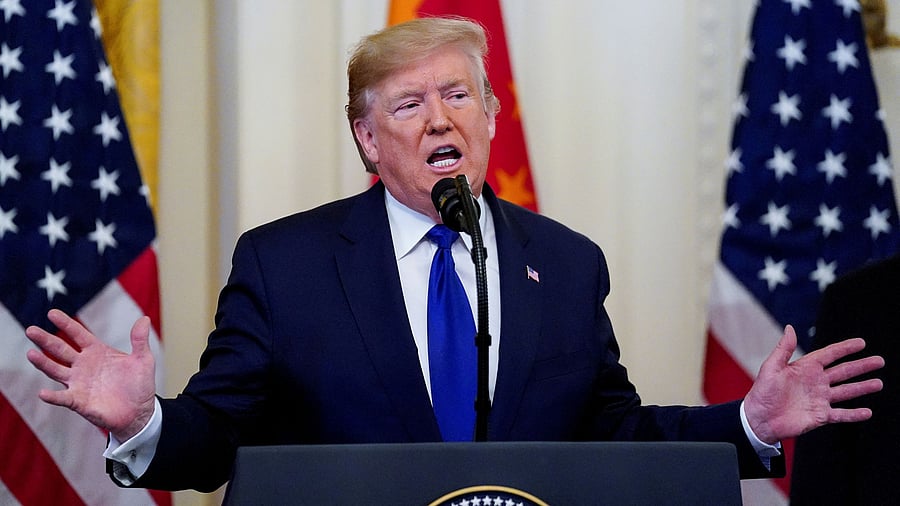
Donald Trump.
Credit: Reuters Photo
Washington: During a closed-door White House meeting in his first term, President Donald Trump demanded to know why the US was accepting immigrants from “shithole countries” like Haiti and some African nations, remarks widely reported at the time by Reuters and other media outlets.
Outrage followed. Lawmakers, including some Republicans, condemned the language as offensive. Even Trump sought to do damage control, denying in a social media post that he had used those words.
On Tuesday, during a televised cabinet meeting, Trump reacted to reports of government fraud among pockets of Minnesota's large Somali population by calling immigrants there "garbage" and saying he wanted them sent "back to where they came from."
This time around, Republican members of Congress stayed quiet. Vice President JD Vance banged the table in agreement, while White House press secretary Karoline Leavitt characterised Trump's remarks as "amazing" and an "epic moment."
The response underscored how Trump's racial views are no longer seen as out of bounds among some of his allies and supporters. Civil rights advocates and researchers say his comments have become increasingly bold, normalized and politically permissible.
"Racism is no longer a dog whistle in America. We’re dehumanizing and targeting people," said LaTosha Brown, co-founder of Black Voters Matter Fund, a group that pushes for better voter access for marginalized and predominantly Black communities.
White House spokeswoman Abigail Jackson said in a statement that President Trump is right to highlight problems caused by "radical Somali migrants."
"While the media feigns outrage, Americans who have suffered at the hands of these schemes will celebrate the president’s comments and strong support for American citizens," Jackson said.
US Treasury Secretary Scott Bessent said this week that his agency is investigating allegations that tax dollars from Minnesota were diverted to the militant group Al-Shabaab in Somalia.
Trump has a long history of racist rhetoric, particularly against immigrants of color. He propelled himself into national politics by advancing the false conspiracy theory that President Barack Obama, a Democrat, was not born in the United States.
Critics say that, as president, Trump has implemented policies that reflect his rhetoric, particularly his immigration crackdown.
On Wednesday, Trump doubled down on his comments, telling reporters in the Oval Office that Somalia "is considered by many to be the worst country on earth" and accusing Somali immigrants of having "destroyed the country."
Jeanne Shaheen, the top Democratic member of the Senate Foreign Relations Committee, and several other Democrats in Congress called his comments "xenophobic and unacceptable" in a statement and warned that militant groups like the Islamic State could use them to stoke anti-American sentiment abroad.
Escalating rhetoric
Alvin Tillery, a political science professor at Northwestern University, said that Trump’s use of the presidential bully pulpit as a platform for racist commentary is "absolutely unique" in the modern era and goes beyond the rhetoric of previous Republican Presidents Richard Nixon and Ronald Reagan, who were often criticized for making what many saw as thinly veiled racial appeals.
"They never went anywhere near this kind of hateful rhetoric targeting communities of color or minority groups," Tillery said. "It’s very dangerous."
In many ways, Trump's immigration policies echo his political statements. He has blocked virtually all new refugees, save for white South Africans whom he falsely claims are the targets of a "white genocide."
Masked federal officers have employed aggressive tactics in immigration sweeps across the country and have been criticized for detaining people who simply look Latino or speak Spanish.
In recent days, Trump has escalated his rhetoric and immigration restrictions in the wake of the shooting of two National Guard soldiers in Washington, D.C. The suspected shooter, an Afghan national who came to the U.S. under a program for Afghans who helped American forces during the war in their country, pleaded not guilty to murder and other crimes.
In response, the White House announced it was pausing immigration applications from 19 non-European countries.
Immigration remains one of Trump's stronger issues, though Reuters/Ipsos polling shows his net approval rating on the subject has gone from plus-7 in January to negative-10 in mid-November. Still, analysts say it gives him leverage at a time when broader support for his policies is faltering.
"It is easy to scapegoat immigrants and say they’re the reason for all these problems," said Melik Abdul, a Republican strategist and political commentator who supports Trump.
Language carries risks
Historians say there’s risk to people of color when authorities use racist rhetoric. In October, leaked political group chats exposed racist, antisemitic and violent rhetoric among young Republican leaders, fueling concerns that hate speech has become normalized in American politics.
Trump’s comments on Tuesday have alarmed the sizable Somali American community in Minnesota, amid news reports of possible federal immigration raids there. There were 76,000 people of Somali descent living in Minnesota in 2024, according to the U.S. Census Bureau; more than half were born in the United States.
Jaylani Hussein, executive director of the Council on American-Islamic Relations in Minnesota, told Reuters that many community members – including some who voted for Trump last year – now fear for their safety, well beyond concerns about immigration enforcement.
Last year, after Trump suggested during a nationally televised presidential debate that Haitian migrants in Springfield, Ohio, were eating household pets, threats to that community spiked, businesses closed and many Haitian legal residents left the city.
Trump has also attacked Minnesota US Representative Ilhan Omar, who came to the US as a Somali refugee when she was a child and is a naturalized citizen. He called her "garbage" as well on Tuesday, and said on Wednesday that "she should be thrown the hell out of our country."
"The president has always had very bigoted, xenophobic, Islamophobic comments when it comes to people who are of Muslim faith or people who are Black,” Omar told Reuters on Wednesday. “We've seen him call African nations as shitholes, and so it's not really surprising.”