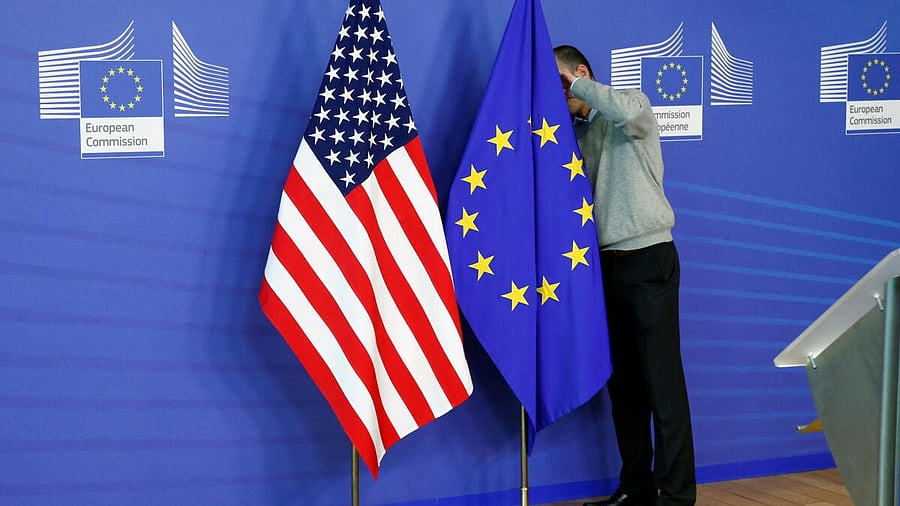
A worker adjusts European Union and U.S. flags at the EU Commission headquarters in Brussels.
Credit: Reuters photo
London/Frankfurt/Paris: Just as European companies were getting used to last year's hard-won US trade tariff deals, President Donald Trump has put them back in his crosshairs with an explosive threat to place levies on nations that oppose his planned takeover of Greenland.
Trump on Saturday said he would put rising tariffs from February 1 on goods imported from EU members Denmark, Sweden, France, Germany, the Netherlands and Finland, along with Britain and Norway, until the US is allowed to buy Greenland, a step major EU states decried as blackmail.
On Sunday, European Union ambassadors reached broad agreement to intensify efforts to dissuade Trump from imposing those tariffs, while also readying a package of retaliatory measures should the duties go ahead, EU diplomats said.
The shock move has rattled through industry and sent shockwaves through markets amid fears of a return to the volatility of last year's trade war, which was only eased with tariff deals reached in the middle of the year.
"This is a very serious situation, the scale of which is unknown," Gabriel Picard, chairman of the French wine and spirits export lobby FEVS, told Reuters.
He said the industry had already seen a 20% to 25% hit to U.S. activity in the second half of last year from previous trade measures, and new tariffs would bring a "material" impact.
But he said what was happening went far beyond sectoral issues. "It is more a matter of political contacts and political intent that must be taken to the highest level in Europe, so that Europe, once again, is united, coordinated, and if possible speaks with one voice."
Stand-off could reignite trade war
In a post on Truth Social, Trump said additional 10% import tariffs would take effect next month on goods from the listed European nations — all already subject to between 10% and 15% tariffs imposed by the U.S. president last year.
The bloc - which had an estimated $1.5 trillion in goods and services trade with the U.S. in 2024 - looks set to fight back. Europe has major carmakers in Germany, drugmakers in Denmark and Ireland, and consumer and luxury goods firms from Italy to France.
EU leaders are set to discuss options at an emergency summit in Brussels on Thursday, including a 93 billion euro ($107.7 billion) package of tariffs on U.S. imports that could automatically kick in on February 6 after a six-month pause.
The other is the so far never used "Anti-Coercion Instrument" (ACI), which could limit access to public tenders, investments or banking activity or restrict trade in services, in which the U.S. has a surplus with the bloc.
Analysts said the key question was how Europe responded - with a more "classic" trade war tit-for-tat tariff retaliation, or an even tougher approach.
"The most likely way forward is a return to the trade war that was put on hold in high-level U.S. agreements with the UK and the EU in summer," said Carsten Nickel, deputy director of research at Teneo in London.
Tougher approach
The Greenland threat was perhaps the jolt that Europe needed to toughen its approach and focus on developing its own joint programmes to be more independent from the U.S., the CEO of German submarine maker TKMS Oliver Burkhard said.
"It is probably necessary... to get a kick in the shin to realise that we may have to suit up differently in the future," he told Reuters.
Wolfgang Grosse Entrup, managing director of Germany's chemicals and pharma lobby VCI, said a "tariff spiral" would cause high economic costs in both Europe and the US, and burden the chemical and pharmaceutical industry on both sides of the Atlantic.
"One thing is already clear: uncertainty in our industry has increased again," he said. "Investment decisions are becoming more difficult, and predictability is being lost."
An official at a French industry association that represents the country's largest firms said the Greenland issue was turning tariffs into a "tool for political pressure", and called for the region to reduce its dependency on the US market.
Neil Shearing, group chief economist at Capital Economics, pointed out that some EU countries - Spain, Italy and others - were not on the tariff list, which would likely see "re-routing" of trade within the EU free trade bloc to avoid the taxes.
Analysts added the new tariffs, if imposed, would likely hurt Trump by pushing up U.S. prices and encouraging the front-loading of exports before the tariffs kicked in, while encouraging companies to seek new markets.
"A trade war only creates losers," said Christophe Aufrere, director general of French autos association the PFA.