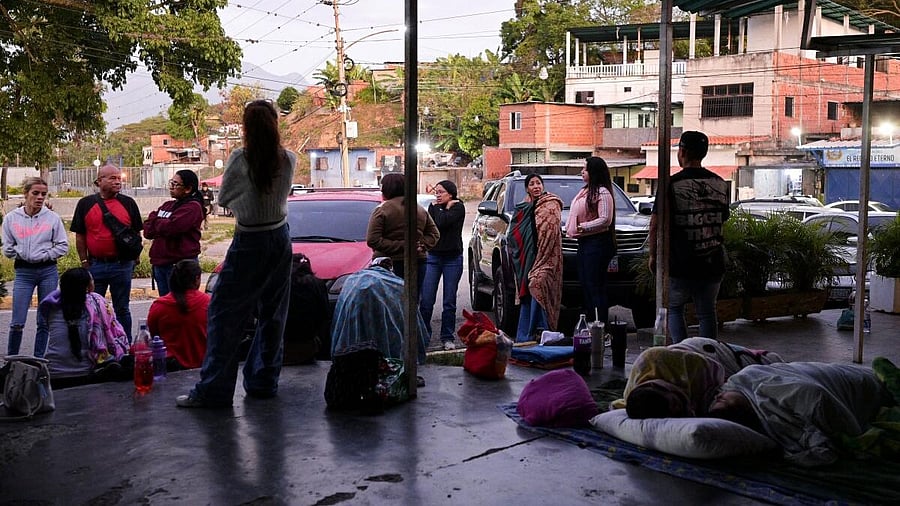
Family members of detainees wait outside the El Rodeo jail, after National Assembly President Jorge Rodriguez announced that a number of foreign and Venezuelan prisoners will be released, in El Rodeo, Miranda state, Venezuela January 9, 2026
Credit: Reuters photo
Venezuela's government began to release political prisoners from two notorious prisons Thursday in the first gesture of change by the new administration since the United States captured President Nicolás Maduro on Sunday.
Jorge Rodríguez, the head of Venezuela's National Assembly, did not specify how many people would be freed but said it would be "an important number" and that they would be both Venezuelans and foreign nationals.
"Consider this gesture from the Bolivarian Government -- made with sincere intentions toward peace -- as the contribution we all must make so that our republic can continue living peacefully and striving for prosperity," said Rodríguez, who is also the brother of Venezuela's interim leader, Delcy Rodríguez.
Among the first prisoners confirmed to be released was Rocío San Miguel, one of Venezuela's most prominent security experts, who had dared investigate her country's authoritarian government until she was detained in February 2024.
San Miguel, who is a dual Venezuelan-Spanish citizen, appeared to be one of five Spanish citizens released Thursday, according to the Spanish government. The government did not release the citizens' names, but San Miguel's relative confirmed her release.
Prisoners' rights groups estimate that between 800 and 900 political prisoners are incarcerated in Venezuela, and they say that most are charged with crimes such as incitement of hate, conspiring to overthrow the government or terrorism for simply exercising basic political rights.
The release of some of those prisoners offered a flicker of hope for a more open, democratic future for Venezuela, even as its government intensified a crackdown on citizens elsewhere, interrogating people and searching their phones for signs of support for Maduro's capture.
"Let us hope that this is indeed the beginning of the dismantling of a repressive system in Venezuela," said Alfredo Romero, director of Foro Penal, Venezuela's leading human rights organization. "May the justice system work to protect citizens, and not as a weapon of political persecution against dissidents."
For years, Venezuela's crackdowns have been followed by limited reprieves, which have included prisoner releases -- a cycle that has exhausted Venezuelans. It remains unclear whether Thursday's announcement signals any real shift toward political opening in the country.
Maduro jailed thousands of people who protested his unsubstantiated victory claim in the 2024 presidential election, and in recent months he had stepped up the arbitrary detentions amid escalating tensions with the United States.
Since the detention of Maduro, President Donald Trump had largely sidelined the issue of human rights in Venezuela to focus on the country's oil reserves.
When Trump was asked by reporters Sunday whether he had discussed with the Venezuelan government the release of political prisoners or the return of opposition politicians to Venezuela, he said, "We haven't gotten to that yet."
"What we want to do now is fix up the oil," he added.
But Tuesday, he said that "they have a torture chamber in the middle of Caracas that they're closing up."
Trump appeared to be referring to El Helicoide, a prison that was once intended to be a shopping mall and that became the headquarters of the secret police and a jail -- a constant and central reminder of state violence.
Still, the announcement of the prisoner release came days after a new interim president, Delcy Rodríguez, was sworn in with the support of the United States, marking a highly symbolic move to show a change in direction in the country's government.
"A certain faction within the government intends to send a positive message not only to the Venezuelan people, but also to the international community," said Gonzalo Himiob, a Venezuelan lawyer and the president of Foro Penal.
Last week, the Venezuelan administration released at least 80 political prisoners, according to rights groups, as is quite regular around the holidays, and others were released in late December.
Prisoners' rights advocates said that visits to Caracas' prisons, where hundreds of political prisoners are also held, were suspended this week. They said that in some jails, the authorities were also not allowing family members to deliver packages of food or medicine to the prisoners.
"We demand an end to the repression -- key conditions for starting a true process of transition and national reconciliation," the Committee for the Freedom of Political Prisoners wrote on social media before the releases.
This article originally appeared in The New York Times.