
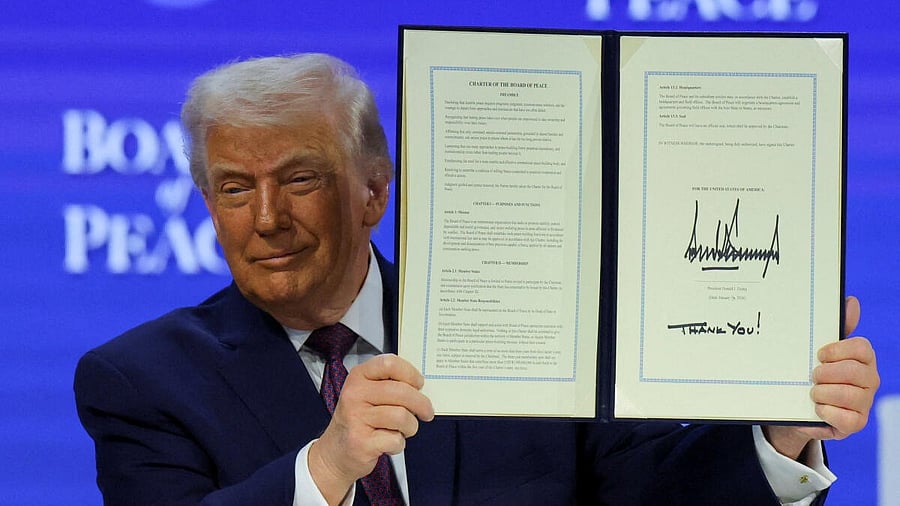
US President Donald Trump holds a signed Charter of the Board of Peace, as he takes part in a charter announcement for his Board of Peace initiative aimed at resolving global conflicts, alongside the 56th annual World Economic Forum (WEF), in Davos, Switzerland
Credit: Reuters Photo
US President Donald Trump has unveiled an expanded version of his proposed “Board of Peace”, a global grouping initially conceived to oversee the Gaza ceasefire plan. What began as a small council of world leaders has now grown into a wider coalition, though not without clear divisions.
According to a tally released alongside the initiative, a clutch of countries from Asia, the Middle East, Eastern Europe and Latin America have agreed to join the board.
Those backing the plan include: Argentina, Albania, Armenia, Azerbaijan, Bahrain, Belarus, Bulgaria, Egypt, Hungary, Indonesia, Jordan, Kazakhstan, Kosovo, Morocco, Mongolia, Pakistan, Qatar, Saudi Arabia, Turkey, United Arab Emirates, Uzbekistan and Vietnam.
Countries that have opted out include: France, Norway, Slovenia, Sweden, United Kingdom.
A third group of countries remains noncommittal. Major powers and blocs such as India, China, Germany, Italy, Russia and the European Union’s executive arm have neither signed on nor rejected the proposal outright, choosing instead to wait and watch.
Trump has pitched the initiative as a global, not American, project. “This isn’t the United States, this is for the world,” he has said, suggesting the model could be extended beyond Gaza if it succeeds. For now, the sharply split responses highlight the diplomatic fault lines around the proposal—and the challenge of building consensus around it.