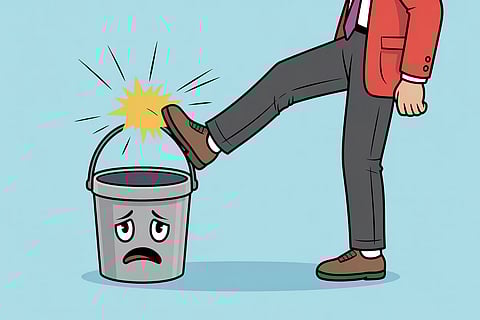

“Kicking the bucket” is one of the strangest ways English talks about death — casual, almost playful, yet deeply old. The phrase has been used for centuries, but its exact origin is still debated, which makes it even more fascinating.
One popular theory comes from old farming practices in England. Animals were sometimes hung from a wooden beam called a bucket or buckett while being slaughtered. When the animal struggled, it would kick the beam — quite literally “kicking the bucket.” Over time, the phrase shifted from a physical action to a figurative way of saying someone had died.
Another explanation points to suicides in which a person stood on a bucket and kicked it away. Yet a third theory links the phrase to church customs, where a wooden frame called a bucket held candles for the dead. None of these explanations can be proven fully, but all place the phrase firmly in everyday life centuries ago.
What’s striking is how the expression softened a serious subject. Saying someone “passed away” or “kicked the bucket” made death easier to talk about. Today, the phrase is informal and often humorous, reminding us that language doesn’t just describe life — it also helps us cope with its hardest realities