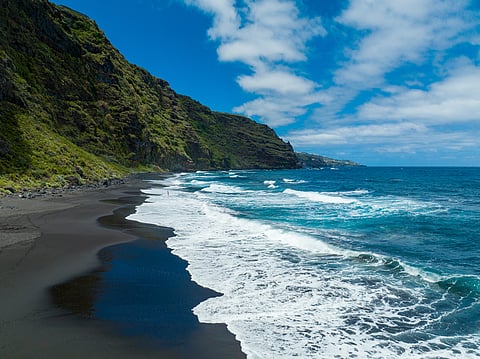

Playa de Nogales sits on the north east coast of La Palma, one of Spain’s Canary Islands. At first glance it looks almost unreal: a wide ribbon of deep black sand, bright white surf, and steep green cliffs that rise like a wall behind the shore. The dark colour is not dirt or pollution. It is the island’s geology, crushed into grains and shaped by the sea.
La Palma was built by volcanic activity. Much of its coastline is made of dark volcanic rock, especially basalt. Over years, rain and wind crack the rock, and waves do the heavy work, grinding it down into finer and finer pieces. Those dark fragments become black sand. When the grains are wet, they can look even darker, almost like pepper sprinkled across the shore.
Nogales also feels dramatic because it is exposed to the Atlantic. The waves can be powerful and the currents can be strong, which is why the beach often looks most beautiful from above, from the viewpoint known as the Mirador. To reach the sand, you park near the top and walk down a path with steps. The walk is part of the experience, because the view keeps opening wider with every turn.
This is the kind of beach that rewards slow travel. Go for the scenery, the sound of the surf, and the feeling of standing on volcanic history. If you plan to enter the water, be cautious and only do so when conditions are calm, because the ocean here does not behave like a gentle swimming pool.