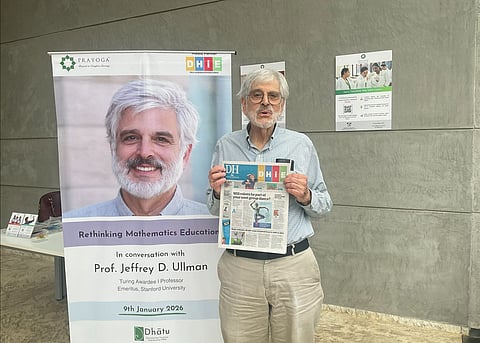

Prayoga Institute of Education Research hosted Prof Jeffrey D. Ullman, Turing Award laureate and Professor Emeritus at Stanford University, for a full day of academic- and industry-focused engagements centred on mathematics education, computer science, and the future of learning and work. The event, with Deccan Herald in Education (DHiE), as media partner featured an interactive session titled, Rethinking Mathematics Education. The session brought together participants from academia, industry, and schools to explore the role of foundational mathematics in developing future-ready skills, the evolving relationship between mathematics and computer science, and the implications for curriculum, pedagogy, and research.

The guests lighting the lamp to begin a day full of academic- and industry-focused engagements centred on mathematics education.
Prayoga Institute of Education Research hosted Prof Jeffrey D. Ullman, Turing Award laureate and Professor Emeritus at Stanford University, for a full day of academic- and industry-focused engagements centred on mathematics education, computer science, and the future of learning and work. The event, with Deccan Herald in Education (DHiE), as media partner featured an interactive session titled, Rethinking Mathematics Education. The session brought together participants from academia, industry, and schools to explore the role of foundational mathematics in developing future-ready skills, the evolving relationship between mathematics and computer science, and the implications for curriculum, pedagogy, and research.
Drawing on his work on the Gradiance platform, Prof Ullman discussed the root questions approach, which enables students to actively solve problems, receive timely guidance when they struggle, and refine their thinking until they arrive at correct solutions. He also addressed persistent challenges in mathematics education, including the scalability of assessment, delayed feedback, and the tendency of homework to function as testing rather than learning.
D N Prahlad, founder and Chairman of Surya Software Systems sharing his thoughts at the event.
The visit marked an important milestone in Prayoga’s ongoing collaboration under the Dhātu initiative, which aims to strengthen deep conceptual understanding in mathematics through research-led and technology-enabled learning. Prof Ullman’s sustained engagement over the past year has contributed to shaping the academic direction and long-term vision of the initiative. Prof Ullman also interacted with students from Prayoga’s Dhātu pilot, a technology-enabled mathematics learning platform based on the root questions methodology, highlighting the role of research-driven approaches in strengthening foundational mathematics learning. Over 70 students participated in the Dhātu pilot, engaging in hands-on activities. The session aimed to expose students to mathematics as a way of thinking and inquiry, while enabling meaningful dialogue with teachers and academic leaders.
Students at the session.
“Students often ask me,”What did I do wrong?” Dhatu provides an answer for this. It not only points out the mistake, but also suggests a path which helps the students with hints to answer their questions. Working with Prof Ullmann and team, we have developed the Dhatu program to give students a platform to learn mathematics without fear or embarrassment.” said Ramana Andra, Lead faculty - Mathematics, Prayoga Institute of Education Research.
Justice Dr M N Venkatachaliah, Former Chief Justice of India and the Chairman of the Advisory Board of Prayoga share his views.
The event also featured an address by Justice M N Venkatachaliah, Former Chief Justice of India, who emphasised the urgent need for institutions and organisations committed to driving meaningful and long-term change in education. During the interaction, participants raised questions on how artificial intelligence is expected to influence teaching, learning, and educational systems, reflecting growing interest in the future of education amid rapid technological change.
Dr H S Nagaraja, Founder & Chief Mentor, Prayoga, shares his views.
The engagement reinforces Prayoga’s ongoing efforts to strengthen foundational mathematics learning through research-led and technology-enabled approaches, while fostering dialogue among students, educators, and researchers on rethinking pedagogy, assessment, and the role of inquiry in education reform.