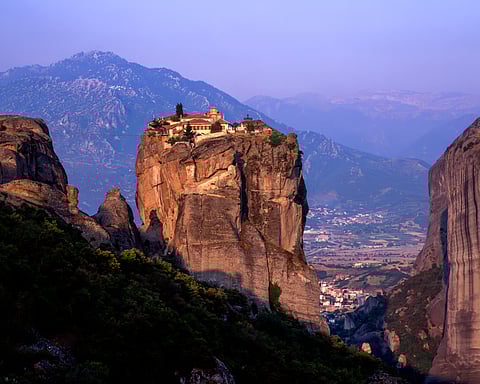

In Greece’s Meteora region, enormous rock towers rise from the landscape, and some boulders appear to balance delicately on narrow points. These formations look unstable, yet they remain firmly in place through storms, winds, and earthquakes. Their stability comes from the way erosion shapes rock masses over millions of years.
Meteora’s rock pillars were originally part of a single sandstone and conglomerate formation. Over time, rain, wind, and temperature changes carved the mass into separate towers with rounded edges. Softer rock layers wore away more quickly, leaving harder layers behind. In places where erosion removed material at the base faster than at the top, narrow pedestal-like shapes formed.
The balancing effect occurs because these rocks developed very low centres of gravity. Although their contact points with the ground appear small from the outside, much of the rock’s weight sits deeper within the formation. Many “balancing rocks” also have broad internal support points hidden from view, which distribute weight evenly.
The region’s climate contributes to their survival. Wind often shapes rocks evenly from all directions, smoothing them without pushing them off balance. Additionally, the internal structure of Meteora’s conglomerate rock—filled with tightly packed pebbles—gives it strength despite unusual shapes.
These formations may look fragile, but they are among the most stable natural sculptures in Europe.
Low centre
Most weight sits deep within the rock’s core.
Even erosion
Wind shapes surfaces uniformly, keeping rocks stable.
Conglomerate strength
Pebble-filled rock layers resist collapse over centuries.