
In the weeks before Christmas, schools everywhere begin to change. Corridors fill with paper stars, classrooms sparkle with tinsel, and someone — a teacher, a senior student, or a brave volunteer — puts on a red coat and a white beard. There are Christmas assemblies, small gifts, laughter and photographs with “Santa Claus”. Most students know it’s a costume, yet the excitement feels real. That familiar figure, dressed in red and spreading cheer, connects classrooms today to a story that began hundreds of years ago.
The story of Santa Claus did not start with sleighs or reindeer. It began with a real person named Nicholas, who lived in the 4th century in a place called Patara, in what is now Turkey. Nicholas was known for his kindness and generosity. He believed in helping people quietly, without asking for praise. According to legend, he secretly left gifts for families who were struggling, often delivering them at night so no one would know who the giver was. Over time, these stories spread, and Nicholas became known as Saint Nicholas, remembered especially for his care for children.

As centuries passed, the story of Saint Nicholas travelled across Europe. Different regions shaped the legend in their own ways. In many places, children were told that Saint Nicholas watched over them and rewarded good behaviour. His feast day, December 6, became a special time when children received small treats. At this stage, Saint Nicholas still looked like a religious figure — tall, serious, and dressed in robes — very different from the Santa we recognise today.
One of the most important changes happened in the Netherlands, where Saint Nicholas became known as Sinterklaas. He was believed to arrive by boat, carrying gifts for children. Dutch families encouraged children to leave out their shoes, hoping to find surprises inside. When Dutch settlers moved to America in the 17th century, they brought the story of Sinterklaas with them. Over time, the name changed in pronunciation, slowly becoming Santa Claus.
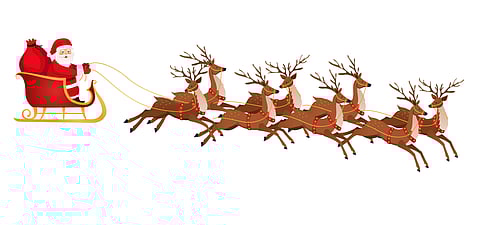
The Santa familiar to us today truly took shape in the 19th century. Writers and artists played a major role in reshaping his image. A famous poem, A Visit from St Nicholas — often called ’Twas the Night Before Christmas — described Santa as cheerful, round and lively. It imagined him travelling in a sleigh pulled by reindeer and entering homes through chimneys. This poem introduced many details that became central to the legend, including the idea of Santa visiting homes on Christmas Eve.
Illustrators added colour and warmth to the story. Santa became jolly rather than serious, friendly rather than distant. Over time, he was shown wearing a red coat trimmed with white fur, suited to cold winter nights. While advertising helped spread this image widely, Santa’s look evolved gradually through books, magazines and artwork, shaped by many storytellers rather than a single source.
Another key part of the Santa story is the North Pole. As people imagined where Santa might live, the far north felt perfect — snowy, mysterious and untouched. The North Pole became Santa’s home, along with his workshop, where elves help make toys throughout the year. The elves represent teamwork and cooperation, reminding children that big tasks are never done alone.
Reindeer soon became part of the legend as well. In real life, reindeer are strong animals that have long helped people travel through snow-covered regions. In stories, they pulled Santa’s sleigh across the sky. Later, Rudolph, the reindeer with the glowing red nose, joined the group. His story carried a message many students relate to — that being different is not a weakness, but sometimes a strength.
As Santa’s story spread around the world, it adapted to local cultures. In some countries, Santa delivers gifts on Christmas Eve. In others, children wait until Christmas morning. In some places, he is known by different names and wears different clothes. Yet the idea behind Santa remains the same everywhere: giving without expecting anything in return.
Today, Santa Claus lives both as a character and as a symbol. In schools, students dress up as Santa during celebrations, skits and charity drives. Teachers organise gift exchanges and encourage kindness. These moments reflect what Santa truly represents — generosity, joy and thinking of others. Even when students know that Santa is part of a tradition, the values behind him continue to feel meaningful.
Some people ask whether Santa is real. The answer depends on what “real” means. The man who inspired the story existed. The kindness he showed existed. And the spirit of giving that Santa represents still exists — every time someone helps quietly, shares joy, or makes another person smile.