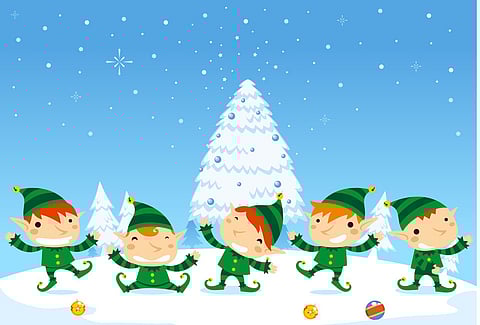

Every December, they quietly appear everywhere. In storybooks, films, classroom decorations and Christmas cards, elves are shown hammering toys, checking lists and peeking out mischievously from Santa’s workshop. They are small, clever, cheerful and endlessly busy. Yet few people stop to wonder where Christmas elves actually came from. They feel as old as Santa himself, but their story is far more layered — and far more surprising.
Long before elves were linked to Christmas, they already existed in European folklore. In ancient Northern and Germanic traditions, elves were not toy-makers at all. They were mysterious beings believed to live in forests, hills and hidden places. Some were thought to protect nature and homes, while others were considered unpredictable and even dangerous. These early elves were powerful, magical and often invisible to humans. They were respected, and sometimes feared.

In Scandinavian folklore, elves were closely connected to daily life. Farmers believed that small household spirits watched over barns, animals and crops. These beings were not called Christmas elves yet, but they shared familiar traits — they were small, hardworking and expected to be treated with respect. Families often left food out for them, especially during winter, believing that neglecting them could bring bad luck. This idea of unseen helpers quietly working in the background would later become central to the Christmas elf story.
As Christianity spread across Europe, old folk beliefs did not disappear overnight. Instead, many were softened and reshaped. Magical beings like elves slowly lost their frightening qualities and became more playful figures in stories and traditions. At the same time, the figure of Saint Nicholas was growing in popularity as a symbol of generosity and care for children. Over centuries, these separate traditions began to blend.
The link between elves and Christmas did not become clear until much later — mainly in the 19th century. This was a time when Christmas itself was changing. It was becoming more child-focused, more family-centred and more imaginative. Writers, poets and illustrators began filling Christmas stories with magical elements that appealed to young readers. Elves, already familiar in folklore, fit perfectly into this growing world of festive fantasy.
One of the biggest shifts came when Santa Claus was imagined not as a lone gift-giver, but as someone who needed help. Making toys for millions of children seemed impossible for one person. Elves provided the answer. They were clever, fast, tireless and joyful workers. Unlike humans, they didn’t complain, and unlike magical creatures of old, they were friendly and trustworthy.
American writers and illustrators played a major role in shaping modern Christmas elves. In the late 1800s and early 1900s, magazines and children’s books began showing elves as small people with pointed hats, rosy cheeks and nimble fingers. They worked in workshops, built toys and followed Santa’s instructions. Their earlier wild and mysterious nature was completely transformed. Elves became symbols of teamwork and cheerful effort.
The industrial age also influenced this image. As factories and assembly lines became common, the idea of a toy workshop filled with busy workers made sense. Elves were imagined almost like skilled craftspeople, each with a role — building, painting, wrapping or checking lists. This mirrored how society itself was changing, but in a gentler, magical form suitable for children.
Films and advertising in the 20th century further fixed the image of Christmas elves in popular culture. They were shown wearing green or red outfits, living in snowy villages near the North Pole, laughing as they worked. Stories introduced playful ideas — elves with specific jobs, training programmes, even schools for young elves. While these details were invented, they helped make the elf world feel organised and believable.
Despite their cheerful image today, Christmas elves still carry traces of their ancient origins. They remain hidden from everyday life, working while humans sleep. They value generosity and fairness. They reward kindness and dislike greed. These qualities echo old folk beliefs about unseen beings who watched human behaviour closely.
Interestingly, different cultures imagine elves differently. In some European countries, similar figures still appear as household spirits rather than toy-makers. In others, elves are closer to fairies or gnomes. But in modern Christmas traditions, the elf has taken on a nearly universal role: Santa’s helper.
In schools today, elves often appear in plays, decorations and classroom traditions. They represent cooperation and creativity. When students dress up as elves or act out scenes from Santa’s workshop, they are unknowingly participating in a story shaped by centuries of folklore, belief and imagination.
The origin of Christmas elves shows how stories evolve. They are not invented in one moment, but built slowly, borrowing pieces from the past and reshaping them for new generations. Elves began as mysterious spirits of nature and home. Over time, they became friendly helpers of Christmas, carrying messages of teamwork, effort and quiet kindness.
So the next time you see an elf perched on a shelf or painted on a classroom wall, remember this: behind that smiling face lies a story that travelled through forests, farms, folklore and finally into the heart of Christmas itself.