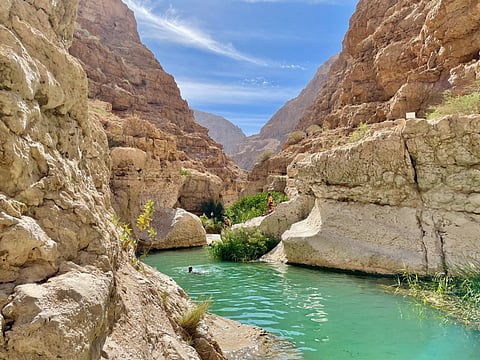

In Oman’s arid landscape, midday temperatures often soar above 40°C. Yet inside certain desert canyons, such as Wadi Shab and Wadi Bani Khalid, the air feels noticeably cooler even at noon. While the surrounding desert bakes under direct sunlight, these narrow gorges maintain a surprisingly comfortable climate. This cooling effect is entirely natural and depends on geography, rock structure, and hidden water flow.
The most important factor is shade. Desert canyons are carved deep into rock, with steep walls that block sunlight for most of the day. Even when the sun is overhead, its rays strike only the upper edges of the canyon, leaving the lower sections in shadow. Without direct sunlight, the ground and air inside the canyon heat up far more slowly.
Rock plays a second role. Canyon walls are made of dense limestone and sedimentary rock that absorb heat slowly and release it gradually. During the night, these rocks cool down significantly. When daytime arrives, they act as thermal buffers, preventing rapid temperature rise inside the canyon.
Water completes the cooling system. Many Omani wadis contain underground springs, pools, or slow-moving streams fed by mountain aquifers. Water holds heat efficiently and cools the surrounding air through evaporation. As warm air moves through the canyon, it passes over water surfaces and loses heat, creating a natural air-conditioning effect.
Air circulation also matters. Cooler, heavier air settles in the lower canyon, while warmer air rises and escapes upward. This constant movement keeps temperatures stable even during peak heat.
Together, shade, rock insulation, groundwater, and airflow allow desert canyons in Oman to remain cool while the desert above swelters.