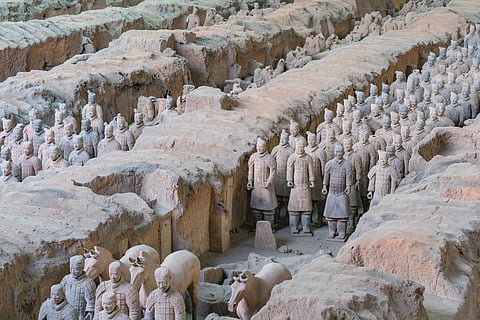

Outside the ancient city of Xi’an in China stands one of the world’s most astonishing archaeological discoveries: an army made entirely of clay, buried underground and facing east. Known today as the Terracotta Army, these life-sized soldiers were created over 2,200 years ago to guard the tomb of Qin Shi Huang, China’s first emperor. What makes this army even more mysterious is that the emperor’s main burial chamber it protects has never been opened.
The Terracotta Army is not symbolic or decorative. It is a full military force, complete with infantry, archers, cavalry, horses, chariots, and commanding officers. Each figure has a unique face, hairstyle, armour style, and rank. Archaeologists believe the soldiers were modelled on real troops from the emperor’s army, making this one of the earliest examples of mass portrait sculpture in history.
The army was buried in long underground pits, carefully arranged in battle formation. All the soldiers face east—the direction from which Qin Shi Huang believed enemies might come. This positioning suggests that the army’s purpose was defensive, meant to guard the emperor in the afterlife just as his real army had protected him in life.
The tomb they protect lies beneath a large earthen mound nearby. Ancient historical texts describe the burial chamber as an underground palace, complete with bronze structures, mechanical traps, and rivers of mercury representing China’s waterways. Modern scientific studies have detected unusually high mercury levels in the soil around the mound, supporting these ancient accounts.
Because of the risk of damage and mercury exposure, archaeologists have chosen not to open the central tomb. As a result, the clay army continues to stand guard—protecting secrets that remain buried more than two millennia later.