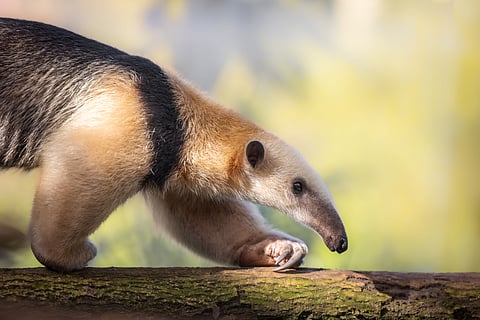

At first glance, an anteater looks like a creature imagined by someone mixing parts from different animals. It has a long, narrow snout, a tongue that seems far too long to be real, shaggy fur, powerful claws, and a tail that looks like a feather duster. Anteaters don’t roar, hunt, or chase. Instead, they move quietly through forests and grasslands, eating thousands of tiny insects a day.
Anteaters live mainly in Central and South America, in habitats ranging from rainforests to open savannahs. Despite their strange appearance, they are perfectly designed for their lifestyle. Their entire body is built around one task: eating ants and termites. These insects may be small, but they live in massive colonies, making them a reliable food source for animals that know how to reach them.

The anteater’s most famous feature is its tongue. It can stretch longer than the animal’s head and is covered in sticky saliva. When an anteater finds an anthill or termite mound, it uses its strong claws to tear it open slightly. Then the tongue flicks in and out rapidly, trapping insects and pulling them into the mouth. An anteater can flick its tongue more than 150 times per minute, swallowing thousands of insects in a short feeding session.
Surprisingly, anteaters have no teeth. They don’t need them. Ants and termites are swallowed whole and crushed in the stomach, where strong muscles and swallowed grit grind the food down. This system works efficiently and saves the energy that chewing would require. It’s another example of how anteaters have evolved to specialise rather than compete with other animals.
There are several types of anteaters, each adapted to a slightly different life. The giant anteater is the largest, growing as long as a person and weighing up to 40 kilograms. It spends most of its time on the ground, walking slowly but confidently. The silky anteater, on the other hand, is tiny and lives in trees, often hidden among leaves. Between them are tamanduas, medium-sized anteaters that split their time between land and trees.
Despite their calm appearance, anteaters are not helpless. Their claws, used mainly for digging, are also powerful defensive weapons. When threatened, an anteater can rear up on its hind legs and use its tail for balance, slashing with its front claws.
Even large predators are cautious around a cornered anteater. However, anteaters prefer to avoid conflict and rely on camouflage, silence and solitude to stay safe.
Anteaters also have an excellent sense of smell. Their eyesight is weak, but smell guides them to food and helps them detect danger. This makes sense in dense forests where vision is often blocked. By following scent trails, anteaters can locate insect nests hidden underground or inside trees.
One of the most important roles anteaters play is controlling insect populations. Ants and termites are vital parts of ecosystems, but if their numbers grow too large, they can damage vegetation and soil structures. Anteaters keep this balance in check. By opening termite mounds and anthills, they also allow other animals to access insects and nutrients, making anteaters quiet engineers of their environment.
Anteaters are mostly solitary animals. They don’t form packs or families, except when mothers raise their young. Baby anteaters ride on their mother’s back for months, blending into her fur so perfectly that they are almost invisible. This close bond helps the young learn where to find food and how to survive.
Unlike many animals, anteaters don’t follow strict daily schedules. Some are active during the day, others at night, depending on temperature and human disturbance. In hotter regions, they often become nocturnal to avoid heat. This flexibility helps them survive in changing environments.
However, anteaters face growing challenges. Habitat loss, road accidents and wildfires threaten their populations. Because they move slowly and have specific habitat needs, they are especially vulnerable to human activity. Conservation efforts now focus on protecting grasslands and forests, creating wildlife corridors, and reducing threats from roads and fires.