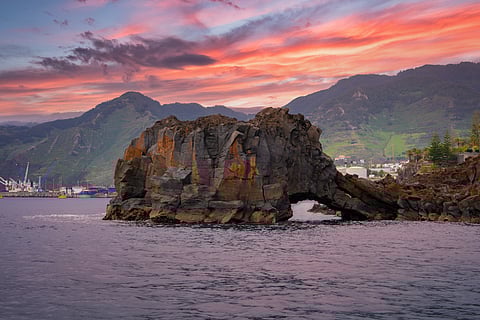

Along parts of Portugal’s Atlantic coastline, especially on Madeira Island, cliffs rise in neat vertical columns that look uncannily like the pipes of a giant organ. These striking formations are not carved by hand or shaped by erosion alone. They are the result of how molten lava cools and contracts after volcanic eruptions.
When thick lava flows spread out and begin to cool, the surface hardens first while the inside remains hot. As the lava loses heat, it shrinks. This shrinkage creates stress within the solidifying rock. To release that stress, the lava cracks. Rather than breaking randomly, it fractures in a regular pattern that distributes tension evenly.
The most efficient way for the rock to crack is into polygonal columns, most commonly hexagons. These shapes allow the cooling lava to contract evenly in all directions. The cracks start at the cooling surface and gradually extend downward, creating long vertical columns as the cooling front moves deeper into the lava flow.
The columns form perpendicular to the cooling surface. In flat lava fields, this produces upright pillars. Along cliffs and coastlines, later erosion exposes these columns in dramatic cross-sections, making them appear like towering stone pipes stacked side by side.
Basalt is particularly suited to this process. It cools slowly enough for organised cracking to occur, yet solidifies strongly enough to preserve the column shapes for millions of years. Wave action and weathering remove surrounding rock, highlighting the columns while leaving them intact.
Although similar formations exist in other parts of the world, Portugal’s coastal setting makes the effect especially visible. What looks like careful architectural design is actually frozen movement—lava locking its final motion into stone.