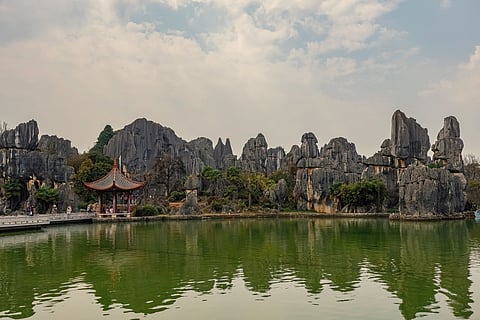

In southern China, the land rises not as hills or cliffs but as thousands of stone pillars, packed so tightly together that they look like a forest frozen in time. From a distance, the formations resemble trees without leaves. Up close, they feel like walls, corridors and towers carved by an invisible hand. This is the Shilin Stone Forest, one of the world’s most unusual landscapes, where rock behaves like wood and geology tells a story millions of years in the making.
The Stone Forest lies in Yunnan, a region known for its mountains, rivers and ethnic diversity. What makes Shilin extraordinary is not its height but its density. Limestone pillars rise sharply from the ground, some taller than buildings, others shaped like blades, animals or human figures. Walking through them feels less like hiking and more like entering a maze built by nature itself.
This strange landscape began forming around 270 million years ago, when the area lay beneath a shallow sea. Over time, thick layers of limestone settled on the sea floor. When the sea receded and the land rose, rainwater took over the work of sculpting. Slightly acidic rain seeped into cracks in the rock, dissolving it slowly, patiently. What remained were the hardest sections of limestone, standing upright as everything softer around them wore away. The process took millions of years, but the result feels almost deliberate.

Plants and moss grow in tiny fissures, proving life can survive even on bare rock.
As the pillars grew taller and closer together, they formed narrow pathways and sudden clearings. Light filters in unevenly, creating sharp contrasts between shadow and brightness. From certain angles, the rocks appear to lean towards one another, as if frozen mid-conversation. From others, they stand isolated and severe. The forest changes character as you move, which is why visitors often feel disoriented yet fascinated.
For the people who have lived near Shilin for centuries, the Stone Forest has never been just a geological wonder. It holds deep cultural meaning, especially for the Yi people, one of Yunnan’s largest ethnic communities. Local legends speak of the rocks as once-living beings, turned to stone by fate or sorrow. One famous story tells of a young woman who was transformed into stone while waiting for her lover, her figure still said to stand among the pillars. These stories give the landscape an emotional layer that science alone cannot explain.
Even today, names given to individual rock formations reflect imagination rather than measurements. Some are called “Sword Peak Pond” or “Ashima Stone,” based on what they resemble. This habit of seeing faces and figures in stone is not accidental. Human brains are wired to find patterns, and the Stone Forest offers endless opportunities for interpretation. Every turn reveals something new, depending on where you stand and how the light falls.
Despite its ancient origins, the Stone Forest is not a dead place. Plants grow in cracks between the rocks. Moss clings to shaded surfaces. Birds nest in high crevices. During the rainy season, water flows briefly through channels at the base, reminding visitors that erosion is still at work. The forest may look frozen, but it is quietly changing, one drop at a time.
The Stone Forest is also part of a much larger system of karst landscapes across southern China, formed by the same interaction of limestone, water and time. What makes Shilin special is how exposed and dramatic the formations are. There is very little soil covering them, so the rock dominates the scene completely. This gives the forest its stark, almost otherworldly appearance.
Walking through Shilin is not about speed. Paths twist and narrow, forcing visitors to slow down. You have to look up, then sideways, then back again. The sense of scale constantly shifts. A pillar that seems small from one angle suddenly towers overhead from another. This shifting perspective is part of the experience. The forest does not reveal itself all at once. It unfolds gradually.
Over the years, Shilin has attracted scientists, artists and travellers alike. Geologists study it to understand erosion and climate history. Photographers return repeatedly, knowing the forest looks different at dawn, noon and dusk. For many visitors, the appeal lies in how unfamiliar the landscape feels. It challenges the idea of what a forest should be, replacing leaves with stone and trunks with rock.
Today, the Stone Forest is protected as a natural heritage site, with pathways designed to reduce damage to the fragile formations. Preservation matters here, because while the rocks took millions of years to form, they can be damaged far more quickly by careless activity. The forest survives because it is respected, both as a scientific record and as a cultural space.