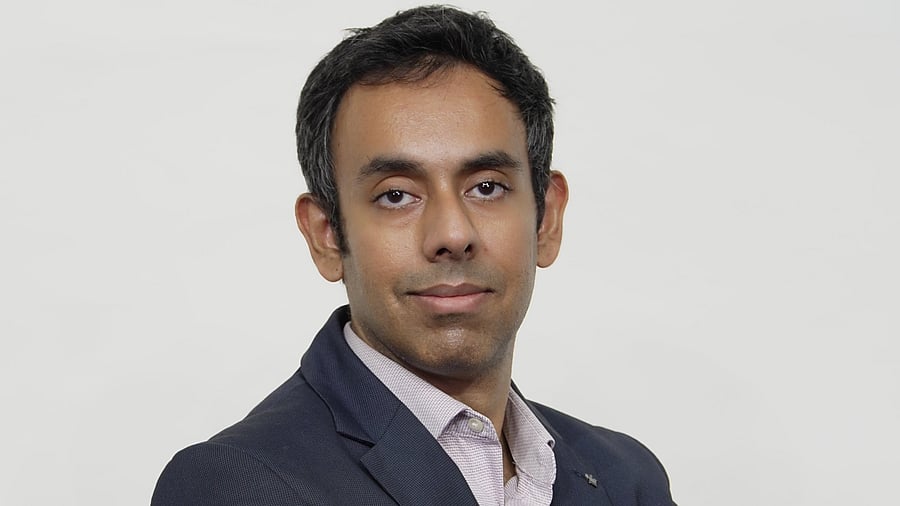
Varun Sharma
Bengaluru: India is at the cusp of a digital disruption, with its digital economy expected to grow 3x nominal GDP over the next decade. Companies leading this digital wave are compounding at 22%, rapidly gaining market share from offline incumbents and outpacing traditional IT services businesses which lag at 4-5% growth. Varun Sharma, Fund Manager, Digital India Fund, Motilal Oswal AMC explains to Mahesh Kulkarni of DH that the runway ahead is massive, with a once-in-a-decade opportunity to invest in companies poised to scale to global levels over the next two decades, with rapid digital ecosystem growth. Edited excerpts:
What will be the key drivers behind India’s digital economy growing at 3x nominal GDP over the next decade?
India’s digital economy is expected to grow about three times faster than the overall GDP, because three big forces are working together. First, the country’s public digital infrastructure — like Aadhaar, UPI, DigiLocker, FASTag, and ONDC — has made it incredibly easy and cheap for people and businesses to come online and transact. These open systems are a global first and give India a huge head start. Second, affordable smartphones and cheap data have created a massive, mobile-first consumer base that’s using digital tools every day, especially in smaller towns. It’s similar to how China’s internet boom took off, but in India, it’s happening through open-access platforms instead of closed ecosystems. Third, millions of small and mid-sized businesses are now going digital with SaaS tools, APIs, and AI — just like US firms did during their cloud revolution. Together, these three trends — digital rails, connected consumers, and business tech adoption — are powering a flywheel that could make India’s digital economy expand much faster than its overall GDP growth.
How is digital fundamentally different from IT, and in what ways is a digital layer disrupting traditional IT services?
In simple terms, India’s IT industry is like a group of factories that provide similar services — mostly providing technology services to other businesses around the world. These companies earn by billing hours or projects, so their growth depends on how much work they take on. The digital economy, on the other hand, is a broad and fast-changing ecosystem that cuts across every sector — finance, healthcare, retail, travel, education, and even manufacturing. It’s made up of apps, platforms, and digital products that keep evolving, learning from user data, and earning through subscriptions, ads, or transactions. While IT is about “doing work for clients in one narrow set of services”, digital is about “building diversified experiences for users across several industries”. In the US, the shift from traditional IT to digital gave rise to cloud and SaaS giants like Amazon Web Services and Salesforce; in China, it led to platform ecosystems like Alibaba and WeChat. India is now following that path — traditional IT firms are being disrupted by digital-first businesses that use AI, APIs, and cloud platforms to deliver smarter, more personalised services across multiple industries.
Which sectors are leading India’s digital transformation today, and from where will the next wave of disruption come in the next 3-5 years?
Right now, India’s digital story is being led by the areas where technology has made everyday life simpler and cheaper — especially payments, shopping, and logistics. Thanks to UPI, paying anyone from a street vendor to a large business takes just seconds, making digital money a daily habit. Online shopping and local delivery services — powered by networks like ONDC — have brought millions of small sellers into the digital fold. Logistics and mapping tech (like MapMyIndia, Delhivery, etc.) have connected even remote towns to the e-commerce economy. The next big wave of change will go deeper into sectors that touch daily life and government systems — like healthcare (digital health records, e-pharmacies, teleconsultations), education, and public services moving online through GovTech. Manufacturing and industrial businesses will also digitise rapidly under the “China+1” strategy, using automation and IoT to compete globally.
What catalysts will enable deeper digital adoption and penetration in Tier-2 and 3 Indian cities?
Digital adoption in smaller Indian towns will grow much faster over the next few years because the key ingredients are finally falling into place. The first is ease of payments: UPI, UPI Lite, and upcoming credit-on-UPI features are making it simple for everyone — from shopkeepers to cab drivers — to go cashless without needing fancy devices. The second is several vertical-specific B2B and B2C platforms. The third big change is language and interface: apps are becoming voice-enabled and available in regional languages, making technology feel more natural to millions of new users. On the business side, local kirana stores and agents are turning into “digital touchpoints”, helping people pay bills, get small loans, or access government services. Affordable smartphones, faster 5G and BharatNet internet, and simplified KYC rules are further breaking barriers.
How should investors view valuation cycles in digital-forward companies?
In the long term, fundamental growth reflects in stock returns. The digital space is usually characterised by competitive monopolies that sustain for longer periods and generate several use cases for their users over time. This enables accelerated scale-up and hypergrowth in initial phases. Profitability usually expands once leadership position is established and over the long term, for leading players, business and profitability tends to be healthy and scaled up. One needs to take a longer-term view on digital businesses and ignore shorter-term movements in businesses and markets. There is an acute challenge of properly valuing digital businesses and both academics and practitioners are facing it.
What are some implications of current regulations – laws, frameworks, and classifications – in India’s digital landscape?
Regulation is pivotal: data protection and consented data-sharing, platform interoperability (UPI/ONDC/UHI), fintech licensing, marketplace vs inventory models, and clarity on digital classifications (intermediary, marketplace, lender, gig). To de-risk and bring investor clarity, align disclosures to unit-economics cohorts, standardise KPIs (take-rate, NRR, CAC payback), adopt regulatory sandboxes, and map businesses explicitly to public-rail policies — turning India’s “digital public infrastructure” from perceived policy risk into a measurable moat, as the US did with cloud/SOX disclosure, and China by codifying payments/logistics standards.