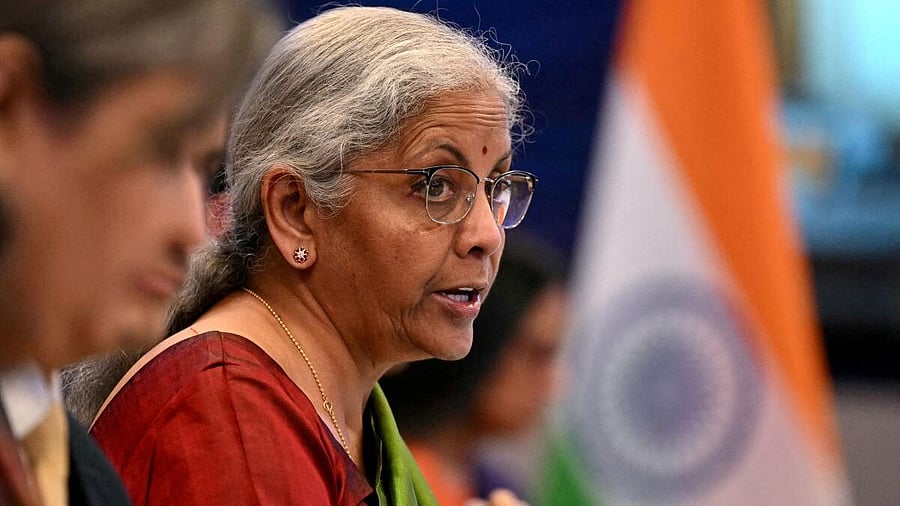
Union Finance Minister Nirmala Sitharaman.
Credit: Reuters
New Delhi: Finance Minister Nirmala Sitharaman is set to present the Union Budget 2026-27 in Parliament on Sunday amid heightened geopolitical uncertainty and sustained outflow of capital.
Though this has dragged the rupee to a record low, the headline macroeconomic numbers look rosy with GDP growth projected at over 7%, inflation under control and the fiscal deficit seeing a steady decline.
This will be Sitharaman’s ninth Budget, a record for the most consecutive Budgets presented by a Union finance minister. This year’s Budget will also bring Sitharaman within striking distance of former prime minister Morarji Desai’s record of 10 Budget presentations. Desai served as finance minister under various prime ministers, including Jawaharlal Nehru and Indira Gandhi.
Also, this is the first time the Union Budget will be presented on a Sunday. In 1999, when the conventional scheduled date of February 28 fell on a Sunday, then Finance Minister Yashwant Sinha presented the Budget a day earlier on February 27 (Saturday).
Until 2017, the Budget used to be presented on the last day of February. However, in 2017 the date was advanced to February 1. While in 1999, the then Atal Bihari Vajpayee government chose to advance the Budget date due to a Sunday, Prime Minister Narendra Modi’s government has decided to stick to the ‘first day of February’ schedule.
This year’s Budget comes against the backdrop of intensifying global trade tensions, record drop in the value of rupee, surge in gold and silver prices, stock market volatility amid sustained outflow of foreign funds and weak private investments.
The rupee has depreciated by around 7% in the past one year. It slipped below 92 against the US dollar on Thursday. Stock markets have been under pressure in recent weeks.
According to analysts, foreign capital outflow has been the key reason for the rupee depreciation and volatility in the stock market. Foreign portfolio investors pulled Rs 38,740 crore out of the Indian markets in January.
“When capital flows become weaker, the currency becomes weaker as well,” Chief Economic Adviser V Anantha Nageswaran told DH in an interview.
“To tackle these issues, we need to do whatever we can to improve capital inflows into the economy,” he said.
V K Vijayakumar, Chief Investment Strategist, Geojit Investments Ltd, said, “FIIs will be looking for indications from the Budget before deciding on their strategy, going forward.”
The Economic Survey 2025-26, tabled in Parliament on Thursday, presented a rosy picture of the economy with GDP growth of 7.4% in the current financial year and in the range of 6.8% to 7.2% in 2026-27.
With inflation projected at 3.5% for FY27, the nominal GDP growth can touch 10%. “This augurs well for corporate earnings in FY 27. If the 2026 Budget turns out to be fiscally prudent and growth-oriented, the market will turn resilient. The sharp correction in gold and silver, if it persists, can draw investors away from precious metals to equity,” said Vijayakumar.
The real GDP growth looks robust mainly because of the sharp decline in inflation. Nominal GDP growth in the current fiscal year is likely to be lower than expected, which will hurt revenue collection.
“The nominal GDP growth relevant for Budget math is expected at 10.5%-11% with the uptrend in global commodity prices percolating in a higher WPI. A bit slower nominal growth may hurt tax revenues in FY27, requiring better expenditure planning,” SBI Research said in a note.
According to SBI Research, the fiscal deficit is expected to be at 4.2% of GDP for FY27. The cost of borrowing from the government is expected at 6.8-7.0% during the fiscal year beginning April 1, 2026.
Notable numbers
- With inflation projected at 3.5% for FY27, nominal GDP growth can touch 10%.
- Nominal GDP growth in current fiscal is likely to be lower than expected, which will hurt revenue collection.
- Real GDP growth looks robust mainly because of the sharp decline in inflation.
- Fiscal deficit is expected to be at 4.2% of GDP for FY27.